
You close your laptop after months of writing and stare at a nearly finished manuscript. The idea still feels strong, the pages are polished, and the concept looks attractive, but you can’t name the exact readers searching for it or willing to pay for it. You have effort, not a reliable signal of demand. The question behind what is book-market fit starts here: who needs the book, understands its promise, and will buy it? Kobo Writing Life observes that many authors write first and work out their audience later, a sequence that can contribute to poor sales. That result doesn’t mean your writing lacks talent.
Most authors don’t have a writing problem. They have a book-market fit problem. A useful answer must account for reader demand, positioning, validation, and commercial viability. Whether you write nonfiction, self-published fiction, your first book, or your tenth, you need a decision process before committing to the full manuscript, cover, or ad campaign. That process shows whether your idea has readers, a clear place in the market, and a publishing path that can support your author business.
Why Book-Market Fit Matters Before You Write, Publish, or Advertise
You can spend months writing, revising, and polishing a book before learning that the intended reader isn’t actively seeking it. By then, your costs may include developmental editing, cover design, formatting, printing, audiobook production, launch preparation, and advertising. The manuscript may be finished, but your investment has already become difficult to recover.
Attention isn’t the same as purchase intent. A post can attract likes, a cover can earn compliments, and an ad can generate clicks without producing sales. Book-market fit gives you an earlier decision point, not a promise of success. It helps you test whether a defined group wants the book, understands its value, and can be reached through a viable publishing path.

How weak reader demand turns a finished manuscript into a costly asset
Weak demand turns a finished manuscript into a costly asset because every late discovery compounds the original writing expense. Kobo Writing Life states that market fit depends on identifying readers who actively want a book and are willing to buy it.
“A book’s market fit depends on identifying readers who actively want and are willing to buy it,” according to Kobo Writing Life.
Interest can create visibility, but willingness to buy supports a book business. Bradley Johnson Productions evaluates demand alongside positioning, discoverability, and the economics of producing and selling the book.
Why product-market fit is not enough for a sustainable book business
Product-market fit is not enough because your book also needs clear positioning, discoverability, sound economics, and a sustainable publishing path. Even strong demand can fail when the promise is vague, the audience cannot find the book, the price leaves no margin, or the format costs too much to produce.
Fit is a starting condition rather than a guaranteed outcome. The wider question is whether one book can support a profitable author ecosystem, including future books and a clear relationship with readers. This guide to what is a sustainable author business covers the longer-term conditions your book must support.
What the 40% rule for product-market fit means as a reader-demand signal
The 40% rule asks whether at least 40% of a clearly defined group would be very disappointed if a product disappeared, a benchmark associated with Sean Ellis’s product-market-fit research. For your book, treat that result as a directional demand signal, not a universal pass-or-fail rule or a sales guarantee.
Practical rule: Before you fund the full manuscript, ask a clearly defined reader group whether losing this book would matter enough to disappoint them, then test whether that response includes willingness to buy.
Attention proves that people noticed something. It does not prove book-market fit. Base your next decision on evidence of reader need and purchase intent, not compliments, clicks, or social engagement alone.
The Four Layers That Make Up Book-Market Fit
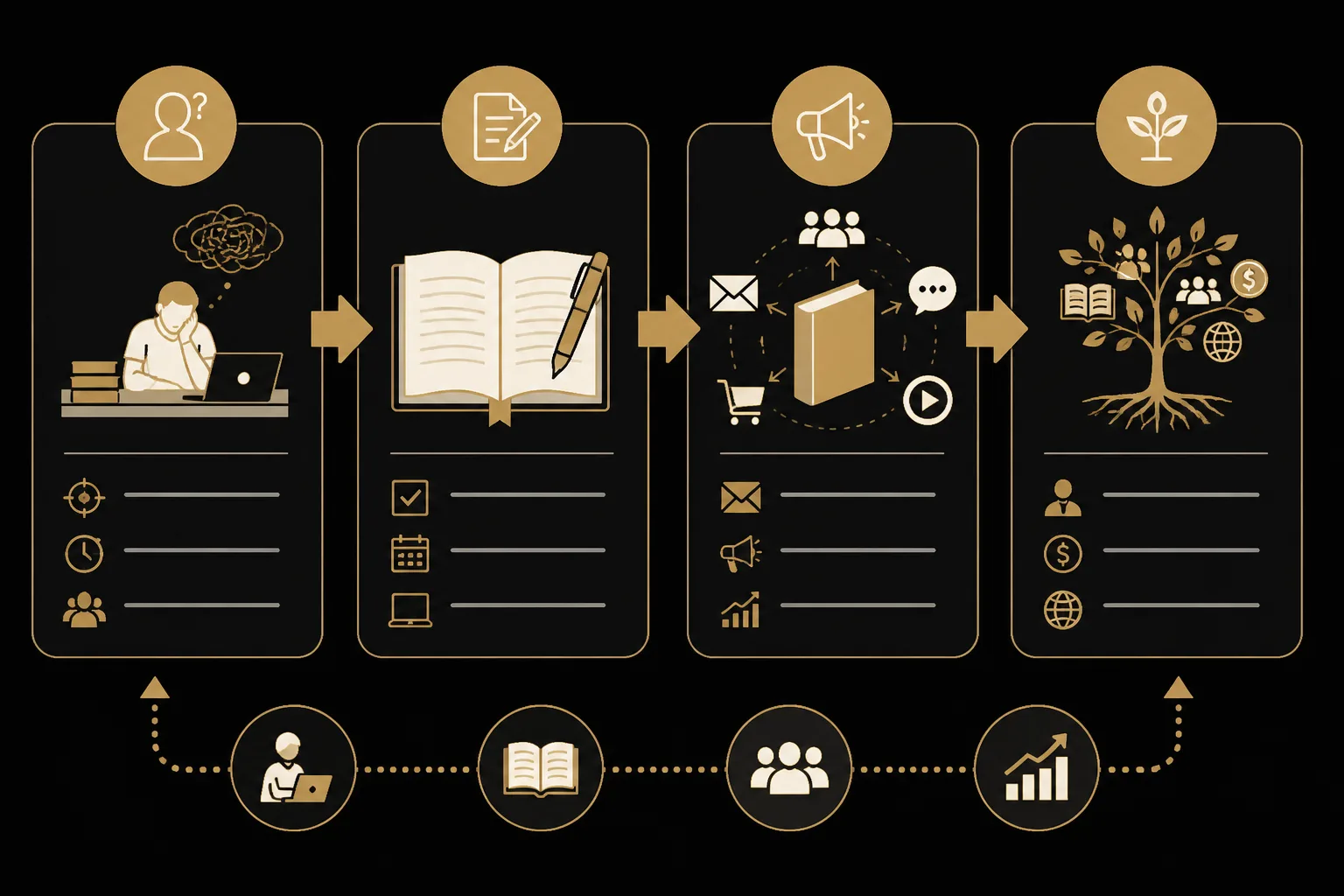
You have book-market fit when a defined reader need, a clear book promise, reachable demand, and a viable publishing path support one another. A strong manuscript alone is not enough.
Bradley Johnson Productions uses this author-focused view because positive feedback isn’t enough. You need evidence that your book can reach readers and support a sustainable author business, although no model can guarantee sales.
How to define product-market fit for a book idea
For a book, product-market fit means your concept solves a meaningful reader problem or delivers a desired experience through a discoverable, commercially workable product.
Weak: “A guide to becoming more confident.”
Stronger: “The First-Time Manager’s 30-Day Confidence Plan,” with a clearer audience, problem, promise, and buying reason.
The four levels of product-market fit from reader need to author business
Assess the model through four connected levels:
- Reader need: You name the specific problem, aspiration, or entertainment desire.
- Book promise: Your title, premise, structure, and outcome visibly answer that need.
- Reachable demand: You identify where those readers search, gather, and buy.
- Publishing viability: You confirm that format, price, costs, positioning, rights, and future books support your plan.
| priority | what to check | why |
|---|---|---|
| 1. Reader problem or desire | Can you name a narrow reader group with a specific urgent problem, aspiration, or entertainment desire? | A vague audience makes the promise and marketing message impossible to focus. |
| 2. Book concept and promise | Does the concept clearly explain the result, experience, or transformation the intended reader will receive? | A defined need does not create fit unless the book visibly addresses it. |
| 3. Reachable demand | Can you identify discoverable search terms, categories, communities, publications, or creators where these readers already gather? | Demand that cannot be reached cannot reliably support sales. |
| 4. Publishing path | Do format, price, production economics, positioning, and series or ecosystem potential support the intended business? | A book can attract readers yet remain commercially unsustainable. |
Books on product-market fit for authors
You can use books such as The Lean Startup and Obviously Awesome as adjacent references, but neither replaces an author-specific fit test. This model adapts those business ideas to reader intent, book positioning, and publishing economics.
The 60/40 marketing rule in a book launch
The 60/40 marketing rule is a planning heuristic: you might assign more effort to reaching the right audience than to polishing promotional material. Treat it as a prompt to test demand early, not as a universal formula. A guide to calculating book pricing for authors covers the publishing layer of that test.
How to Test Book-Market Fit With One Concrete Book Idea
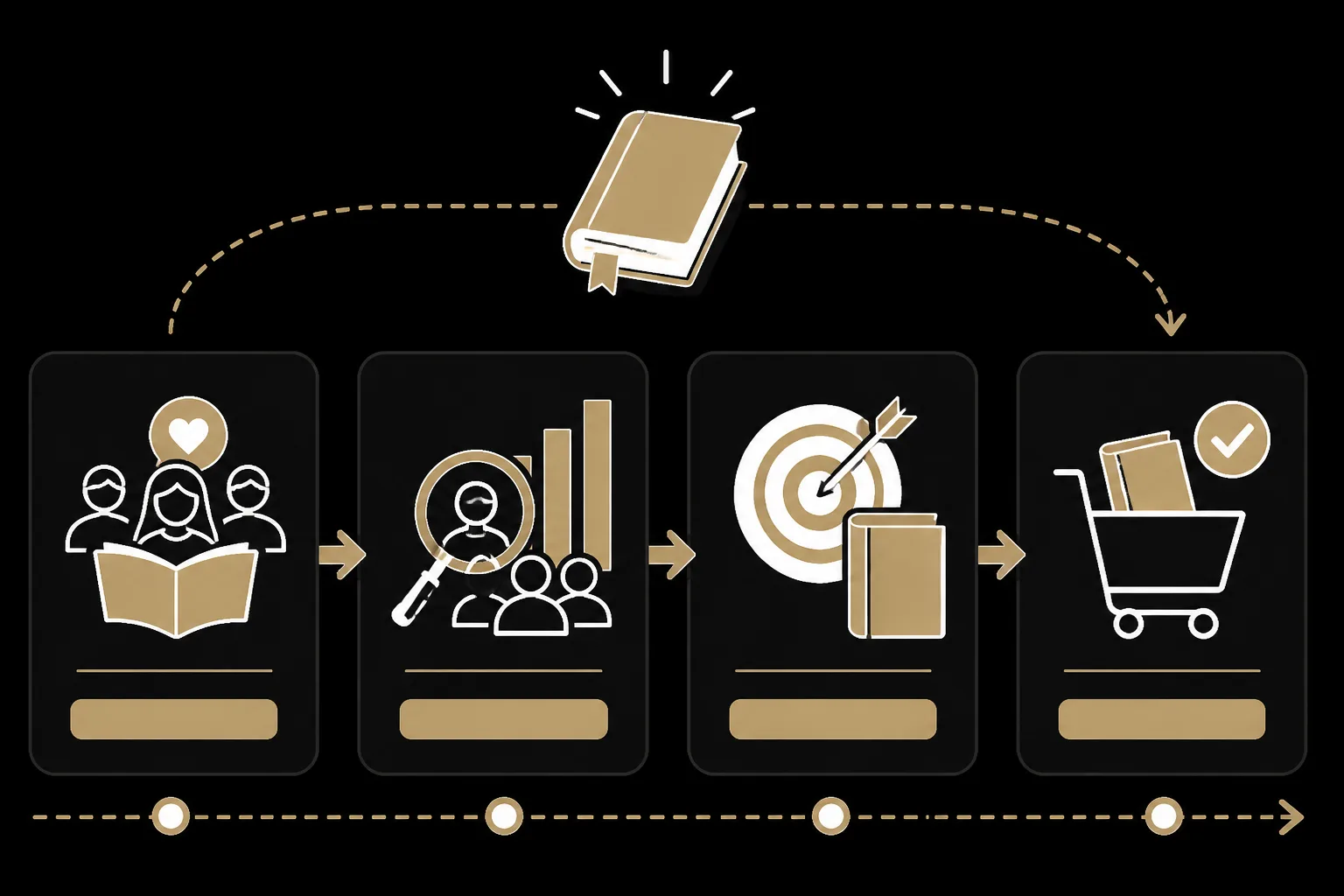
A promising concept needs more than praise. You need evidence that a defined reader has the problem, recognises your promise, and will take a meaningful step before you commission the full manuscript.
Use one idea as a controlled test. In this example, the author is considering The First-Time Manager’s 30-Day Playbook, without treating the title, audience, or format as settled.
An example of product-market fit for a book
The book has stronger fit when it helps a recently promoted U.S. professional manage a small team before an upcoming performance cycle. That reader is narrower than “every new manager,” and the problem creates a clear reason to buy now.
Kobo Writing Life recommends defining the target reader as the exact group of readers who care about the topic rather than using a broad label, as explained in its crowded-market guidance.
Next, compare competing books by audience, promised outcome, format, subtitle, category, reviews, and recurring complaints. Amazon autocomplete, category language, bestseller pages, reader discussions, newsletter communities, and search intent offer directional signals, not guaranteed forecasts.
Before: “The First-Time Manager’s 30-Day Playbook helps new managers become better leaders.”
After: “The First-Time Manager’s 30-Day Playbook gives newly promoted team leaders daily scripts for feedback, delegation, and performance conversations before the next review cycle.”
Evidence that readers want the promise
Test both positions through short interviews, a landing page, a sample chapter, and a reader-interest form. Compliments show that people like the idea. An email address, preorder, deposit, or paid pilot shows stronger buying intent.
- Reader: You can name the job situation, urgency, team size, and immediate consequence.
- Promise: You can describe one practical outcome without claiming to solve every leadership problem.
- Competition: You can state what existing books miss, such as scripts for an imminent performance cycle.
- Commitment: You receive qualified sign-ups, sample requests, preorders, deposits, or paid pilot agreements.
- Decision: You record a go, revise, or stop choice before paying for the complete manuscript.
| situation | better move | why |
|---|---|---|
| The concept is aimed at every new manager. | Define the narrowest avid reader: a recently promoted U.S. manager responsible for a small team and an imminent performance cycle. | A specific target reader makes the problem, promise, channels, and competing alternatives testable. |
| Readers say the idea sounds useful. | Ask for a measurable action such as joining a waitlist, requesting a sample, preordering, or agreeing to a paid pilot. | Compliments indicate interest; a commitment supplies stronger evidence of buying intent. |
| Several competing management books rank well. | Compare their promises, subtitles, formats, reviews, categories, and gaps before choosing a distinct position. | Demand alone does not show that your concept gives readers a reason to choose it. |
| Search and category signals look promising. | Run a small position test with two descriptions or landing-page messages and track qualified responses. | Discoverability is only useful when the message converts attention into meaningful action. |
| The test produces weak commitments. | Revise the reader, promise, or channel before paying for a full manuscript, cover package, or ad campaign. | Early revision is cheaper than scaling a book with unproven fit. |
Choosing a marketing route while fit is still being tested
Choose the route your evidence supports: search-led, community-led, partnership-led, or audience-led marketing. Don’t default to ads before knowing which message earns qualified action.
If managers find the concept through search, test search-led content and Amazon positioning. If professional groups respond, try community partnerships. If a workplace trainer requests the sample, test partnerships. If an existing author audience converts, use audience-led promotion. Let the evidence choose the route.
The Author Decisions That Create False Confidence in Market Fit
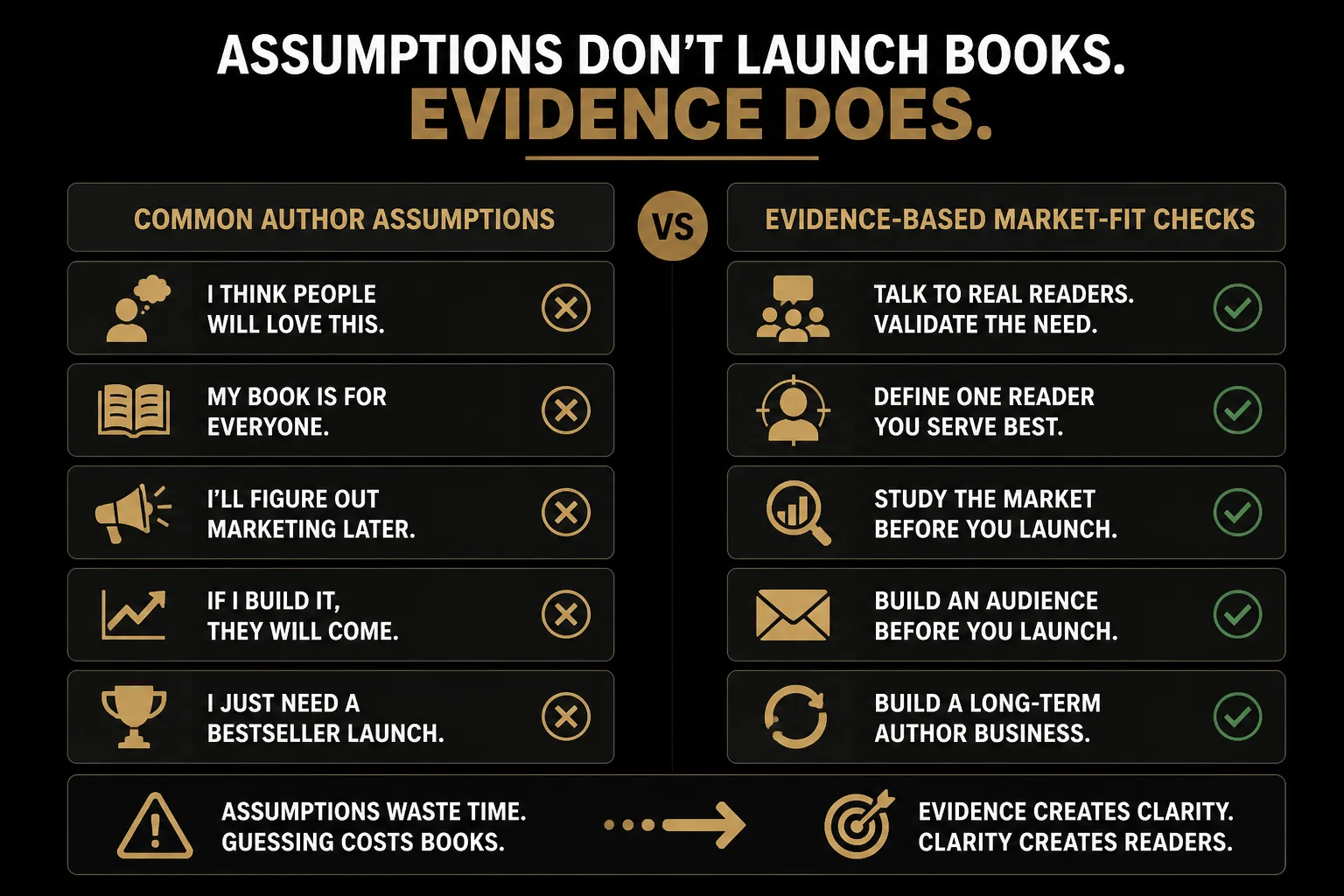
Positive signals can still mislead you. A polished manuscript, busy social feed, or strong launch may show attention without proving that the right readers will keep buying your books.
You need evidence tied to a specific reader, problem, promise, and buying action. Bradley Johnson Productions helps authors test those connections, although no advisor can replace direct feedback from your intended readers.
Mistaking a broad audience for a reachable reader segment
You create false confidence when your audience is “everyone who likes personal growth” or “all fantasy readers.” Name the reader and situation instead. Weak: “A confidence book for anyone who feels stuck.” Strong: “A 30-day confidence workbook for first-time managers preparing for difficult team conversations.” Your author audience segmentation examples companion fits this process when you need to separate broad interest from reachable reader groups.
Confusing praise, clicks, and followers with willingness to buy
You do not have purchase evidence because people like a post or praise your idea. Ask about current alternatives, request a sample, test a paid offer, collect waitlist sign-ups, or run structured interviews. High visibility without meaningful engagement is a warning sign, not proof of demand.
Building a book around a trend without a distinctive promise
You can copy a successful genre and still miss the reason its readers bought that comparison book. Match the reader promise, not just the category, cover style, or keywords. “A cozy mystery in a seaside town” is weaker than “a low-violence mystery where an amateur baker solves crimes through local food traditions.”
Knowing whether you have product-market fit without overclaiming certainty
You have stronger fit when several signals converge, not when one launch goes well. Check whether readers mention the promised outcome in reviews, buy again, continue through the series, join your direct audience, and remain reachable through the same channel. Test the concept before polishing every chapter, cover, and brand asset.
What works
- Specific reader: You define a person, situation, and urgent problem.
- Structured feedback: You compare interviews, sample requests, paid tests, and buying behavior.
- Durable evidence: You monitor repeat sales, read-through, reviews, and audience growth.
What fails
- Broad identity: You treat “everyone interested in history” as a reachable market.
- Visible attention: You mistake views, likes, comments, or followers for orders.
- Single launch: You call one successful release proof of lasting book-market fit.
FAQ
How to define product-market fit
Product-market fit means a specific group of readers wants the result your book promises and chooses it over competing options. For an author, look for repeated demand, clear reader language, strong sample-chapter responses, sales or preorders, and readers who recommend the book to others. Interest matters, but behavior gives you better evidence.
What is the most effective way to market a book
The most effective approach starts with a defined reader and a promise that matters to that reader. Reach people through the channels they already use, such as a focused newsletter, podcast interviews, library events, retailer search, or trusted communities. Test one message and one offer at a time, then keep the activities that produce sign-ups, sales, or useful conversations.
Why product-market fit is not enough
A book can satisfy readers and still struggle if its price, packaging, distribution, or marketing fails to reach them. Product-market fit shows that the book has value for a market. It doesn’t guarantee discoverability, healthy margins, reliable production, or a sustainable publishing business. Authors still need a workable plan for sales and ongoing reader relationships.
What are the four levels of product-market fit
There isn’t one universal four-level framework, but a useful author version moves from problem fit to solution fit, market fit, and business fit. First, the reader has a real problem or desire. Then your book addresses it. Next, enough readers respond to the offer. Finally, the format, price, costs, and sales path support a sustainable business.
Start With a One-Page Book-Market-Fit Brief
Before you commission a cover, finish a manuscript, or spend on ads, put the evidence for your book idea where you can judge it clearly.
Your brief doesn’t need polished language. It needs a specific reader, a useful promise, visible demand, competing alternatives, and one next test. Start there, not with production.
Name the Reader and the Problem
Describe the person and situation that make your book relevant. Avoid broad labels such as “people who enjoy history.” Use the reader’s own words for the problem or desire.
- Exact reader: Record who the reader is, what they are trying to do, and when the problem becomes urgent.
- Reader language: Write the question, frustration, or desired outcome your reader would actually say aloud.
Record Demand and Competing Alternatives
Document how your reader already searches, learns, and spends money. Include comparable books, online communities, categories, search language, reachable audiences, and observed commitments such as preorders, paid guides, or repeated questions.
- Evidence: List the demand signals you can verify rather than relying on personal enthusiasm.
- Alternatives: Name the books, courses, podcasts, free resources, or existing habits your book must replace or improve.
Test the Promise Before Full Production
State what your reader will understand, do, achieve, feel, or experience after reading. Then ask real readers structured questions and request a concrete next action, such as joining a waitlist or reviewing a sample chapter.
- Measurable promise: Replace “helps readers feel confident” with a result you can observe and discuss.
- Behavior test: Separate polite praise from a meaningful action that shows genuine interest.
Choose the Next Validation Task
Put the sequence on one page. Your book-market-fit brief should contain the reader, promise, evidence, competing alternatives, and next validation test.
- Name the reader: Define the exact person and situation that make your book relevant.
- State the problem: Use the reader’s own language for the problem or desire.
- Write the promise: Describe the measurable change your book intends to create.
- Document demand: Record search language, categories, communities, comparable books, audience access, and observed commitments.
- Test the position: Ask real readers structured questions and track their next action, not just their praise.
- Choose the path: Set a viable format, budget, price, timeline, channel, and possible series or author-ecosystem opportunity.
For help turning your brief into a workable publishing decision, Bradley Johnson Productions provides guidance on book development, audience fit, Amazon SEO, pricing, and long-term strategy for independent authors building profitable, sustainable book businesses. Find practical guidance in the author-business and publishing articles.