You finish a chapter late at night, run it through Grammarly, and see a clean result. The sentences look polished, yet you still ask, “Is Grammarly correct?” Your nonfiction may not sound authoritative, or your novel may not feel natural to paying readers. You can spot no obvious errors, but the page may still carry awkward phrasing, unclear meaning, or a voice that doesn’t sound fully intentional.
Most independent authors don’t have a Grammarly problem. They have a publishing-readiness problem. The useful answer depends on what you expect the software to judge. Grammarly can flag patterns it detects, but its score cannot decide whether your terminology builds credibility, your argument communicates accurately, or your fiction has convincing pacing, characterization, and continuity.
Automated checks can improve a manuscript, but some choices need human judgment. That boundary supports the sustainable publishing quality Bradley Johnson Productions focuses on, although it can’t replace a full professional edit or a final review by someone who understands your book, audience, and publishing goals.
A Clean Grammarly Score Does Not Equal a Ready Manuscript
When you search “Is Grammarly correct,” you’re not only checking software. You’re asking whether your manuscript sounds credible, earns reader trust, and deserves a professional review. Supplied keyword research records 74,000 monthly searches for that concern, which signals widespread uncertainty about whether automated correctness equals publishable quality.
A polished sentence can still make a weak claim, flatten a character’s voice, or contradict an earlier chapter. If you treat a clean score as approval to publish, you risk poor reviews, confused readers, and costly revisions after your book reaches the market. Grammarly can assist your process, but it can’t make the publishing decision for you.
How good Grammarly is
Yes, Grammarly can be useful for recurring surface-level issues, but it isn’t a complete editorial assessment. You may catch spelling errors, repeated words, missing punctuation, and some awkward constructions faster with the tool. You still need to judge whether each suggestion preserves your meaning, audience fit, voice, and authority.
For nonfiction, Grammarly can’t verify that your terminology is accurate or that your argument supports its conclusion. For fiction, it can’t decide whether dialogue sounds natural, a scene moves at the right pace, or a character behaves consistently. Those judgments affect how readers experience your book.
Whether professional writers use Grammarly
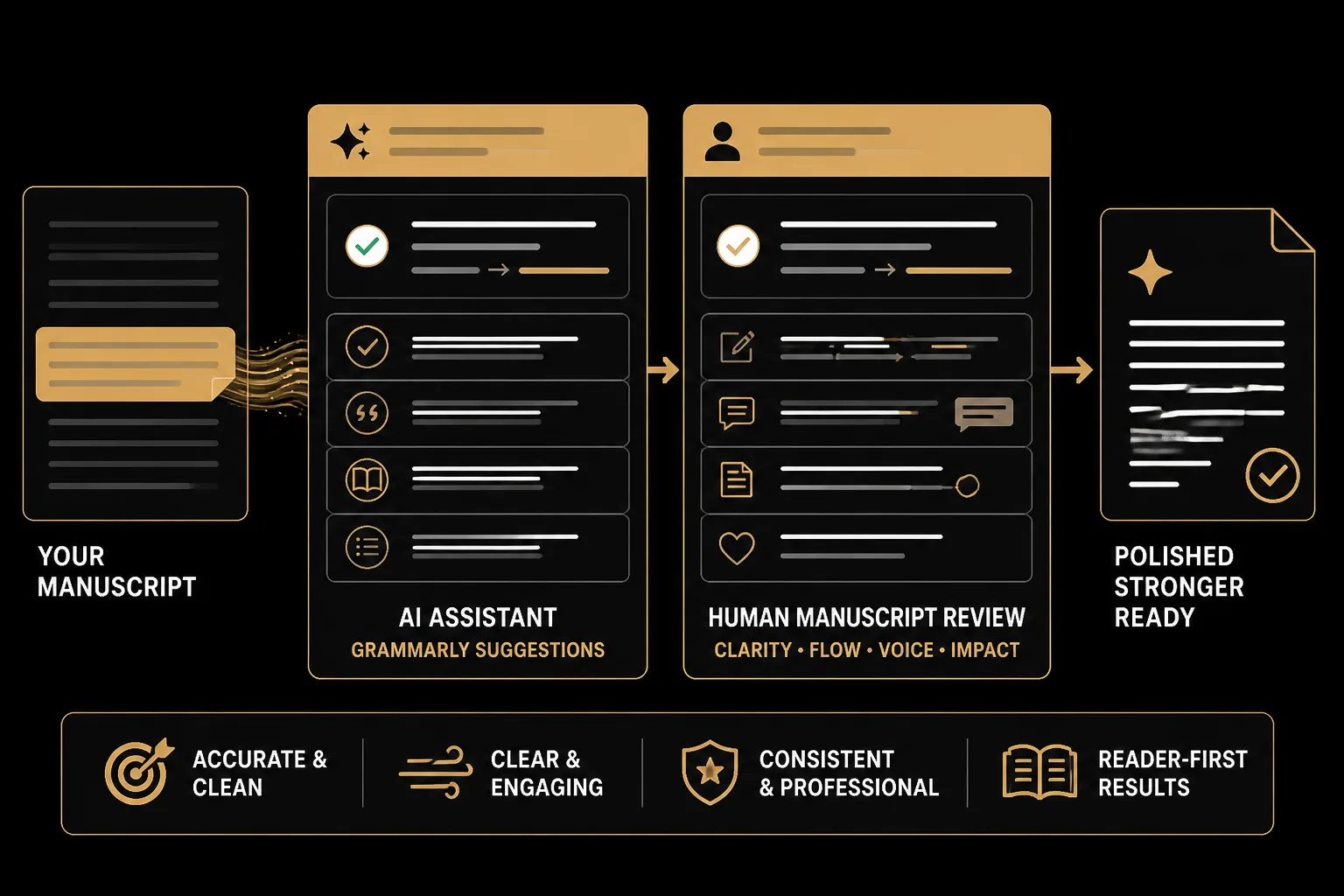
Professional writers may use Grammarly for one pass, not as their only editor. You may also need a developmental editor, copyeditor, style sheet, beta readers, or a subject-matter reviewer, depending on your manuscript and publishing goals.
A clean score is a checkpoint, not a publication decision.
The practical rule for authors publishing at scale
Your long-term book business depends on more than error-free sentences. A reader who finds unsupported claims, inconsistent names, or careless formatting may question your expertise across your entire author ecosystem. For a broader publishing strategy, see this guide to building a profitable author ecosystem. Bradley Johnson Productions helps independent authors connect manuscript quality with audience trust and sustainable publishing strategy, although its broader business guidance doesn’t replace a professional manuscript edit.
Practical rule: Use Grammarly to flag patterns, then use human judgment or professional review to assess meaning, voice, continuity, and publishing quality.
What Grammarly Can Judge and What It Cannot See
When you ask, “Is Grammarly correct,” you’re testing a pattern detector against a manuscript built from meaning, memory, and intent. You may get useful flags for grammar, punctuation, spelling, clarity, tone, and word choice, but you still decide whether each suggestion belongs in your book.
You need more than clean sentences. Your fiction requires believable voice and continuity, while your nonfiction requires accurate terminology, supportable claims, and consistent publishing conventions.
What Grammarly checks in a manuscript
Grammarly checks sentence-level patterns that often signal grammar, punctuation, spelling, unclear wording, inconsistent tone, or unnecessary repetition. You can use those suggestions to spot a missing comma or an awkward sentence, but the software doesn’t reliably understand your character’s motive, your argument’s accuracy, or your book-wide style sheet.
Its wording suggestions work from likely language patterns. Your manuscript may intentionally break those patterns, especially in dialogue, interior monologue, technical explanation, or literary prose. A review of different styles of writing and how they shape reader expectations fits this same editing workflow.
The best app for fixing grammar and punctuation
The best choice depends on your task because no app replaces a full editorial process. You may use Grammarly for fast sentence-level checks, another proofing tool for a second pass, and a human editor for voice, structure, continuity, facts, and publishing quality.
Your tool should support the manuscript, not standardize it. A clean score can’t decide whether a scene sounds natural or whether a nonfiction claim deserves verification.
Why Grammarly may not correct a mistake
Grammarly may miss a mistake when the problem depends on context, intentional style, specialized terminology, or information outside the sentence. You may also be seeing a book-wide continuity error, factual problem, or convention that automated software can’t compare across your entire manuscript.
For example, Grammarly may accept “The trial began in 1842” even when your source records show 1843. You must verify that claim yourself. It may also question a technical term that your field uses correctly, so you should check the accepted usage and your style sheet before changing it.
| situation | better move | why |
|---|---|---|
| A character uses a fragment or unusual phrasing in dialogue | Check whether the wording supports the character and scene before changing it | A grammatically conventional rewrite can flatten intentional voice |
| A nonfiction manuscript uses specialized terminology | Confirm the term against the field’s accepted usage and the book’s style sheet | Automated wording suggestions may not understand the subject or intended meaning |
| A sentence is technically clear but conflicts with a prior chapter | Review the surrounding chapter and continuity notes | Sentence-level software doesn’t reliably judge book-wide consistency |
| A suggestion changes emphasis, tone, or authorial intent | Keep the original or ask an editor for a contextual decision | Clarity isn’t always improved by making prose more uniform |
A before-and-after example an author must review
A fiction writer might receive a suggestion on this line: “Don’t go,” Mara said. “Not now.” The fragment creates urgency, so inspect the scene before accepting a rewrite.
Weak version: “Do not go at this time,” Mara said.
Stronger version: “Don’t go,” Mara said. “Not now.”
Test every suggestion against your purpose, voice, audience, and style sheet. Grammarly can identify a pattern. You must decide whether changing it improves the book.
Grammarly Mistakes Authors Make Before Publication
You can use Grammarly carefully and still weaken a manuscript before publication. The risk appears when a helpful first-pass check becomes the final decision on wording, voice, or book readiness.
Each mistake has a visible symptom. You can correct it by comparing the suggestion with your intent, your surrounding passage, and your book style sheet.
Accepting every suggestion
Symptom: Your sentence becomes smoother but less precise, personal, or emotionally exact. Compare the original with the suggested rewrite before accepting it.
Weak version: “The rain fell down heavily on the windows.”
“Rain hammered the windows.”
The stronger sentence is shorter, but you should keep the original if its slower rhythm suits the scene. Grammarly can suggest a cleaner line. You decide whether it remains your line.
Editing away a deliberate authorial voice
Symptom: Your novel, memoir, or author-led nonfiction starts sounding uniform. You may lose dialect, repetition, unusual rhythm, or emphasis that helps your intended reader hear the narrator.
Use the suggestion when it removes accidental clutter. Keep the choice when it carries character, setting, or conviction. A guide to literary elements with examples for authors fits this review because it helps you test whether a stylistic choice serves the book.
Treating a clean score as a final proofread
Symptom: Your score looks reassuring, but you haven’t checked plot continuity, repeated facts, citations, terminology, formatting, or chapter-level consistency. A separate manuscript review catches concerns a sentence checker can’t see.
Checking sentences without checking the book
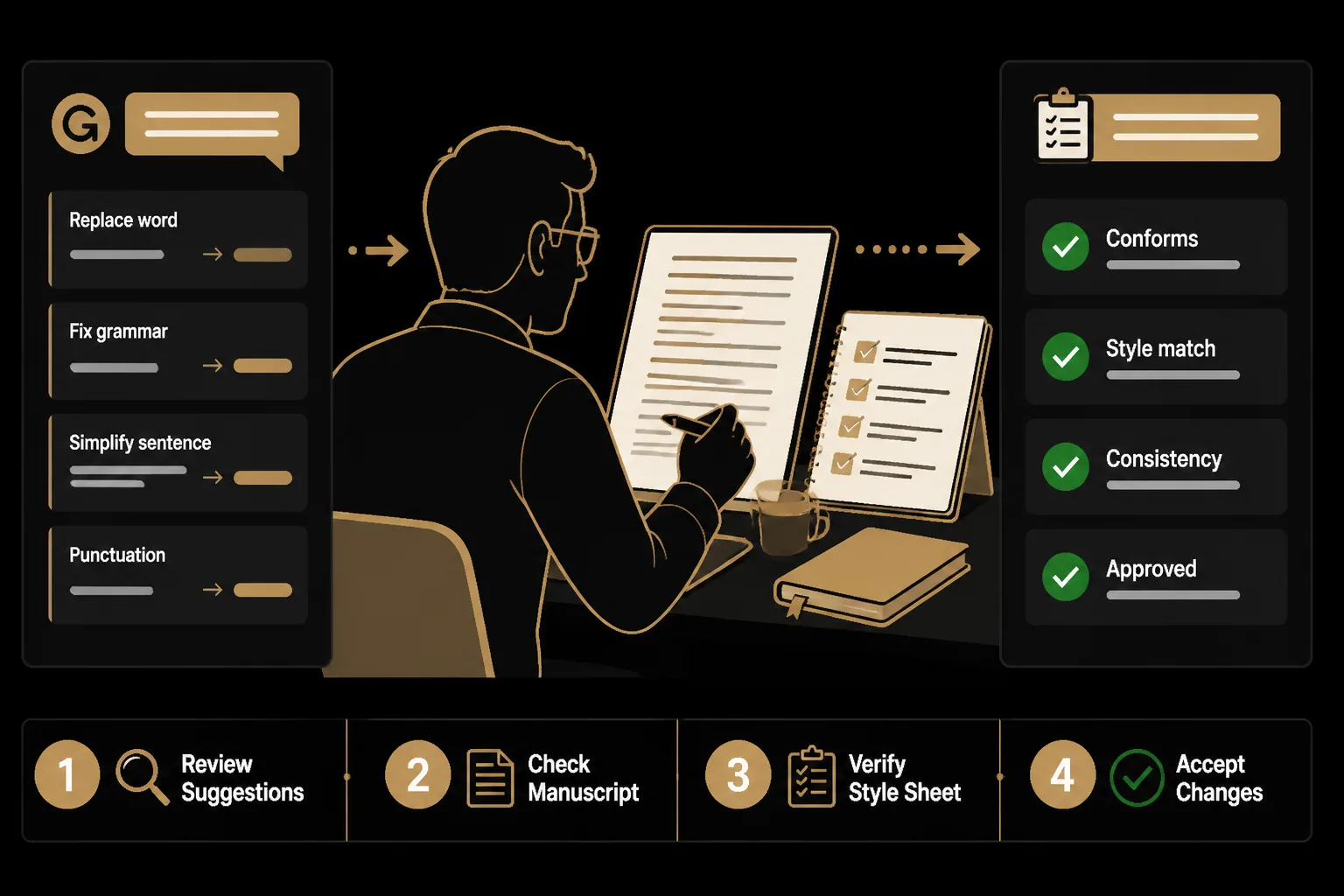
Symptom: An accepted suggestion creates an awkward transition or conflicts with your style sheet. Read the surrounding paragraph, then record decisions about capitalization, spelling, hyphenation, names, and preferred terms.
- Compare versions: Keep the original when the rewrite loses accuracy, voice, or purpose.
- Protect voice: Preserve deliberate rhythm, dialect, and emphasis when they serve your readers.
- Proof the manuscript: Review book-level details separately from Grammarly’s sentence suggestions.
- Record decisions: Check each change against the surrounding passage and your style sheet.
Grammarly is a useful assistant, not a professional editor or publishing strategist. Bradley Johnson Productions helps you connect manuscript quality with positioning, audience expectations, and a sustainable author ecosystem.
Grammarly Questions for Independent Authors
Unpublished books raise practical concerns beyond sentence-level corrections. You also need to consider privacy, authorship, reader trust, and whether a free tool gives you enough coverage before sharing commercially important work.
These answers help you decide where Grammarly fits in your publishing process, without treating it as an editor, proofreader, or publishing strategist.
Whether Grammarly is secure to use
Grammarly may be suitable for routine text, but you should review its current privacy and product terms before uploading sensitive material. Unreleased books, client content, and confidential research deserve extra care. Understand how your text is processed, stored, and handled before using any online writing tool.
The drawbacks of using Grammarly
The main drawbacks include false positives, missed context, flattened voice, subscription limits, and overreliance. You may accept a change that weakens a character’s speech or a nonfiction claim. Grammarly can support your review, but you still need human judgment and a publishing-quality read before sharing your manuscript.
Whether ChatGPT or Grammarly is better
Neither tool is simply better because you use them for different workflows. Grammarly is suited to a first-pass language check, while ChatGPT can help generate or discuss alternatives. Verify every suggestion against your manuscript, facts, voice, and audience. Neither tool should make unverified publication decisions for you.
Whether Grammarly use can trigger an AI flag
Using Grammarly alone doesn’t establish authorship or guarantee how an external AI detector will classify your text. Preserve drafts, revision history, research notes, and your honest editing process. If a detector raises concern, those records give you stronger evidence of how you developed the manuscript.
Whether people still use Grammarly
Yes, you can still use Grammarly wherever you want a quick first-pass check. Its value depends on your workflow, not on treating it as a final authority. You may find it useful for emails, sample chapters, and early manuscript reviews, while professional editing remains necessary for publication-ready books.
How accurate Grammarly’s free version is
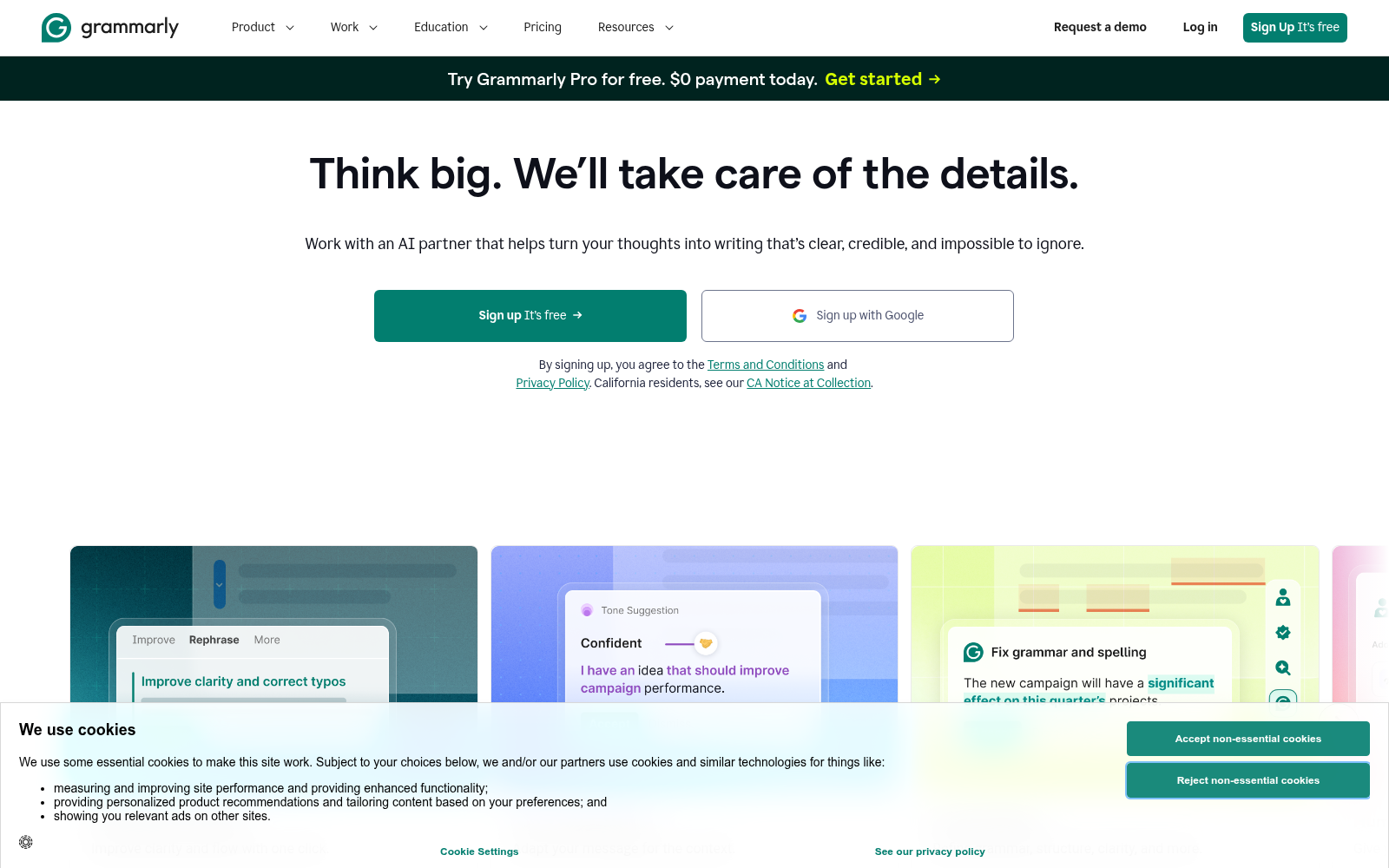
Grammarly offers a free grammar checker, according to Grammarly’s own product information. Don’t confuse free access with complete editorial coverage. A free check may help you spot basic issues, but it won’t assess your book’s structure, market position, factual reliability, or publishing quality.
A Five-Step Grammarly Review Before You Publish
A publication-ready manuscript needs more than corrected sentences. You need a repeatable review that protects your voice, your reader’s experience, and your credibility as an author.
Use Grammarly as one checkpoint, not the decision-maker. You’ll get better results when each suggestion supports a clear editorial purpose.
-
Step one:
Set the voice and style boundary
Define your book’s audience, purpose, tone, spelling preferences, and non-negotiable style choices before opening Grammarly. You might choose conversational language for a memoir or restrained authority for a financial guide. Write those decisions down.
-
Step two:
Run the automated first pass
Run Grammarly across the manuscript for surface patterns such as spelling, punctuation, repeated words, and sentence clarity. You’re collecting possible issues, not approving changes. Preserve your original file before reviewing the suggestions.
-
Step three:
Investigate every meaningful suggestion
Ask whether each change protects your meaning, voice, and intended audience. A suggestion that improves a business sentence may flatten a character’s speech. Keep it, change it, or ask an editor when the answer is uncertain.
-
Step four:
Review the page in context
Read the full scene, section, or chapter after making sentence-level decisions. Check continuity, pacing, transitions, factual claims, and the reader’s experience. Copyediting fixes expression; developmental feedback examines structure and substance.
-
Step five:
Start with one representative page
Open a page that reflects the book’s usual style, then create a short decision log. Before sharing your manuscript, obtain the human review your stage requires: proofreading for final errors, copyediting for consistency, developmental feedback for the book’s shape, or publishing guidance for audience and positioning.
- Keep: The suggestion supports your voice and meaning.
- Change: The correction improves accuracy or clarity.
- Ask an editor: The decision affects structure, credibility, or reader expectations.
That log gives Bradley Johnson Productions a real editorial question to address through book development, audience strategy, positioning, and long-term publishing guidance. Sustainable author credibility starts with judgment, not a score.
If you want a faster way to connect manuscript decisions with audience strategy, Bradley Johnson Productions provides book-development, marketing, and publishing guidance for independent authors through its book-development and publishing guidance blog.