
You proudly send a reader to your new site, then notice the problem. The homepage looks polished, but your visitor still can’t tell which book to start with, where to buy it, why to join your email list, or what to read next. The best author websites guide readers somewhere useful. A handsome site can still leave your best reader at a dead end.
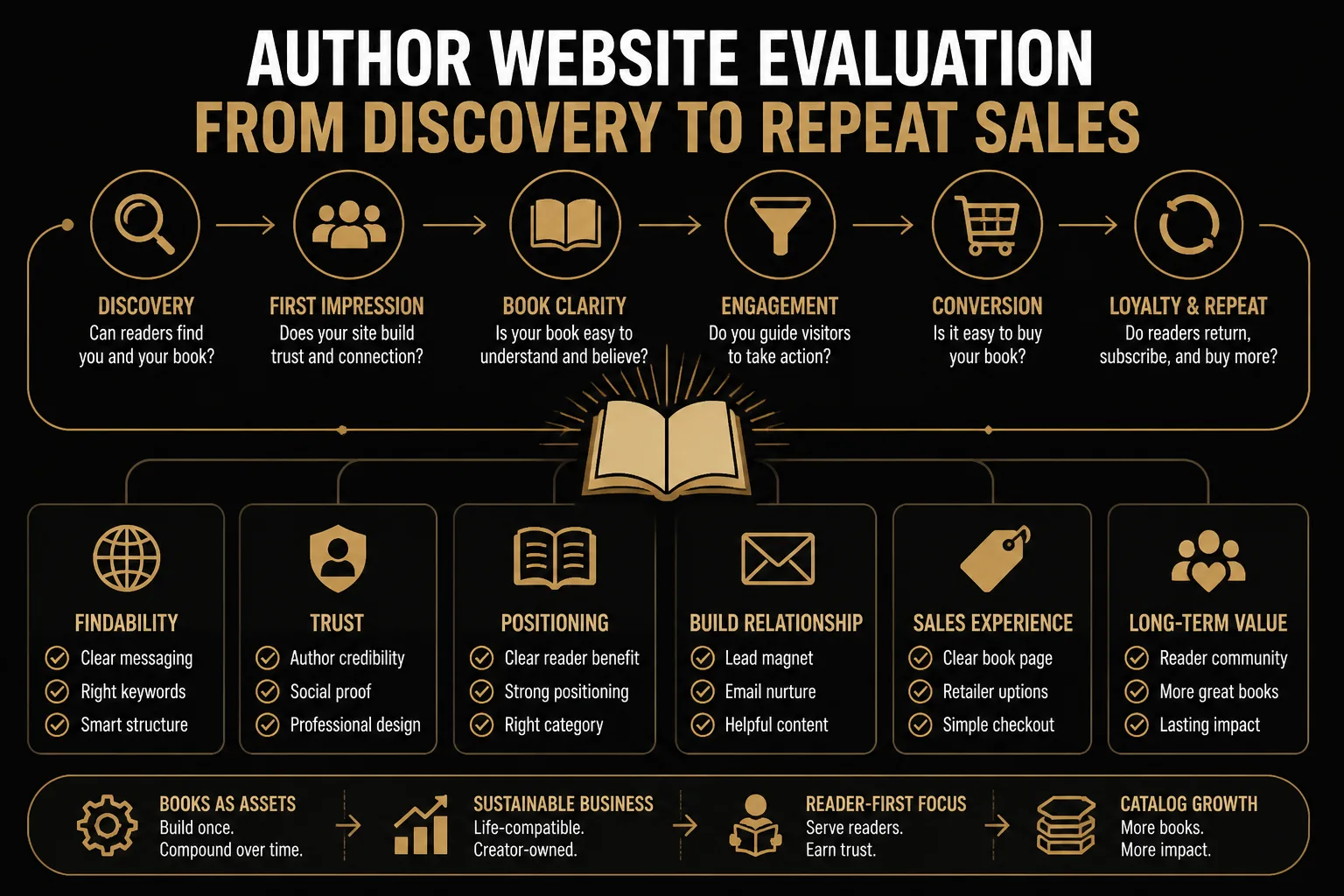
Most authors don’t have a design problem. They have an ecosystem problem. A useful author website connects discovery, purchase, email growth, audience segmentation, and your next publishing decision. “Best” doesn’t mean the prettiest homepage or the platform with the most templates. It means the structure that supports your books, readers, sales goals, and capacity to maintain it.
Bradley Johnson Productions takes that ecosystem-focused view, although its guidance is strategic rather than a drag-and-drop website platform. The right choice depends on when a managed builder makes sense, when self-hosted WordPress gives you better control, and what fits your stage, from a first launch to a sustainable author business.
Judge an Author Website by Its Business Path, Not Its Homepage
A polished homepage can still lose readers before they reach the right book. Compare the full path from discovery to purchase, email signup, and the next relevant step.
Clear design, a featured latest book, and easy buying or contact are useful starting points. Bradley Johnson Productions adds a business test: whether your site supports Amazon SEO, audience segmentation, ownership, and a sustainable publishing strategy.
Book Discovery and Amazon SEO Pathways
Your visitor should quickly identify which book fits their interest, then find an accurate path to Amazon or another retailer. Check that each book has focused metadata, a clear promise, relevant keywords, and links that match the search intent bringing readers to your site.
- Book path: You can reach every major title from the homepage within one or two choices.
- Search alignment: You connect each book page’s topic and language with its Amazon SEO strategy.
- Reader fit: You show which book suits a new reader, a returning fan, or a specific nonfiction need.
Sales, Email Capture, and Audience Segmentation
Your site must support more than a sale. It should make the next action obvious, whether that means buying a book, joining your email list, or entering a reader segment that matches future recommendations. A marketing mix for independent authors follows the same logic by connecting channels with longer-term publishing goals.
“Clear design, a featured latest book, and easy buying or contact are useful, but incomplete criteria,” according to the supplied ranking-page research.
Ownership, Scalability, and Long-Term Maintenance
You are building an asset, not merely renting a brochure. Compare who controls your content, how easily your site can add books and reader segments, and whether you can maintain accurate links, prices, and launch details. A sophisticated system that you never update serves you less well than a simpler structure you can keep current.
Practical rule: Choose the structure that keeps your next reader action clear and your publishing system maintainable.
Self-hosted WordPress Gives Authors the Deepest Ecosystem Control
Self-hosted WordPress gives you room to build when your author business needs more than a homepage and one sales link. It can support several books, distinct reader paths, lead magnets, and search-focused content as your catalog grows.
That control has a cost. You make more decisions about hosting, plugins, page structure, forms, analytics, updates, and security. For your long-term publishing strategy, the best choice depends on whether that freedom supports your capacity or exceeds it.

Book Discovery and Amazon SEO Pathways
You can create separate pages for each book, genre, topic, or reader problem. A nonfiction author might guide readers from a search article to a specific resource, then to Amazon or an email sequence. This structure also gives you more room to organise content around relevant search terms. A companion guide to book marketing websites and their business fit covers the wider platform decision this structure assumes.
Sales, Email Capture, and Audience Segmentation
You can offer different lead magnets to different audiences, such as a writing checklist for aspiring authors and a workbook for existing readers. Your forms, book pages, and follow-up paths can support a broader author ecosystem, including future courses, services, or products. The trade-off is coordination. You must keep links, prices, forms, and reader journeys accurate.
Ownership, Scalability, and Long-Term Maintenance
You own more of the structure, so your website can grow with multiple books and audience segments. Bradley Johnson Productions can help you plan that ecosystem strategically, although it can’t remove the technical upkeep your chosen setup requires. A powerful site that you cannot update becomes outdated, confusing, or insecure.
What Works
- Catalog depth: You can build clear paths across multiple books, series, topics, and reader needs.
- Audience growth: You can connect lead magnets and email forms to distinct reader segments.
- Future capacity: You have room for services, courses, products, and search content later.
What Fails
- Maintenance load: You must manage updates, plugins, hosting, forms, analytics, and security.
- Excess complexity: You can create too many pages and paths before your business needs them.
- Neglected systems: You lose the benefit of control when you lack time to keep your site current.
A Managed Website Builder Keeps a Focused Author Launch Simple
If you have one book, limited time, and a launch date approaching, a managed website builder can protect your momentum. You can publish a clear book page, purchase link, contact path, and basic email signup without taking on a large technical system.
You trade some future flexibility for a simpler first reader path. That can be a sound choice when your immediate goal is to launch one offer, not build a full author ecosystem on day one. For more planning context, see this guide to building an author website.

Book Discovery and Amazon SEO Pathways
You can give each book a focused page with its title, description, keywords, and Amazon link. Your site may support basic search content, but complex topic clusters and detailed pathways across series or nonfiction subjects can become harder to manage.
Sales, Email Capture, and Audience Segmentation
You can guide a reader from one book page to one purchase link and one signup form. A narrow offer needs little more. As you add reader segments, lead magnets, or different email journeys, the builder may give you less control.
Weak example: “Learn more about Jane Carter’s book.” Your reader still has to find the book, buying option, and signup reason.
Strong example: “Start The Two-Minute Reset, then get Jane Carter’s 7-day focus guide by email.” The next steps are visible.
Ownership, Scalability, and Long-Term Maintenance
You may launch effectively with less maintenance, but generic simplicity can become structural simplicity. When your catalog, audience, content, or products grow, your platform may constrain the wider business you want to build. Bradley Johnson Productions can help you weigh that trade-off, although a managed builder can’t offer the same depth as a fully customised system.
What Works
- Launch speed: You can publish a focused author site faster when your time or technical confidence is limited.
- Clear path: You can connect one book, purchase route, contact option, and signup form.
- Lower upkeep: You can spend more time writing what you love and less time maintaining site infrastructure.
What Fails
- Segmentation depth: You may struggle to create distinct journeys for different reader groups.
- Catalog growth: You can outgrow simple navigation as you add books, series, and resources.
- Business expansion: You may face limits when your author ecosystem includes products, courses, or advanced content.
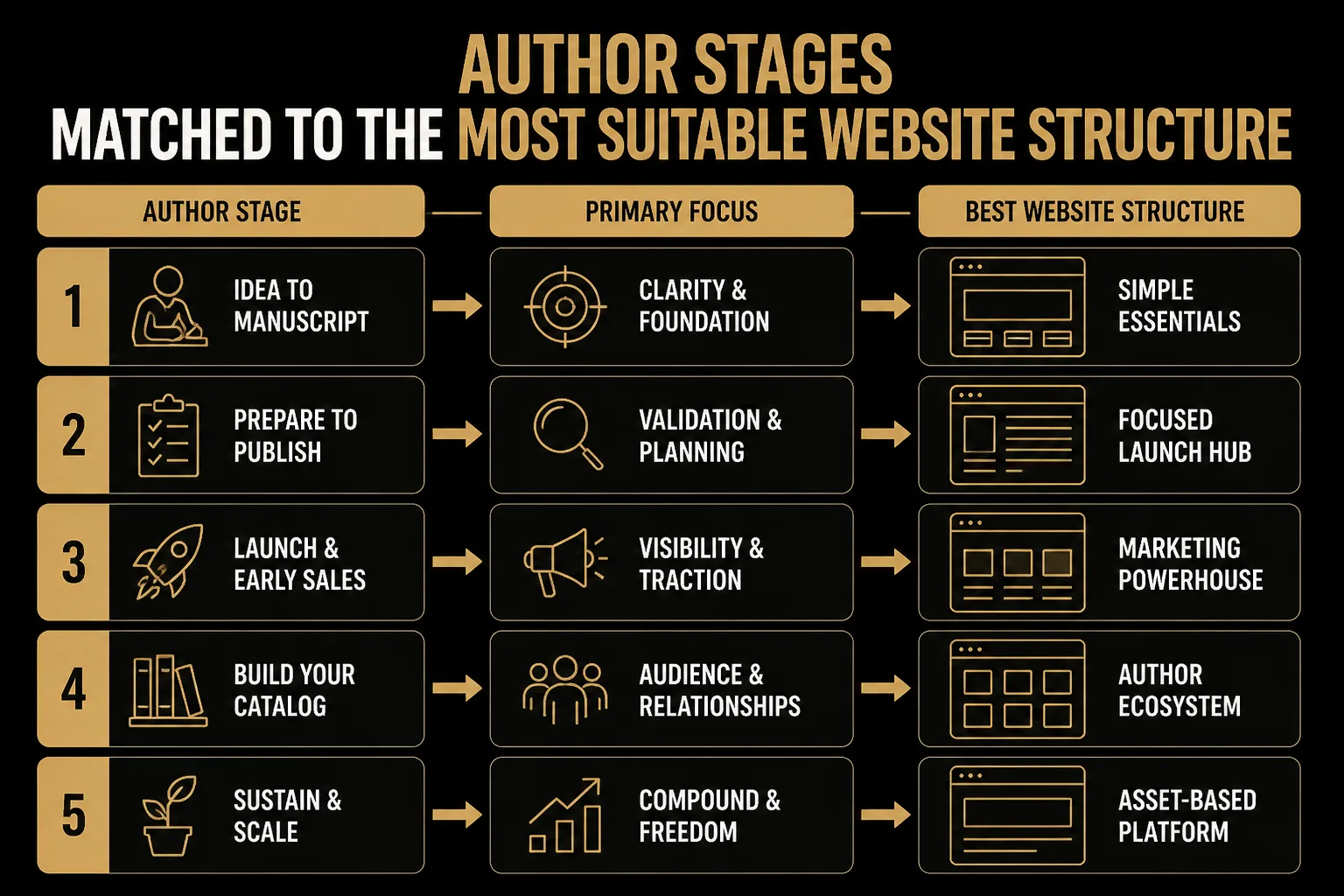
Choose the Website Structure That Matches Your Author Stage
Your first book needs a clear path, not a larger technical project. If you have one offer and a launch date, choose the structure that helps you publish on time.
Your recommendation changes when your catalog, audiences, or offers grow. The right website must support how readers discover, buy, and continue with your books.
| criterion | self-hosted WordPress | managed website builder | edge |
|---|---|---|---|
| First launch with one clear offer | More decisions and ongoing upkeep than needed for a focused launch | Faster path to a clear book page, purchase link, contact path, and basic signup | Managed website builder |
| Multiple books | Can support multiple books and connected reader journeys | May become constrained as the catalog grows | Self-hosted WordPress |
| Audience segmentation | Can support segmented reader journeys | Less flexible for complex segmentation | Self-hosted WordPress |
| Nonfiction resources and future offers | Can accommodate search content, lead magnets, services, and products | More limited for expanding content systems and ecosystems | Self-hosted WordPress |
| Maintenance capacity | Requires ongoing upkeep and more operational decisions | Reduces friction for authors with limited time | Managed website builder |
If You Are Launching Your First Book
Choose a managed website builder when you have one clear offer. You need a focused book page, purchase route, contact option, and signup form without adding technical upkeep before launch.
- Best fit: A first-time author with limited maintenance capacity and one primary book.
If You Are Building a Multi-book Fiction Catalog
Choose self-hosted WordPress when you have multiple books, series pages, or connected reader journeys. You gain room for catalog navigation and future audience growth.
- Best fit: A fiction author whose website must guide readers across several books or series.
If You Are Growing a Nonfiction Business or Author Ecosystem
Choose self-hosted WordPress for nonfiction resources, segmented audiences, lead magnets, services, or wider offers. Bradley Johnson Productions helps connect that structure with book development, Amazon SEO, pricing, rankings, marketing, and long-term publishing strategy. Platform choice alone won’t create a profitable, sustainable author ecosystem.
- Best fit: An author building books that do more than generate one-time sales.
Answers to Common Searches About the Best Author Websites
A gallery of attractive homepages isn’t enough. The best author websites make books easy to find, give readers a useful reason to join an email list, and offer an intentional next action.
What the Top 10 Best Author Websites Have in Common
Useful examples aren’t always the prettiest websites. You can evaluate ten author websites by checking whether each one makes the first book easy to find, gives that book a focused page, offers a relevant email signup, and points readers towards a clear next step. For fiction, inspect series navigation. For nonfiction, look for resources that support the wider author business.
What the Best Free Author Websites Should Provide
The best free author websites still support discovery, email capture, and a deliberate next action. Before choosing one, check who owns your content and domain, whether signup forms and purchase links work, how the site handles growth, and what maintenance limits apply. Free access can suit a first launch, but it shouldn’t trap your books inside a restricted structure.
What a Romance Author Website Should Include
A romance author website should guide readers through the series, latest release, reader signup, and next-book path. Make the reading order obvious, feature the current book without hiding earlier titles, and give visitors a genre-appropriate reason to subscribe. Bradley Johnson Productions helps connect that structure to your wider author ecosystem, although website strategy alone cannot replace strong books or consistent marketing.
Build Your Author Website in Seven Decisions, Starting With One Reader Path
Your platform choice matters less than the path your reader follows. Before you commission design or compare features, decide who you want to help, which book fits, and what should happen next.
You need one clear page before you need a complete website.
Define the Primary Reader and Business Goal
Choose your primary reader and book promise first. You can then select a structure that supports a profitable, sustainable author ecosystem rather than decorating an unclear offer.
Map One Homepage-to-Book-to-Email Journey
Draw the journey on paper: arrival, best-fit book, purchase link, and relevant email pathway. A weak version says, “Browse my books.” A strong version says, “Start with Reset Your Budget, then get the three-step savings guide for new homeowners.”
- Reader: Name the audience.
- Promise: State the book’s outcome.
- Next step: Choose one action.
- Review: Set a regular check-in.
Choose the Platform After the Path Is Clear
Use this seven-step action plan:
- Reader: Define the primary reader and book promise.
- Structure: Choose the website format.
- Homepage: Map the reader journey.
- Book page: Create the best-fit sales page.
- Links: Connect Amazon Author Central and purchase links.
- Email: Add one segmented pathway.
- Review: Schedule checks for rankings, pricing, and conversions.
Start today with one page: the homepage reader journey map. Bradley Johnson Productions can connect these decisions with book development, Amazon SEO, marketing, pricing, rankings, and long-term publishing strategy. Website planning alone can’t replace strong books or consistent promotion.
If you want a faster way to build this path, Bradley Johnson Productions provides strategic guidance on book development, marketing, audience segmentation, Amazon SEO, pricing, and sustainable author ecosystems for independent authors. The author strategy and publishing guidance blog supports that work with practical planning resources.