Ever wonder why Jeff Kinney, the mastermind behind the Diary of a Wimpy Kid series, decided to become an author? It wasn’t exactly a straight path. From early doodles to online experiments, Kinney’s journey is a fascinating look at how a simple idea can grow into a global phenomenon. Let’s explore the story behind why did Jeff Kinney become an author and what makes his books so special to millions of kids.
Key Takeaways
- Jeff Kinney’s path to authoring began with a childhood love for drawing and storytelling, which he nurtured through college and various jobs.
- The Diary of a Wimpy Kid series started as an online experiment, gaining unexpected popularity before being published as a book.
- Kinney focuses on creating relatable characters and humor, blending text and illustrations to capture the everyday struggles of middle schoolers.
- Beyond the Wimpy Kid books, Kinney has expanded his creative reach into film, the Awesome Friendly Kid series, and the online world of Poptropica.
- Despite facing early rejections and challenges like writer’s block, Kinney’s persistence and deep respect for young readers have been central to his enduring success.
The Genesis Of A Wimpy Kid
Early Love For Storytelling And Cartoons
Jeff Kinney wasn’t born with a book deal in hand. Growing up, he had a real knack for drawing and telling stories. Think about it: most kids doodle in their notebooks, but Jeff was already thinking about how to weave those drawings into a narrative. His parents encouraged his education, but that creative spark was always there. Even back in college, he tried his hand at a comic strip called ‘Igdoof.’ While it didn’t exactly take the world by storm outside of campus, it was a start, a sign of things to come. He bounced around different jobs after college, working in writing and design, but that core idea of combining words and pictures kept bubbling up.
Sketching Ideas While Working As A Game Designer
It’s kind of wild to think that a massive book series like Diary of a Wimpy Kid started while Jeff Kinney was busy designing video games. Back in 1998, he was working in the online game world. But even with that going on, he couldn’t shake the idea for Greg Heffley. He started sketching out the basic concepts, the early versions of Greg’s world. It wasn’t a polished manuscript yet, more like a collection of thoughts and drawings. He kept these ideas tucked away, working on them in his spare time. It was a slow build, a passion project happening on the side while he did his day job.
The Online Experiment That Sparked Success
So, Jeff had this big manuscript, like 1,300 pages of it, and he’d been working on it for years. He wasn’t really showing it to anyone, partly because he was sure it would get rejected. He even kept it pretty quiet, not wanting to deal with the pressure of people asking about it. But then, he decided to try something different. He put parts of the story online on a website called Funbrain.com around 2004. This online experiment was the real turning point. It wasn’t just a few people checking it out; thousands of kids started visiting the site every day, eager to read the next installment. This huge online interest is what finally got the attention of publishers, leading to the first physical book being released in 2007. It just goes to show, sometimes putting your work out there in a new way can make all the difference.
Crafting Greg Heffley’s Relatable World
Jeff Kinney really hit a sweet spot when he created Greg Heffley. It wasn’t about making a perfect kid; it was about making a kid that felt real, flaws and all. Greg’s world is a mix of everyday middle school stuff – the awkwardness, the social pressures, the constant feeling of being misunderstood. The magic is in how Kinney captures those universal adolescent feelings, even when Greg is doing something totally ridiculous.
Balancing Humor And Everyday Adolescent Struggles
Greg’s life is basically a series of minor disasters, and that’s where the humor comes in. He’s not trying to be a hero; he’s just trying to survive middle school. Whether it’s dealing with his annoying older brother Rodrick, trying to impress girls, or just avoiding chores, Greg’s struggles are pretty much what every kid goes through. Kinney doesn’t shy away from the embarrassing moments, which is probably why kids connect with him so much. It’s like looking in a funhouse mirror at your own life.
The Unique Blend Of Text And Illustrations
One of the things that makes the Wimpy Kid books stand out is the way text and drawings work together. It’s not just a story with pictures; the illustrations are part of the joke, often showing Greg’s exaggerated reactions or the ridiculous situations he gets himself into. This format makes the books super accessible, even for kids who don’t usually pick up a book.
Here’s a look at how the format helps:
- Visual Gags: The drawings often deliver punchlines that the text alone wouldn’t.
- Pacing: The mix of text blocks and images breaks up the reading, keeping things moving.
- Character Expression: Illustrations capture Greg’s emotions (or lack thereof) in a way words can’t always.
Creating A Character That Resonates With Readers
So, why does Greg Heffley work so well? It’s because he’s not perfect. He makes bad decisions, he’s a bit selfish sometimes, and he definitely complains a lot. But underneath it all, he’s just a kid trying to figure things out. Kinney has said he based Greg on the parts of himself he’s not always proud of, and that honesty shines through. Kids see their own awkwardness and insecurities in Greg, and that makes him feel like a friend, not just a character in a book.
It’s easy to judge Greg, and sometimes you want to shake him. But then you remember being that age, and how confusing and overwhelming everything felt. Kinney taps into that shared experience, making Greg’s misadventures feel familiar, even when they’re laugh-out-loud funny. He’s the kid who says what others are thinking but are too afraid to admit.
Beyond The Diary: Expanding The Universe
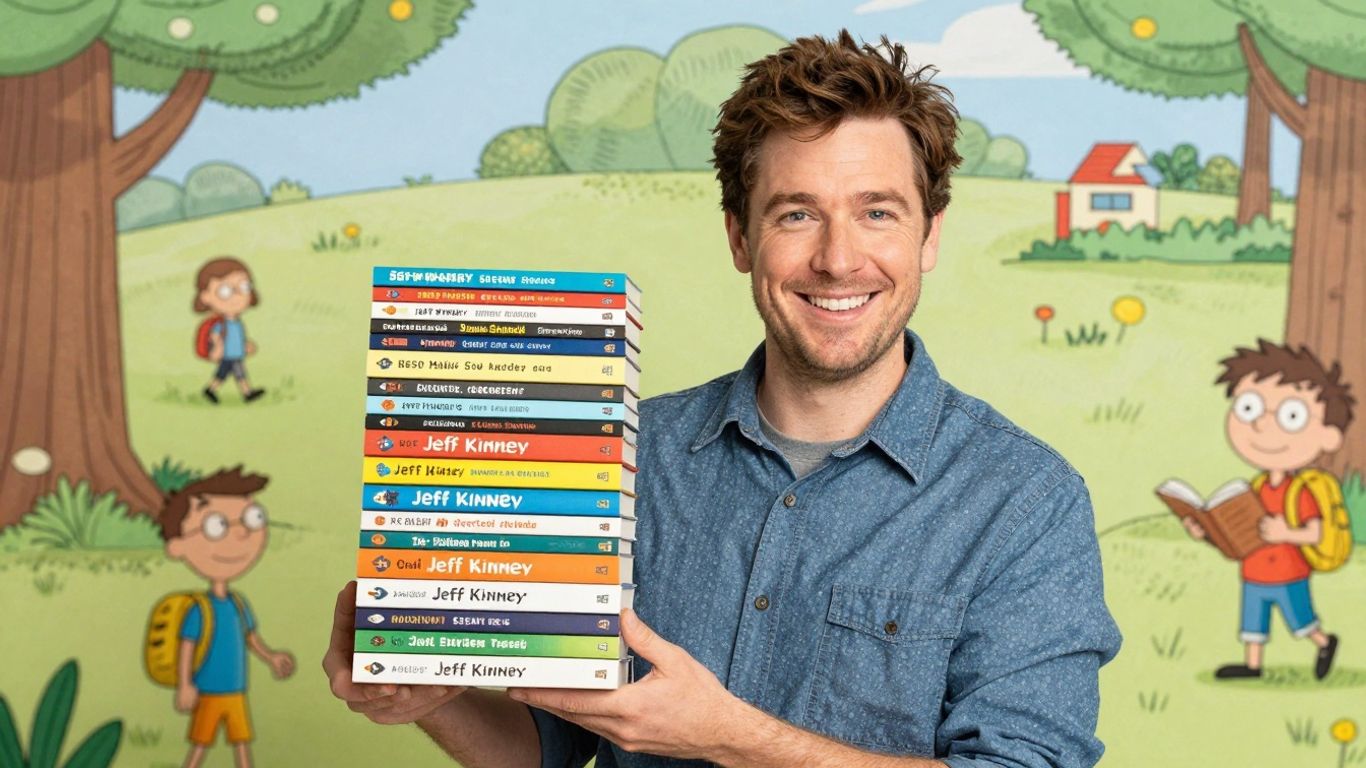
Jeff Kinney didn’t just stop with Greg Heffley’s diary, oh no. He kept building, adding more layers to this whole ‘Wimpy Kid’ world. It’s like he found a secret door and decided to see what was on the other side.
Introducing The Awesome Friendly Kid Series
First up, we got the ‘Awesome Friendly Kid’ series. This is basically Rowley Jefferson’s turn in the spotlight. You know, Greg’s best friend? The one who’s always a bit too eager and maybe a little naive? This series flips the script, showing things from Rowley’s perspective. It’s a neat way to explore friendship and what it’s like to be the sidekick. The books, like ‘Diary of an Awesome Friendly Kid: Rowley Jefferson’s Journal’, give us a different angle on the same kind of everyday kid stuff, but with Rowley’s own brand of optimism. It shows that even the ‘sidekick’ has a whole world going on.
Venturing Into Film Adaptations
Then there were the movies. Kinney got involved in bringing his books to the big screen, and more recently, to streaming. These animated adaptations allowed the ‘Wimpy Kid’ universe to reach even more people in a new way. It’s one thing to read about Greg’s mishaps, but it’s another to see them play out with animation. He’s talked about how CG animation offers new creative chances for the franchise, letting them expand the stories and characters in ways that weren’t possible on the page alone. It’s a big step from stick figures to full animation, and it seems to have worked out pretty well.
The Creation of Poptropica
But wait, there’s more! Before all the books and movies really took off, Kinney was already creating digital worlds. He co-created Poptropica, a really popular online game for kids. It’s a whole virtual island where players can go on adventures, solve mysteries, and explore different islands. It’s got that same kind of quirky humor and storytelling that fans love about his books. It’s pretty wild to think that the same guy who draws Greg Heffley also built this whole interactive world. It really shows how his creative energy goes in a lot of different directions. It’s a testament to his ability to connect with young audiences across different media, from books to games.
It’s clear that Jeff Kinney isn’t content to just stick to one thing. He’s always looking for new ways to tell stories and connect with kids, whether that’s through a new book series, an animated movie, or an online game. It’s about keeping the fun going and finding different avenues for creativity.
The Author’s Creative Process And Challenges
Jeff Kinney has talked about how he approaches writing his books, and it sounds like a lot of work. He’s mentioned that for each book, he tries to come up with around 700 jokes. That’s a huge number! He sees himself as a joke-teller first, then a cartoonist, and then a writer. The main goal is to make sure the books are funny because, as he puts it, "The currency of my books is humor, and if they’re not funny, then I haven’t done my job." It’s a constant balancing act, trying to weave those jokes into a story that also makes sense and keeps readers interested.
Generating Hundreds Of Jokes For Each Book
Kinney’s process involves a massive brainstorming phase for humor. He doesn’t just write jokes as they come; he actively generates a large volume, aiming for quantity to find the best quality. This means a lot of ideas might not make it into the final book, but they serve the purpose of sparking the right kind of funny.
The Struggle With Writer’s Block
Even with a system, writer’s block is a real thing. Kinney has admitted to spending days, even eleven days, just trying to get the first sentence of a new book down. He finds Greg Heffley’s voice particularly tricky to capture sometimes. It’s interesting that he finds the spin-off books about Rowley a bit easier to write, which suggests that even familiar characters can present new challenges.
Finding The Intersection Of Storytelling And Humor
This is where the real magic, and the hard work, happens. Kinney is always looking for that sweet spot where a good story meets great jokes. It’s not enough for a book to be funny; it needs a narrative that pulls you in. Likewise, a great story won’t fly if it’s not entertaining. He has to make sure the jokes serve the story and the story makes the jokes land better. It’s a delicate dance.
The sheer volume of jokes he aims to create highlights a dedication to his craft. It’s not just about having a few good gags; it’s about building an entire world where humor is the foundation, and that requires a deep well of comedic ideas to draw from.
Here’s a look at how he might approach the joke generation:
- Brainstorming scenarios from Greg’s daily life.
- Writing multiple punchlines for each setup.
- Testing jokes on himself and his team to see what lands.
- Discarding jokes that feel forced or don’t fit the character’s voice.
- Revisiting old ideas with a fresh perspective.
It’s a process that requires patience and a willingness to keep trying, even when the words or the jokes aren’t coming easily. He’s mentioned that sometimes he’ll write a whole manuscript and then realize a lot of the jokes just aren’t working, requiring him to go back and rewrite large sections. That’s a tough but necessary part of making sure the final product is as funny as it can be.
Navigating Rejection And Persistence
It’s easy to look at Jeff Kinney’s massive success now and think it all just happened overnight. But like most creators, his path wasn’t exactly a straight shot to the top. Before Greg Heffley became a household name, Kinney faced his fair share of bumps in the road. It’s a good reminder that even the most popular stories often start with a lot of doubt and a refusal to give up.
Early Setbacks With The Igdoof Comic Strip
Long before Diary of a Wimpy Kid took the world by storm, Jeff Kinney was working on a comic strip called Igdoof. He poured his energy into this project, aiming for a spot in the newspaper funny pages. However, Igdoof never quite caught on with editors. It’s tough when you put your heart into something and it doesn’t get the reception you hoped for. This early experience showed Kinney that not every idea lands, and that’s okay. It’s part of the process.
The Long Road To Publishing The First Manuscript
When Kinney first started writing Diary of a Wimpy Kid, he wasn’t even sure it would work as a children’s book. He actually thought it was more of an adult project, inspired by classic comics and shows that looked back at childhood. He kept the manuscript quiet for a long time, pretty sure it would get turned down. He told himself, "This is my opus, this is the thing I’m gonna do, and I can’t control whether it’s accepted or not." He worked on it for years, not telling many people, because he expected rejection. It was only after a chance meeting at Comic-Con that the idea to market it as a kids’ series came up, leading to its eventual publication.
Keeping The Dream Alive Through Doubt
Kinney’s journey highlights the importance of believing in your work, even when others don’t see the vision. He kept Diary of a Wimpy Kid under wraps for a long time, partly because he anticipated rejection. This period of quiet work, where he wasn’t seeking external validation, allowed him to fully develop his idea without the pressure of immediate approval. It’s a powerful lesson: sometimes, the best way to push through doubt is to focus on the creation itself, letting the work speak for itself when it’s ready.
The creative process often involves a lot of trial and error. What might seem like a failure at one point could simply be a stepping stone to something much bigger. It’s about learning from each attempt and keeping your focus on the end goal, even when the path isn’t clear.
Here’s a look at some of the early stages:
- Concept Development: Years spent refining the idea for Diary of a Wimpy Kid.
- Initial Rejection: The Igdoof comic strip didn’t get picked up by newspapers.
- Quiet Work: Keeping the manuscript private for an extended period due to expected rejection.
- Unexpected Turn: A meeting at Comic-Con shifted the book’s direction towards a children’s series.
A Deep Respect For Young Readers
Jeff Kinney seems to really get kids. It’s not just about making them laugh, though he’s definitely a master at that. It’s about seeing the world from their point of view, even the messy, awkward parts. He’s said before that he spent years trying to remember what it was like to think like a kid, to figure out how they make sense of things. That kind of effort shows.
Making Books Accessible For Reluctant Readers
One of the biggest wins for the Wimpy Kid series is how it pulls in kids who might not normally pick up a book. The mix of text and drawings makes it feel less intimidating. It’s like a secret handshake for kids who find big blocks of words a bit much.
- Short sentences and paragraphs keep the pace moving.
- Illustrations break up the text and add another layer of humor.
- Relatable situations make the stories feel familiar and engaging.
The Importance Of Positive Representation
While Greg Heffley isn’t always the best role model (he does have a frown on his face on every cover, after all), the books show a kid trying his best, even when he messes up. It’s about showing that it’s okay to be imperfect. The stories often highlight family and friendships, even when things get complicated.
It’s easy to think that writing for kids means keeping things super simple or always having a clear moral lesson. But Kinney seems to understand that kids are smart. They can figure things out for themselves. He lets Greg be Greg, and readers can decide what they think about his choices. That’s a pretty respectful way to treat young audiences.
Empathy As A Key Takeaway From The Series
Ultimately, the Wimpy Kid books offer a chance for kids to see themselves and their own struggles reflected on the page. It’s about understanding that everyone, even the seemingly popular kids or the ones who seem to have it all together, has their own set of problems. This shared experience can build a sense of connection and understanding, which is a pretty big deal for middle schoolers trying to find their place in the world.
Maintaining Grounded Normality
Even with the wild success of the Diary of a Wimpy Kid series, Jeff Kinney seems to have a pretty firm grip on reality. It’s easy for people to get lost in the glitz and glamour of fame, but Kinney has made a point of keeping his life pretty down-to-earth. He lives in a small town, not some celebrity enclave, and he’s even chosen to own a bookstore there, called An Unlikely Story. It’s a way to stay connected to the community and, you know, just live a regular life.
The Evolution Of Touring And Book Signings
When Kinney hits the road for book tours, it’s not exactly a rockstar experience. He’s mentioned driving a van himself, which feels more his speed than those giant tour buses. It’s about being present and connected, not about the spectacle. He’s talked about how he’s the one pumping gas and doing the driving, and that just feels right.
- Driving his own tour van: This offers a more personal connection to the journey.
- Focusing on accessibility: Making sure the experience isn’t overwhelming for him or the fans.
- **Keeping it
So, Why Did Jeff Kinney Become an Author?
Looking back, it’s clear Jeff Kinney’s path to writing wasn’t a straight line. He tried different things, from games to comics, before finding his groove. It seems like a mix of passion for drawing and telling stories, a bit of luck with how he shared his work online, and a whole lot of hard work went into making Diary of a Wimpy Kid a thing. He really just wanted to make kids laugh and connect with them through Greg’s everyday struggles. And honestly, he totally nailed it. It’s pretty cool how one person’s idea can bring so much joy to so many people around the world.
Frequently Asked Questions
How did Jeff Kinney first get the idea for Diary of a Wimpy Kid?
Jeff Kinney started sketching ideas for Diary of a Wimpy Kid while working as a game designer. He first shared parts of the story online in 2004 on Funbrain.com, and it became super popular, leading to the first book being published in 2007.
What makes the Diary of a Wimpy Kid books unique?
The books are special because they mix diary entries written in a funny, everyday style with simple drawings. This mix makes Greg Heffley’s middle school adventures feel very real and easy for kids to connect with.
Did Jeff Kinney always want to be a writer?
Jeff Kinney loved drawing and telling stories from a young age. He tried making a comic strip in college called Igdoof, but it didn’t get published widely. He worked in different jobs before the idea for Wimpy Kid really took off.
Has Jeff Kinney written other books besides the Wimpy Kid series?
Yes! He also created the Awesome Friendly Kid series, which tells stories from the perspective of Greg’s best friend, Rowley Jefferson. He also developed the popular online game world called Poptropica.
Does Jeff Kinney ever get stuck when writing?
Even though his books are very funny, Jeff Kinney admits he sometimes struggles with writer’s block. He mentioned it can take him a long time to write just one sentence for a new book, especially when trying to capture Greg’s voice.
Why are the Wimpy Kid books good for kids who don’t like reading?
The books are written in a simple, engaging way with lots of pictures, which makes them easy and fun to read. Many kids find Greg’s problems and feelings very relatable, making it a great way to get into reading.