
You upload the final manuscript, open the paperback proof, and spot the mismatch immediately. Your cover looks polished, but it promises a different kind of book than the pages deliver. The interior feels improvised, and each change to trim size, typography, or ebook formatting creates another costly revision. That is a book design problem, not just a production glitch.
Book design covers more than cover art. According to AIGA, it includes the cover’s visual treatment and the interior’s functional page layout. A matte finish may give your cover a soft, glare-free feel, according to IngramSpark, but it isn’t automatically right for your genre, audience, or sales plan.
This guide separates cover design from interior design, then connects both to genre positioning, Amazon thumbnail recognition, print production, and your future catalog. You’ll learn how to shape an audience brief, plan editions, proof files, and preserve reusable brand assets. Bradley Johnson Productions can offer strategic guidance, while final design execution may still require a specialist.
The criteria behind effective book design decisions
Attractive options aren’t enough when your book must earn attention, satisfy readers, and support your next release. Each choice here is judged by its effect on reader expectations and your publishing business.
Design works best as a decision system rather than a collection of trends. The same framework can support a first novel, a nonfiction series, or a wider author ecosystem, with specialist execution where your project needs it.
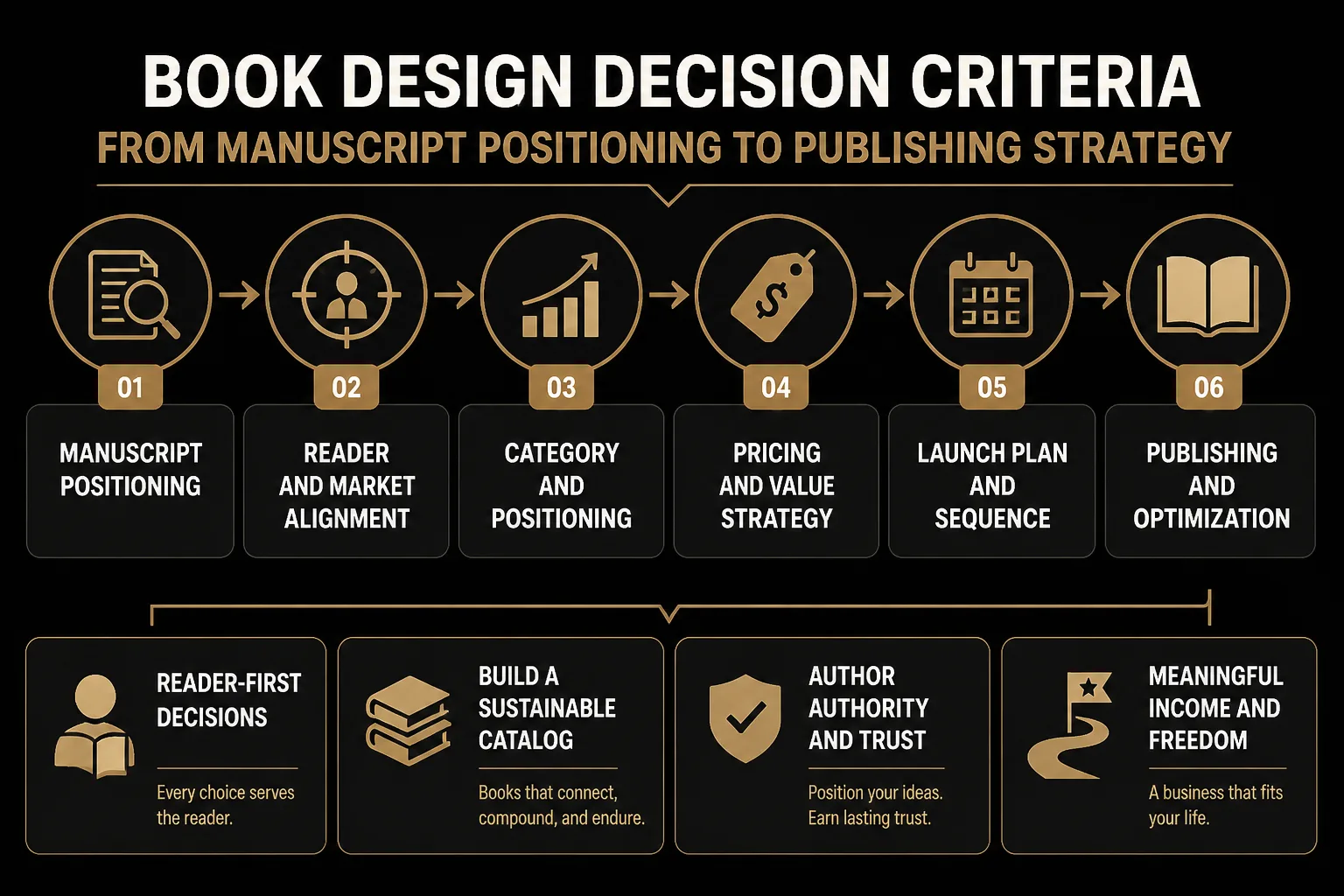
The five criteria behind every entry
Judge each recommendation against five practical questions: does it clarify your position, serve the cover or interior’s function, work across required editions, reduce production risk, and remain useful for future books? A guide to the author styles that shape books fits this workflow because your voice and audience should influence visual decisions.
- Audience: Identify the readers the design must attract and reassure.
- Promise: State what the cover and interior signal about the reading experience.
- Format: Confirm that the choice works for paperback, hardcover, ebook, or audiobook promotion as needed.
- Production: Check files, specifications, proofs, and likely failure points before release.
- Reuse: Carry the system into another title, edition, or series without starting over.
What generic cover-style lists leave out
Competitor material may list trim sizes, printing options, textures, bindings, inks, paper weights, design ideas, DIY methods, and hiring advice. Those lists name possibilities, but they rarely show when a choice supports a defined audience or sales plan. IngramSpark describes a gloss cover as having a high-shine, smooth finish, while its Digital Cloth option offers a subtle cloth-like appearance with or without a dust jacket. Neither choice is automatically better for your genre or budget.
Practical rule: Before you approve any design choice, confirm that it supports your audience, promise, format, production plan, and future catalog.
Trade-offs matter more than surface-level style recommendations. They help you build a profitable author ecosystem without treating every book as an isolated project.
A reader-first design brief for genre positioning
Will your intended reader recognize the book before reading a single page? Answer that before choosing typography, imagery, trim size, or production settings.
A design brief turns your audience, category, comparable titles, promise, tone, sales context, and back-cover message into one working direction. You can reuse it across editions and future releases instead of treating each cover as an isolated creative exercise.

How do you create a reader-first design brief
Begin by defining what your reader expects from the category and what your manuscript actually delivers. A nonfiction guide may need authority and easy navigation. A Christian title may need recognizable market cues with appropriate restraint. A memoir can signal intimacy and authenticity, while romance depends heavily on established visual signals. Your business book must communicate utility and credibility quickly.
Use the brief to support audience segmentation, Amazon SEO, pricing, and a sustainable author ecosystem. The book genres guide covering five paths for authors fits this workflow when you need to clarify your category before setting visual direction.
When is a reader-first design brief most useful
- Primary audience: Name the main reader segment, its need, and any secondary audience.
- Market promise: State the experience, result, or emotional payoff the book must signal.
- Visual and sales direction: Record comparable titles, tone, sales context, and the finished back-cover message.
Weak: “A practical guide for becoming more confident.”
Strong: “The Calm Presenter: A step-by-step system for clear, confident meetings.” You can now judge whether the design signals practical authority rather than general inspiration.
What trade-offs does a reader-first design brief involve
You give up some early creative freedom by fixing the reader and promise first. In return, you reduce attractive but misplaced design choices that draw the wrong audience. Bradley Johnson Productions connects this brief to broader publishing strategy, although its wider guidance may require more input than a single design project.
Use it if… you want a repeatable brief that keeps each new edition aligned with reader expectations and your long-term author position.
Book design for print and ebook editions
One book can feel coherent as a thumbnail, paperback, hardcover, and ebook, but each format has a different job. The cover must identify and sell the book. The interior must guide, reassure, and support the reading experience.
A paperback uses a full-color laminated cover with perfect binding, where the pages and paper cover join with glue at the spine, according to IngramSpark. A hardcover may have a dust jacket or none, while case lamination joins the pages to the hardcover at the ends, also according to IngramSpark. Those production choices affect thickness, handling, artwork, and cost.
Best use case
Use a coordinated system when you want your cover, interior, and ebook previews to feel like one product. Trim size changes page count and typography, while paper and binding affect thickness and handling. An ebook must reflow across screens, so it shouldn’t imitate a fixed print page.
Weak version: “The Quiet Ledger” uses a tiny subtitle on its cover, decorative chapter pages, and an ebook with oversized blank spaces.
Strong version: “The Quiet Ledger” uses readable thumbnail text, consistent chapter openings, linked contents, and a reflowable ebook layout.
| option | best for | strength | limitation | cost |
|---|---|---|---|---|
| Paperback with laminated cover and perfect binding | Accessible first print edition and broad everyday reading | Full-color cover with a familiar glued-spine production method | Less rigid protection than hardcover | Not specified in the supplied research |
| Hardcover with dust jacket | Premium positioning, gifting, and visible jacket artwork | Adds a removable printed jacket and hardcover presence | Requires coordinated jacket and underlying case decisions | Not specified in the supplied research |
| Hardcover without dust jacket | A simpler case-focused hardcover presentation | The hardcover itself carries the physical presentation | Fewer separate jacket surfaces for messaging | Not specified in the supplied research |
| Case-laminated hardcover | Durable editions with planned case artwork | Pages join the hardcover at the ends, with design possible beneath a jacket | Requires more deliberate cover and case coordination | Not specified in the supplied research |
- Series authors: Repeat typography, placement, and visual cues so your next release is recognizable.
- Nonfiction authors: Prioritize navigation, accessibility, captions, headings, and credible page architecture.
- Fiction authors: Protect genre signals across thumbnail tests, print proofs, and ebook screens.
Trade-off
A distinctive design may need extra artwork, separate case treatment, or edition-specific adjustments. A restrained system costs less to repeat and is easier to proof, but it can look less memorable. Bradley Johnson Productions can connect these choices to a wider author ecosystem, although broader strategy guidance requires more input than a single design project. The guide to the parts of a book fits the same workflow when you are checking navigation and front matter.
Use it if you want one design system that survives thumbnail tests, print proofs, reflowable reading, and future editions without losing its promise.
A publishing-ready workflow before launch
A strong design cannot rescue an unstable manuscript, vague positioning, or incomplete publishing plan. Treat each decision as part of the route from finished pages to the reader’s hands, whether you’re planning book printing, Amazon book publishing, or distribution through Christian book distributors.
The safest workflow exposes costly errors early. Review the manuscript, design samples, production settings, cover promise, metadata, pricing, and upload files before launch, not after readers find the problems.
Best use case
This workflow suits you when your book must support a serious publishing plan rather than exist as a single attractive file.
- Stable manuscript: Finish structural edits before commissioning final interior pages or cover artwork.
- Comparable designer review: Request sample pages, inspect relevant books, confirm the process, and verify that editable source files are included.
- Edition planning: Decide print, ebook, hardcover, distribution, metadata, and pricing requirements before final production.
How to publish a book
Stabilize the manuscript, write a reader-and-positioning brief, request sample pages, and check the designer’s workflow before approving the full project. Then align cover copy with metadata, test the cover as a small thumbnail, review a print proof, set pricing, and complete the final upload.
- Production check: Confirm trim size, bleed, paper, color settings, and editable source files.
- Cover-copy check: Weak example: “A powerful story of faith.”
- Stronger cover copy: When Faith Is Tested: “A practical guide for Christians rebuilding trust after betrayal.”
- Metadata check: Weak example: “Personal growth book.” Strong example: Christian recovery guide: “A faith-based workbook for rebuilding trust after betrayal.”
How to self-publish a book
Coordinate design with platform specifications, pricing, proof approval, and distribution requirements instead of treating design as an isolated purchase. Black-and-white printing is the most economical printing option and uses 50 lb / 74 gsm paper, according to IngramSpark, so your interior choice can affect format planning and budget.
Production choices also need early approval. IngramSpark explains that jacketed case lamination joins the pages to a hardcover at the ends and lets you choose what prints beneath the jacket.
Trade-off
A careful workflow takes more decisions before launch, but it reduces rework. You may also find that a designer with strong visual work lacks publishing knowledge, while Bradley Johnson Productions can connect design decisions to a wider author ecosystem. Broader strategy guidance requires more input than one design project.
Use it if you want your design, publishing route, and long-term author business to support the same reader promise.
FAQ
How to publish a book from finished manuscript to sale
To publish a book, finish the manuscript, prepare a professional cover and interior, choose your formats, set metadata and pricing, then upload files to the retailer or distributor that fits your plan. Order a proof before release. Treat the first edition as a complete product, not a holding place for unfinished copy or design decisions.
How to self-publish a book without skipping production checks
To self-publish a book, you keep control of the schedule, budget, files, and publishing choices, but you also own each quality check. Confirm the trim size, typography, cover dimensions, ISBN or platform requirements, sales description, and author copies before you approve distribution. A freelance editor, designer, or proofreader can handle specialist work without taking over your project.
How to publish a book in several formats
Publishing several formats works best when one edition comes first. Release the format your readers can buy and review confidently, then adapt the approved design and manuscript for ebook, paperback, hardcover, or audiobook. Check each version separately because page count, cover files, navigation, and pricing can change. Reusing a file without testing it can create expensive corrections.
One publishable edition at a time
You have the decisions needed to move from visual direction to production. The risk is trying to create every format, variation, and future edition before one version has earned a reader’s response.
Start smaller. Your first goal is one coherent, legible, financially sensible edition that teaches you what to improve. That approach turns book design into a publishing asset rather than a finished file that sits alone.
The seven-step design-to-market sequence
- Define the reader and promise: Write who your book serves, what it helps that reader do, and what experience your cover must signal.
- Document the design brief: Record genre cues, comparable titles, tone, trim size, color direction, typography preferences, and required files.
- Separate cover from interior: Give the cover its sales job and the interior its reading job. Your paperback cover needs thumbnail clarity, while your pages need comfortable hierarchy and spacing.
- Choose the first profitable format: Select the edition with a credible path to profit, whether that means ebook first, paperback first, or a carefully priced combination.
- Test at two scales: Review your cover as an Amazon-sized thumbnail, then inspect the full print layout for legibility, balance, and production errors.
- Vet the process: Ask whether your designer or production partner understands your genre, printer specifications, editable source files, and publishing route.
- Approve a proof: Examine a physical or digital proof before distribution, checking the cover, margins, page order, metadata placement, and final export.
The one-page brief to create today
Open one page and write the book’s primary reader, promise, category, comparable titles, chosen first format, price logic, and three visual signals. Add the decisions your future books should preserve, including typography, colour, and file organisation.
Bradley Johnson Productions connects this design asset to audience segmentation, Amazon SEO, pricing, future launches, and catalog growth, although broader strategy requires more input than a single design project. Preserve editable files and record each decision. Sustainable author businesses grow from repeatable systems, not isolated covers.
If you want a faster way to do this, Bradley Johnson Productions helps independent authors build profitable book businesses through book development, audience segmentation, Amazon SEO, pricing, and long-term publishing strategy. Find practical guidance in the author publishing and business strategy blog.