
You check Amazon Ads before breakfast and see clicks climbing, while your book sales barely move. The campaign looks active, yet your royalties feel thinner each day. You start asking how much should I pay per click for Amazon book advertising, whether your bid is too high, or whether your product page is failing to convert.
Most independent authors don’t have a CPC problem. They have a profitable-sales problem. Amazon Ads explains that Sponsored Products and Sponsored Brands use cost-per-click billing, so you pay when a reader clicks your ad, not only when that click produces an order.
The useful answer isn’t a universal dollar figure. Amazon Ads distinguishes between your bid, which is what you’re willing to pay, and your CPC, which is the average amount you actually pay.
This guide separates those two numbers and shows you how to set a sensible ceiling from your book’s economics, conversion rate, and wider author goals. Bradley Johnson Productions helps you build a sustainable author ecosystem where advertising supports your book, backlist, and long-term publishing business, not just maximum traffic.
The basis for the bidding method
A market average won’t tell you what a click is worth for your book. Your royalty, sale price, conversion rate, series read-through, and target audience decide whether a click supports your business or drains it.
The method ranks bidding decisions in the order you can trust them: economics first, controlled testing second, and conversion improvement third. You get a book-level method, not a generic ecommerce percentage.
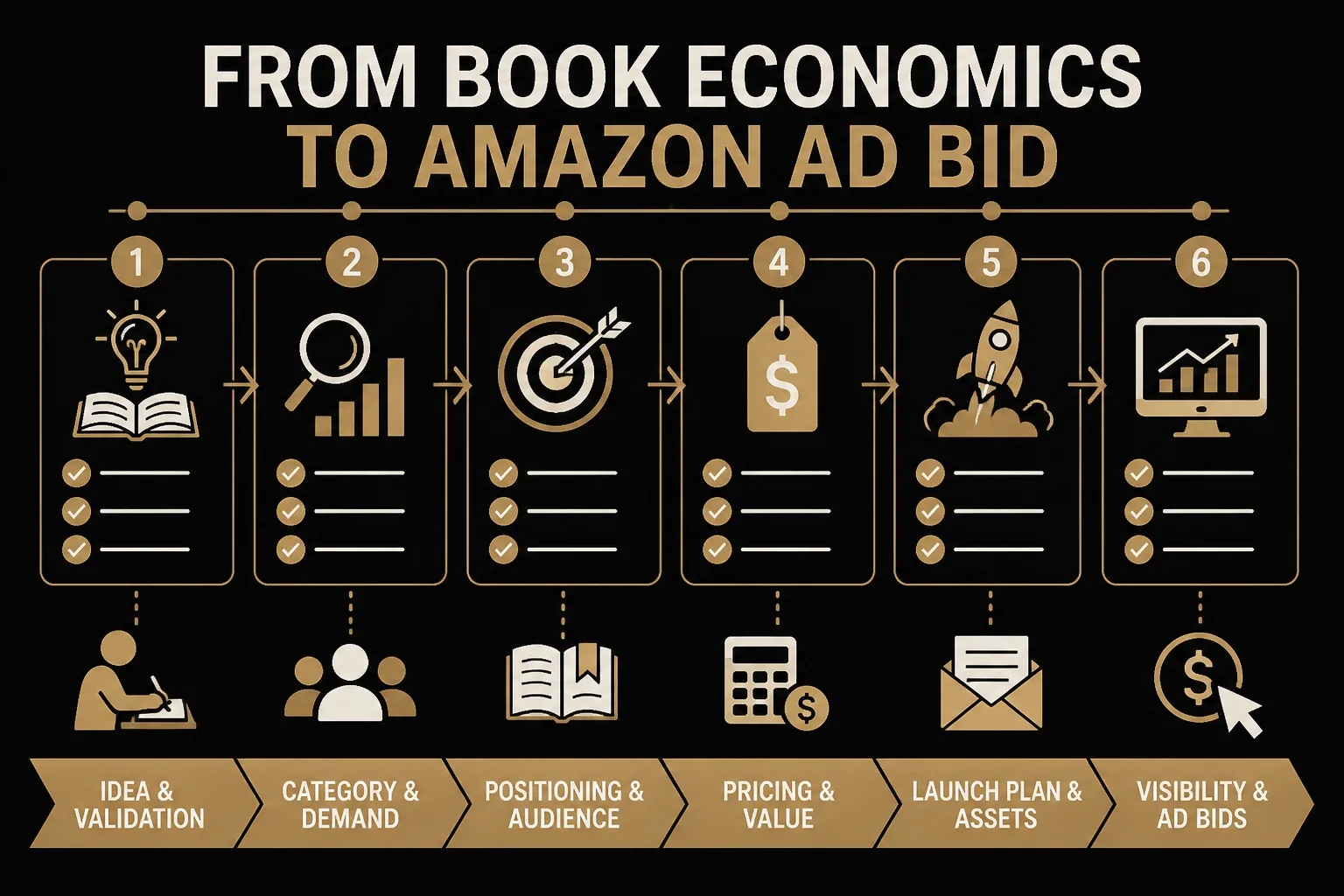
The three decision points
First, calculate the maximum CPC your book can support with this formula: sale price × target ACoS × conversion rate. Then use a bounded test when your conversion data is thin. Finally, improve targeting and product-page conversion before raising the ceiling.
- Economics: Confirm your sale price, target ACoS, royalty, and acceptable CPC.
- Evidence: Set a limited test budget and judge clicks alongside conversions.
- Optimization: Tighten relevance and improve your product page before bidding higher.
Amazon Ads says your daily budget caps how much a campaign can spend in a day. Budget control is part of the test design, not an afterthought.
What the CPC formula can and cannot tell you
The formula gives you a ceiling, not a guaranteed winning bid. It helps you compare a low-priced paperback with a higher-margin nonfiction book, while your actual auction CPC still depends on competition, relevance, and conversion.
Practical rule: Set the first bid below your maximum CPC, then raise it only when reliable conversion data supports the change.
Why a universal book-ad average is unsafe
A percentage rule can offer a rough starting reference, but it cannot replace your book’s economics. Broad ecommerce guidance often overlooks thin royalties, series read-through, and the long-term value of an author ecosystem. Your best click may sell the next book, not just this one.
This approach translates auction and conversion principles for independent authors. If you plan several releases, this guide to planning multiple book releases fits the same workflow.
1. Set your maximum profitable CPC from the book’s economics
Start with the ceiling, not a market average. Maximum CPC equals sale price multiplied by target ACoS multiplied by conversion rate.
For a $30 product targeting 25% ACoS with a 12% conversion rate, that calculation produces a $0.90 maximum CPC. Adapt it to your book’s price, royalty, conversion rate, and advertising objective. The Amazon Ads guide for authors can help you connect this calculation to campaign setup.
Best use case: choosing a ceiling before launch
Your Amazon Ads bid is the maximum amount you offer for a click. Your CPC is the average amount you actually pay through the auction. The ceiling protects your book’s economics, but it cannot replace testing your listing and targeting.
| situation | better move |
|---|---|
| A $30 product targets 25% ACoS and converts at 12%. | Use $0.90 as the maximum CPC calculation before evaluating the bid. |
| The same target and price convert at 18%. | Recalculate the ceiling; stronger conversion supports a higher CPC than at 12%. |
| A low-priced book has weak conversion. | Keep the CPC ceiling conservative and improve the listing before increasing bids. |
Best for authors protecting margin on low-priced books
- Low royalty: Keep your ceiling below a bid that could consume most of your earned royalty.
Best for authors with a measured conversion rate
- Reliable data: Recalculate your ceiling when your conversion rate changes materially.
Best for authors setting a target ACoS
- Clear objective: Match the calculation to whether you want immediate profit, launch visibility, or series read-through.
Before changing a bid, inspect your Amazon Ads clicks, spend, attributed sales, orders, conversion rate, CPC, and ACoS. A lower-priced book or weakly converting product cannot safely copy a competitor’s bid. This keeps your first bid grounded in your book’s economics rather than an unsupported industry average.
2. Use a controlled test bid when you have no reliable conversion data
When a new book or keyword has no dependable sales history, an untested bid can’t become a permanent decision. Use a bounded experiment to find out whether relevant shoppers click, buy, and support your target economics.
Amazon’s suggested bid reflects auction activity, not your book’s profitable sale price. Set a fixed daily budget, choose closely relevant targets, and review the campaign after enough activity produces useful signals. Your first goal is learning, not immediate efficiency.
Best use case: launching an unproven book or keyword
Start with tightly related search terms or products. Avoid broad targeting until your results show genuine search intent.
Best for first-time advertisers with a fixed test budget
- Fixed test budget: Cap daily spend before launching, so curiosity cannot consume your launch funds.
- Relevant targets: Begin with phrases and books closely matching your audience, not every adjacent category.
- Learning window: Give the test time to produce clicks and sales evidence before changing the bid.
Weak setup: Target broad book terms, accept Amazon’s suggested bid, and leave the budget unrestricted.
Strong setup: Target closely related phrases, set a fixed daily cap, and review CPC, conversion, and attributed orders together.
What works
- Focused targeting: You gain cleaner evidence about who finds your book relevant.
- Defined limits: You separate learning spend from scale spend.
What fails
- Broad reach: You collect ambiguous clicks that explain little.
- Suggested-bid trust: You may pay for sales that don’t meet your economics.
The trade-off is slower reach in exchange for clearer evidence. Continue when relevant clicks produce acceptable conversion and the resulting CPC supports your target. Pause or refine when spending accumulates without useful signals.
3. Improve conversion before paying more for the same click
Clicks can arrive while your book page fails to turn interest into sales. A higher bid won’t repair unclear positioning, mismatched targeting, or a weak product page.
Your conversion rate changes the maximum CPC your economics can support. At the same target ACoS, a book that converts better can justify a higher bid, so your product page becomes a cost lever before bidding does.
Best use case: clicks are arriving but sales are not
Start with relevance, then inspect the cover, title promise, description, sample, price, and audience fit. Low CTR may signal weak relevance or poor positioning. Strong CTR without sales points more strongly toward the product page or offer. There is no universal good CTR because targeting, placement, genre, and downstream conversion change its meaning.
Weak copy: “Simple budgeting tips for everyone.”
Practical strong copy: “A beginner-friendly plan for paying off credit-card debt without abandoning everyday life.” If your page needs structural review, this guide to the parts of a book fits the same listing-improvement workflow.
- Best for authors refining keywords and listing relevance: Match nonfiction promises to a clear outcome and fiction copy to expected genre signals.
- Best for authors cutting wasted clicks with negatives: Remove searches that plainly attract the wrong reader or format.
- Best for authors deciding whether to hire specialist help: Use Bradley Johnson Productions for broader strategy, while recognizing outside help still requires accurate sales data.
- Tighten relevance: Confirm each target describes the book readers will actually find.
- Review the promise: Check the cover, title, description, and sample against the ad.
- Confirm fit: Recheck price, audience, and genre expectations.
- Add negatives: Block clearly wasteful searches.
- Reassess bids: Raise CPC only after conversion improves.
What the three bidding choices mean for your book
You have three useful ways to decide what a book-ad click is worth. The right choice depends on whether your book already has dependable conversion data, needs a controlled test, or receives relevant clicks without enough sales.
Your entered bid sets a ceiling, not necessarily the amount Amazon charges for each click. A broad or competitive term may cost more while producing no better book sale, so your decision must connect bidding with evidence and reader fit.
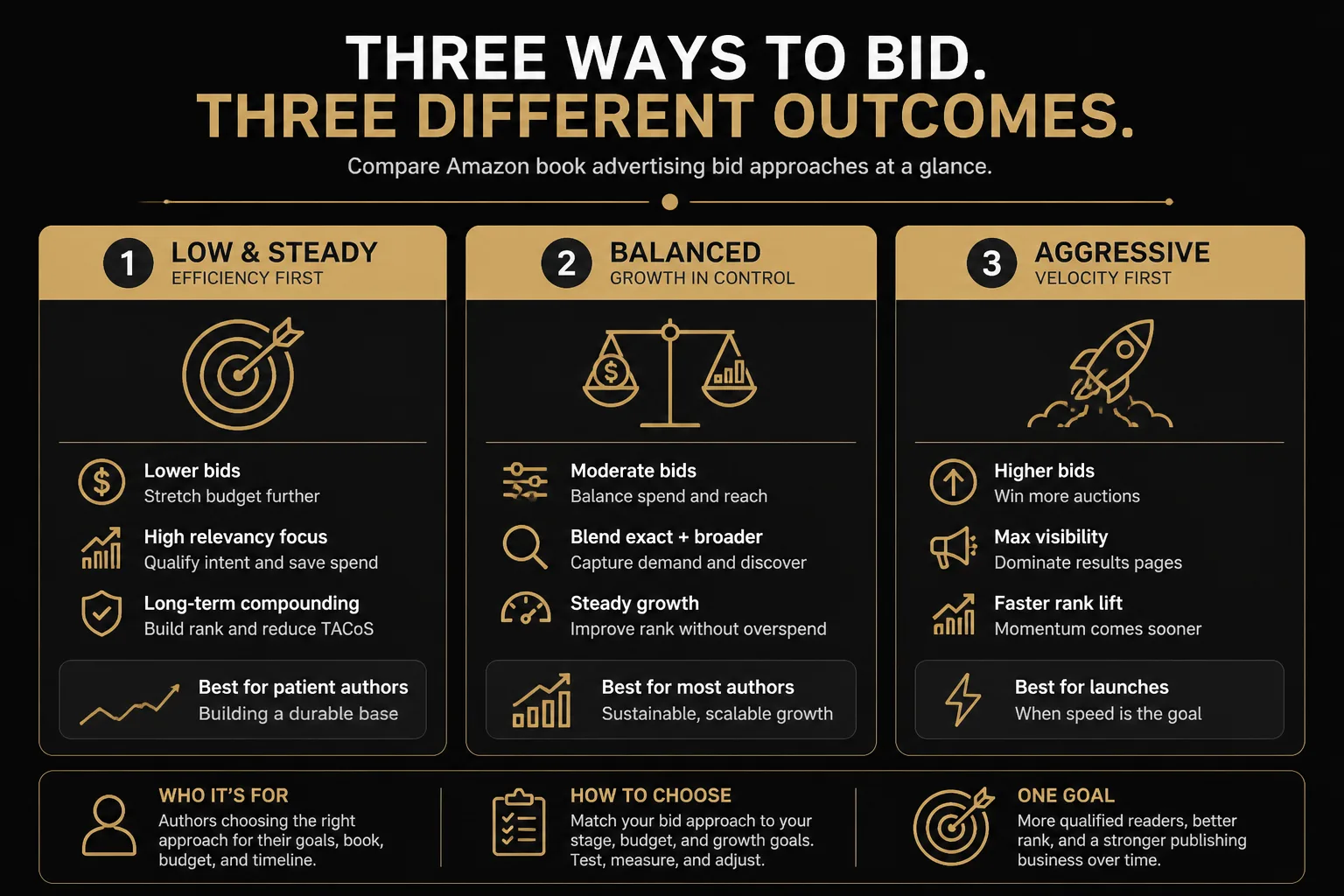
Compare the three approaches
| option | best for | strength | limitation | cost |
|---|---|---|---|---|
| Formula-based ceiling | Books with usable price, target ACoS, and conversion data | Ties CPC to the book’s economics | Requires reliable conversion evidence | Maximum CPC is sale price × target ACoS × conversion rate |
| Controlled test bid | New books or keywords without dependable conversion data | Buys information while limiting risk | Early results are uncertain | Spend is constrained by the campaign’s daily budget |
| Conversion improvement | Campaigns receiving relevant clicks but too few sales | Can raise the profitable CPC ceiling | Requires listing and targeting work before scaling | May reduce wasted click spend, but requires optimization effort |
Read the limitation before increasing the bid
The formula protects your profitability when you know your price, target ACoS, and conversion rate. Testing gives you evidence when those inputs are missing. Conversion work expands what a profitable click may be worth, but it cannot rescue irrelevant targeting or a mismatched audience.
Amazon charges for clicks, yet your entered bid is not automatically your average CPC. The safest process is to set an economic ceiling, test carefully, then improve conversion before paying more.
Questions authors still ask about Amazon book advertising
Before another click spends your royalty, judge Amazon Ads by your book’s economics, audience, and long-term publishing aim.
What is the average cost per click for Amazon advertising
There is no dependable universal average CPC for your book. Your cost changes with category competition, relevance, targeting, placement, and conversion. An industry average cannot tell you what your title should pay. Use your royalty and conversion evidence to set a ceiling, then treat market costs as context rather than a decision.
Is pay-per-click advertising worth it
Pay-per-click advertising is worth it when your spending supports a defined objective. You might seek profitable sales, series read-through, launch visibility, or audience growth. Each goal needs suitable limits and measurement. If your book page, targeting, or follow-up fails that objective, more clicks usually create expense rather than a sustainable author business.
How much does Amazon pay per click
Amazon doesn’t pay you per click. You pay Amazon when a reader clicks an eligible ad, according to your campaign’s auction and billing terms. Your entered bid is not automatically your final average CPC. Check what each click produces before deciding whether the campaign deserves more budget.
What is a good click-through rate for Amazon ads
A good CTR depends on your targeting, format, placement, category, and campaign objective. CTR is a diagnostic, not a standalone profit target. A high rate with weak sales signals a conversion problem, while a lower rate may still work when your clicks produce profitable orders or valuable series read-through.
What is an Amazon PPC specialist
An Amazon PPC specialist plans, launches, monitors, and improves your pay-per-click campaigns. The role may include targeting, bids, budgets, search-term analysis, and reporting. You don’t automatically need outside management. Bradley Johnson Productions supports sustainable author businesses, but your budget, goals, and willingness to learn should determine whether specialist help fits.
Turn your book’s numbers into the first safe bid
You can choose a bid today without guessing. Your book’s price, target ACoS, and conversion rate give you a starting boundary, while a small test protects your royalties from careless spending.
Use one page of account data, one controlled campaign, and one review point. You’ll learn what your book can support before you expand its reach.
1. Record the three numbers
- Open your data: Record your sale price, target ACoS, and observed conversion rate from your Amazon Ads and sales pages before choosing a bid.
2. Set the ceiling and test limit
- Set your boundaries: Calculate your conversion-based maximum CPC, then choose a test budget you can afford to spend for learning. A weak setup might show “Bid: $0.85” for every target. A safer setup: “Bid: $0.32” on tightly relevant targets within a defined test budget.
3. Review evidence before changing bids
- Check the signals: Review clicks, spend, orders, and conversion together. Remove waste or reduce bids first. Raise bids, expand targeting, or improve the listing only after the data identifies the bottleneck.
4. Start with the book’s sales and ad data page
- Start today: Keep the first campaign tightly relevant, then judge it against your wider author ecosystem, including backlist sales or series read-through where those apply. Bradley Johnson Productions treats this as long-term publishing strategy, not a short traffic spike.
If you want a faster way to connect ad decisions with a profitable author ecosystem, Bradley Johnson Productions provides guidance on book development, audience segmentation, Amazon SEO, and long-term marketing strategy for independent authors. The author publishing and marketing blog offers practical guidance for your next decision.