
You’ve polished a chapter until the vocabulary sounds cleaner, the sentences vary, and every comma sits where it belongs. Yet when you read the pages aloud at your desk, they still feel borrowed. You change a verb, cut a sentence, then change the punctuation again. The problem may be choosing among the types of author styles, not fixing another comma.
Most authors don’t have a grammar problem. They have a style-selection problem. You haven’t yet decided what experience your reader should have: learning through clear explanation, feeling persuaded, following a reveal, enjoying a story, or trusting a candid guide. When someone asks about author styles, they’re usually choosing more than tone. They’re choosing how the book earns attention and confidence.
The four styles below give you a practical way to compare reader experience, strengths, trade-offs, and business fit without forcing every project into one permanent label. A recognisable style can shape positioning, audience expectations, and a sustainable author ecosystem while leaving room for your latest books to serve different readers.
How These Four Author Styles Are Separated
You need a useful distinction before choosing among the styles. Surface mechanics, such as word choice, sentence length, paragraph structure, and punctuation, shape delivery. They don’t explain the reader’s dominant experience on their own.
Grammarly describes an author’s style as a unique fingerprint formed through sentence structure, tone, and delivery. Bradley Johnson Productions uses that distinction to separate purpose from presentation, although no framework can predict every reader’s response. For a related look at voice and identity, see this guide to finding your author voice.
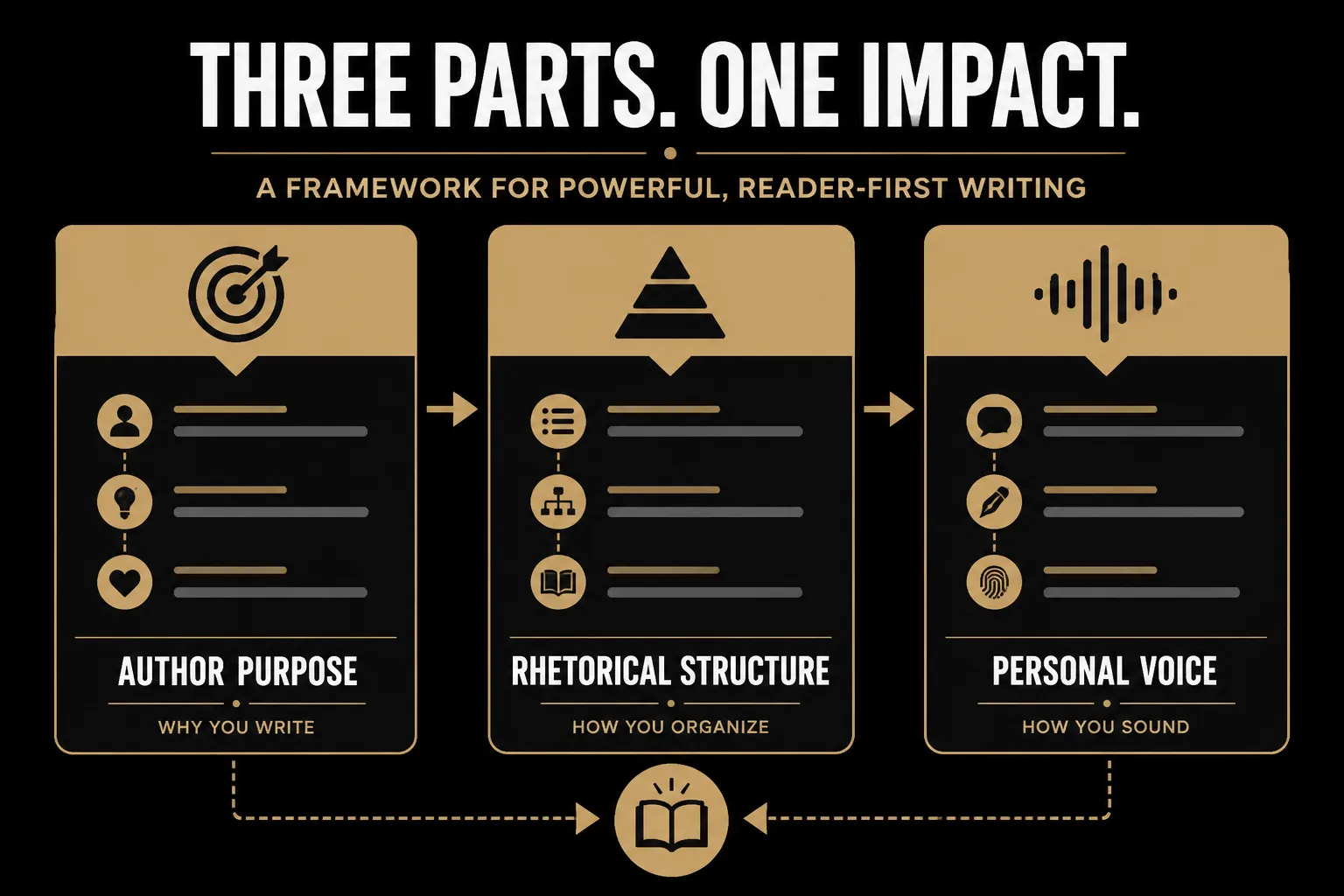
The four criteria used for every style
- Purpose: Identify what the book asks the reader to do or feel.
- Reader relationship: Check whether you guide, persuade, explain, or reveal.
- Strongest use case: Match the style to the book’s clearest job.
- Publishing trade-off: Weigh audience fit against limits in tone, format, or marketing.
How many different types of writing there are
There is no fixed number. You can combine four core rhetorical styles with literary modes, genres, and personal voice.
The seven types of writing styles
Seven-style lists often mix narrative, persuasive, descriptive, expository, technical, poetic, and reflective labels. That inventory combines purpose, genre, and mechanics, so it doesn’t give you seven author identities.
The reader experience each style is built to create
These four styles are ordered by the experience they lead: following a story, accepting an argument, understanding evidence, or trusting reflection. You may combine them, but one style should normally lead your book.
Practical rule: Choose the reader experience first, then let your sentence mechanics deliver it.
The Narrative Storyteller Style
Some readers need to remember what happened, not just what you explained. The narrative storyteller style leads them through people, scenes, tension, and change, so each idea arrives inside a journey.
You can use it in fiction or nonfiction. A novel may build escalating conflict, while a business book may teach through a customer’s turning point or a founder’s before-and-after story.
The distinction is structural, not cosmetic. You create narrative through sequence and momentum, not by copying another author’s vocabulary.

What J.K. Rowling’s writing style shows
J.K. Rowling’s accessible narrative craft gives readers clear characters, forward movement, rising problems, and satisfying change. You cannot reproduce that effect by borrowing sentence quirks or familiar words.
Narrative creates momentum and emotional investment.
The useful lesson for your manuscript is simple: build a journey readers want to continue.
Best use case
Use this style when your reader needs to experience a transformation. A memoir, leadership book, or customer-success guide can turn information into a sequence with stakes and consequences.
Best for
- Fiction authors: You can shape conflict, character choices, and consequences into an absorbing plot.
- Nonfiction teachers: You can explain an idea through a client, patient, founder, or customer journey.
- Memoir authors: You can connect personal change with the lesson your reader came to find.
Trade-off
You gain emotional engagement, but scenes, pacing, transitions, and continuity demand substantial revision time. A list of facts is faster to draft. A convincing journey takes more shaping.
Use it if your reader needs a journey rather than a list of information.
The Persuasive Guide Style
Your reader may understand the problem but still hesitate over what to believe or do. Give them a clear path from a recognisable concern to a supported conclusion without making every page sound like a command.
This style gives your argument direction. It works best when your reader needs informed movement, not just description.
Five author purposes and examples
You may write to inform, explain, persuade, entertain, or express. A persuasive guide can inform readers about Amazon categories, explain keyword research, persuade them to revise a sales page, entertain them with a client example, and express your considered view.
Three common reasons authors write
You usually write to help, influence, or connect. These motives overlap, so your practical guide may help a reader, influence a decision, and connect through shared experience.
Best use case
Define the problem, state your view, support it with relevant evidence or examples, answer objections, and offer a suitable next step. Weak: “Your book description needs work.” Strong: “Rewrite your book description around the reader’s problem, then test whether each sentence earns its place.”
Best for
- Practical nonfiction: You can turn expertise into clear decisions and useful action.
- Professional education: You can build authority while teaching a repeatable method.
- Author businesses: You can connect a strong point of view with books, services, or future content.
What works
- Direction: You give readers a reason to continue and act.
- Evidence: You make your position easier to trust.
What fails
- Overinstruction: You can make curious readers feel managed.
- Fixed conclusions: You may leave too little room for discovery.
Trade-off
You can build authority through a strong argument, but excessive persuasion feels directive when your reader needs exploration. Use it if your reader is ready for a supported decision, and soften the direction when discovery matters more.
The Analytical Expert Style
Some readers need a decision, not another pile of information. Use the analytical expert style to define terms, sort categories, test evidence, compare options, and state what each finding means.
For business, technical, educational, and research-informed nonfiction, this style turns expertise into usable guidance. Clean, short, direct sentences can improve access, according to Grammarly, but minimalist mechanics alone do not make expert writing compelling.
The three C’s of writing
The three C’s are clear, concise, and compelling. Use them as a decision test, not merely an editing slogan.
Clear writing
Clear writing lets you follow the concept without decoding specialist language. Weak: “Optimize operational outputs through strategic alignment.” Strong: “Set one sales goal for each campaign.”
Concise writing
Concise writing removes unnecessary complexity while preserving the evidence you need. Cut repetition, not useful qualifications.
Compelling writing
Compelling writing gives information stakes, examples, or consequences that matter to you. A case, scenario, or decision makes precision feel relevant.
Best use case
Use this style when readers must understand a complex issue and choose their next move.
Best for
- Business books: Compare strategies and show likely outcomes.
- Technical guides: Define systems before explaining procedures.
- Educational books: Turn research into decisions you can apply.
Trade-off
Precision can make your book feel dry if you remove every human example. Add cases, consequences, and reader-centred stakes. Use the checklist below on one representative page.
- Definitions: Every key term has a plain-English meaning.
- Evidence: Claims connect to relevant support.
- Decision: You can see what action follows.
Use it if you need to turn complexity into confident, informed decisions.
The Reflective Voice Style
Some readers want to remember the person behind the book, not just its advice. The reflective voice centres your observations, emotional honesty, and interpretation of experience, giving memoir, essays, personal growth, and values-led nonfiction a close human presence.
You can build trust when readers see how you make meaning from real events. That trust may support future books, newsletters, courses, and other relationships in your author ecosystem, but only when each reflection gives readers something useful.
Best use case
Use this style when your lived insight is the reason readers need your book. Pair reflection with a scene, question, takeaway, or usable principle. “I felt lost after leaving my job” is thin. “After leaving my job, I listed the decisions I could control, then used that list to rebuild my week” gives your reader a path.
Best for
- Memoir: Turning personal experience into meaning readers can carry forward.
- Personal growth: Connecting vulnerability with practical change.
- Values-led books: Showing the principles behind your decisions.
Trade-off
Personal expression can become self-indulgence when disclosure overwhelms structure, repeats the same lesson, or offers no external value. Bradley Johnson Productions can help you shape a trusted author ecosystem, though no publishing guidance can make unedited self-expression useful by itself.
What works
- Trust: Readers understand the person behind your information.
- Differentiation: Your interpretation gives familiar subjects a distinct position.
What fails
- Self-focus: Your story dominates while the reader gains little.
- Disclosure without direction: Emotional detail replaces a clear takeaway.
Use it if your authentic voice serves the reader. Authentic voice is shaped self-expression, not every unedited thought.
Compare the Four Styles Before You Draft
You can choose the right subject and still create the wrong reading experience. Your style affects what you must sustain across every chapter, not just your vocabulary, punctuation, or sentence length.
Use the comparison below to match your project with its repeated demands. Your best choice is usually a dominant mode supported by techniques from another style.

The style comparison table
| option | best for | strength | limitation | cost |
|---|---|---|---|---|
| Narrative storyteller | Fiction and nonfiction taught through lived experience | Creates momentum, emotional engagement, and a sense of change | Can delay the main lesson and require careful pacing | High scene, transition, continuity, and structural revision demand |
| Persuasive guide | Practical books that seek belief or action | Clarifies a problem, position, evidence, and next step | May feel too directive when readers need discovery | Moderate argument, evidence, objection, and conclusion revision |
| Analytical expert | Business, technical, educational, and research-informed nonfiction | Turns complexity into definitions, categories, and decisions | Can feel dry when precision replaces examples or human stakes | High research organization, explanation, and consistency demand |
| Reflective voice | Memoir, personal growth, essays, and values-led books | Builds intimacy, trust, and a distinctive author presence | Can become self-indulgent without a reader benefit | Moderate-to-high shaping of vulnerability, interpretation, and structure |
What the strengths reveal
Your dominant style also shapes positioning, reader expectations, product descriptions, and the language you use in Amazon Author Central. Bradley Johnson Productions can connect that choice to a wider author ecosystem, though your editorial judgment still decides what belongs in the book.
What the limitations cost
When you combine styles deliberately, you can keep a narrative nonfiction book moving while adding analytical clarity, or give a practical guide more personal trust. Your next step is this guide to audience segmentation for authors, which fits the same workflow when you decide who your chosen style must reach.
Author Styles in Publishing: Questions Authors Still Ask About Style
You may see several labels for the same writer. Context matters more than another rigid list when you’re choosing a style for your book.
Types of authors
Author types describe purpose or audience. You might be a novelist, educator, memoirist, business author, researcher, or hybrid author. Those categories describe what you write and whom you serve. Your style may still be narrative, persuasive, analytical, reflective, or a blend, so no category permanently defines your creative identity.
Four types of writers
The four useful style groups are narrative, persuasive, analytical, and reflective. You can use narrative scenes in a business book, analytical reasoning in a novel, or reflective passages in a guide. These labels describe techniques you choose for a reader experience, not fixed identities you must keep across every book.
Tools authors use to write books
Most authors use a word processor, outlining system, research database, dictation tool, or revision software. You might draft in Microsoft Word, organise chapters in Scrivener, capture sources in Notion, and dictate through a phone. Your tools affect workflow, not voice. Style comes from the choices you make on the page.
Seven writing styles with examples
Seven-style lists often mix writing modes with techniques. You may see narrative, descriptive, expository, persuasive, analytical, reflective, and creative writing. A memoir can combine narrative scenes with reflective insight, while a marketing guide can use expository explanation and persuasion. Treat these labels as overlapping options, not a permanent formula.
Turn Your Chosen Style Into a Book Decision for Independent Authors
Your manuscript may already contain a recognisable voice, but you still need to decide what that voice promises readers. Open one representative page before changing every sentence, hiring coaching, or rebuilding your outline.
Turn that small test into a publishing decision. The winning style should guide the book experience, not trap you inside a rigid formula.
Define the reader and promised change
- Label the experience: Open one representative page today, name your intended reader, and write what you want that reader to understand, feel, or do afterward. You are identifying the current experience, not judging your prose.
- Name the change: Write one sentence such as, “You help first-time freelancers replace uncertain pricing with a repeatable $2,000 proposal process.” That sentence gives your style a job.
Select and test the dominant style
- Rewrite one page: Use the four-style comparison to choose a dominant approach, then rewrite your page using its principles. You do not need to imitate another author’s surface language.
Weak version: “Pricing matters because clients have different budgets and expectations.”
Analytical version: “You can separate freelance pricing into scope, risk, and revision limits before naming your fee.”
- Ask for evidence: Show both versions to one target reader and ask which better supports the intended change. You are testing the reader’s response, not collecting compliments.
Apply the style across the author ecosystem
- Carry the principle outward: Put the winning style into your outline, product description, and Amazon Author Central profile. You can then connect it to audience segmentation, Amazon SEO, rankings, pricing, and a sustainable author ecosystem through Bradley Johnson Productions.
Consistency creates a recognisable reader promise. Your style becomes useful when it shapes every decision around the book.
If you want a faster way to connect style with book development, audience segmentation, Amazon SEO, rankings, pricing, and long-term publishing strategy, Bradley Johnson Productions supports independent authors building sustainable book businesses. You can find practical guidance in the author publishing and marketing guidance library.