
You open your sales dashboard after a promising week and still feel uneasy. Your manuscript needed more work for its intended reader, the price was chosen by guesswork, and promotion is scattered across ads, social posts, and occasional mentions. A workable marketing mix should connect those decisions. Your retailer pages and direct channels generate sales, but they don’t guide readers toward your next book. You have activity, not a dependable author business.
Most independent authors don’t have a promotion problem. They have a marketing mix problem. A book can sell while the product, price, place, and promotion pull in different directions. “You need a marketing mix,” a publishing adviser might say, meaning every decision should reinforce one reader promise and one business objective.
This guide shows how those four Ps connect for nonfiction authors, first-time launchers, fiction writers, and established indies. You’ll see how to shape the book, set its role in your catalog, reach readers through the right channels, and create the next reader action after the sale, so your books can support a profitable, sustainable author ecosystem.
Why the marketing mix matters for independent authors
You can sell a book and still lose money when its product, price, distribution, and promotion contradict one another. A practical nonfiction book with a vague cover attracts the wrong clicks, while a strong sales week may end without reviews, email sign-ups, or interest in your next title.
The phrase “marketing mix” receives 12,100 monthly searches, which shows broad interest in the idea, not guaranteed demand for an author’s book. Investopedia defines the marketing mix as the controllable tactical tools a company combines to produce a response from its target market. For you, that means each decision must reinforce the same reader promise and business direction. That starts with building a profitable author ecosystem rather than treating each book as a one-off project.
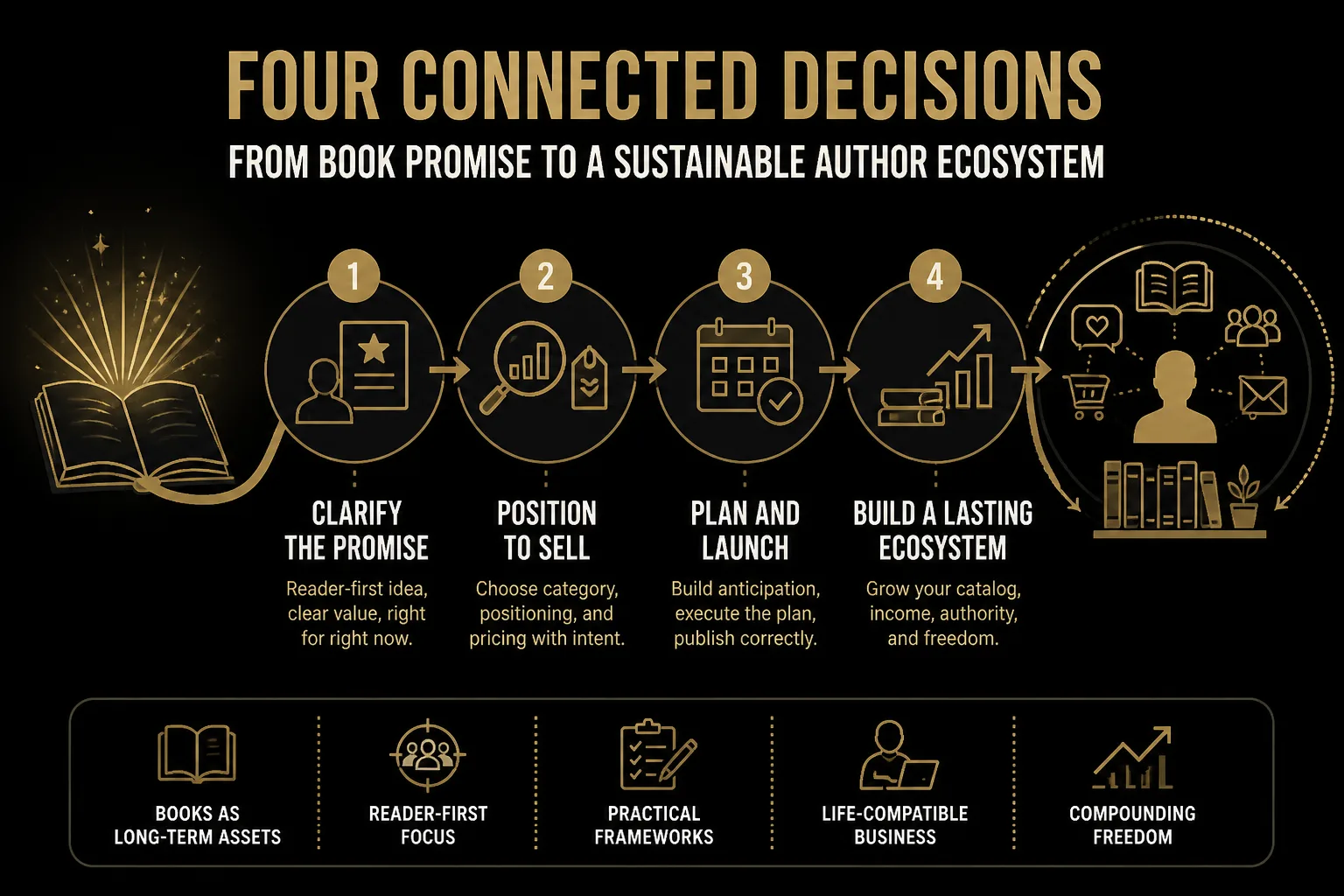
Where a disconnected marketing mix leaks revenue
When you plan each element as a separate project, the damage appears in your cash flow and catalog momentum. A mismatch between your manuscript, cover, retailer description, and price can lower conversion. Scattered ads then pay to send more uncertain visitors to the same weak offer.
| situation | better move | why |
|---|---|---|
| The manuscript promises a practical transformation, but the cover and description sound broad and inspirational. | Align the book package with the specific reader problem and promised outcome. | A consistent promise improves the chance that the right reader clicks, understands the offer, and continues to the next step. |
| A low launch price attracts bargain traffic even though the book is designed for a specialist audience. | Set price in relation to audience value, format, positioning, and the next business objective. | Price influences perceived value and revenue capacity, not just unit volume. |
| Ads, retailer pages, social posts, and the author website use different messages. | Give every channel the same audience promise while assigning each channel a distinct job. | Message continuity reduces wasted attention and makes performance easier to interpret. |
| A launch produces sales but no sign-up, follow-on offer, or reason to read another book. | Design a post-purchase path into the author ecosystem before promotion begins. | The catalog can compound only when one reader action leads naturally to another. |
Weak: “Find Your Best Self” paired with a $2.99 price and ads aimed at every nonfiction reader.
Aligned: “A 30-Day Decision System for Overwhelmed New Managers” paired with specialist positioning, evidence-led copy, and a follow-up workbook.
A marketing mix combines controllable tactical tools to produce the response you want from your target market, according to Investopedia.
The author-business rule that keeps the four Ps aligned
Before you approve a cover, price, channel, or campaign, name the reader promise and the next business objective. Bradley Johnson Productions applies this ecosystem view to book development and marketing, although its guidance cannot replace your own audience research or sales testing.
Practical rule: Every marketing decision must support the same audience promise and the next business objective.
The four Ps become seven decisions in an author business
With the reader promise and business objective in place, you need a model that shows what each decision controls, from the manuscript to the reader relationship.
The classic mix gives you four connected choices. Your author ecosystem adds three more, so your book business earns trust and repeats what works instead of restarting with every release.
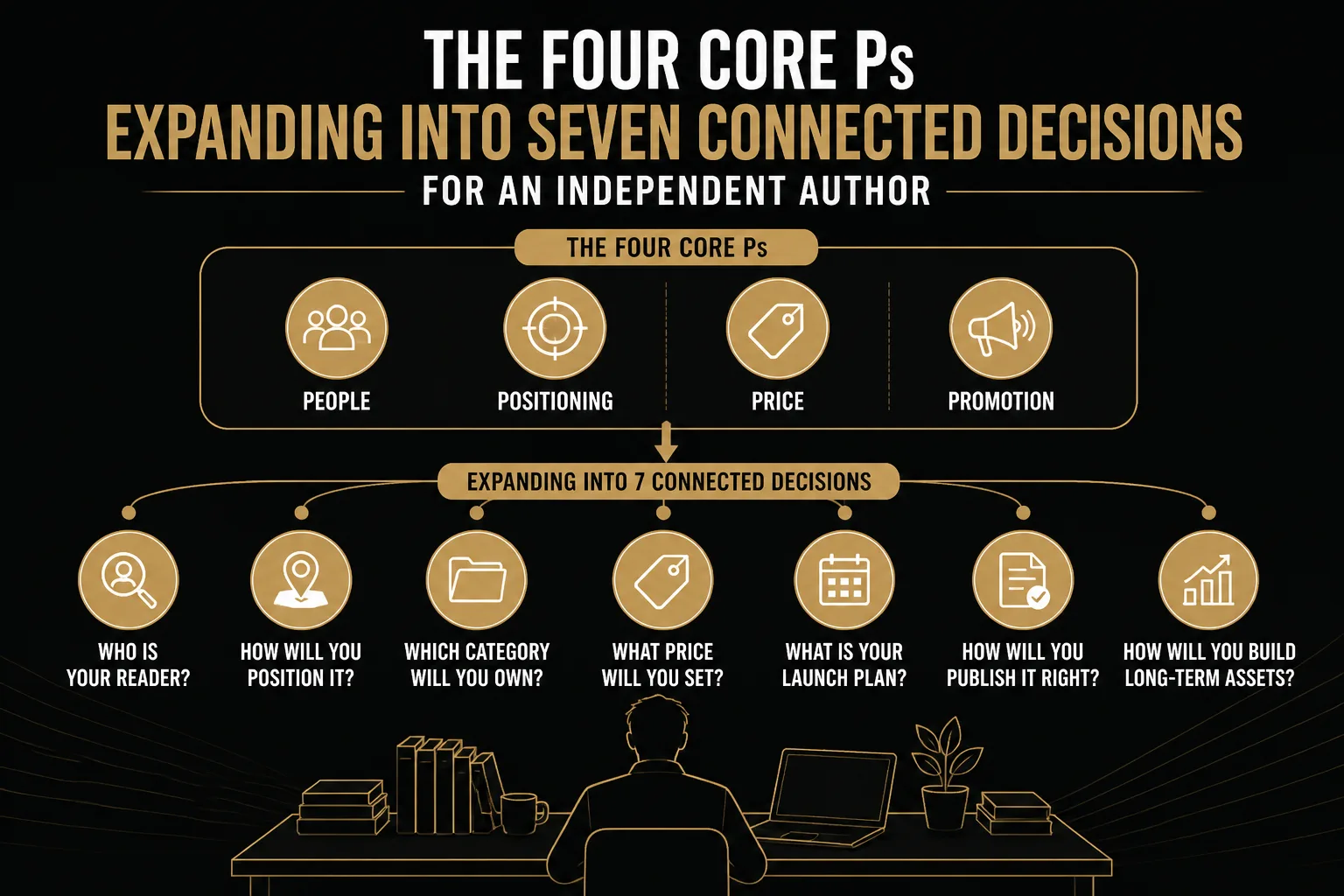
What are the four parts of the marketing mix
The four parts of the marketing mix are product, price, place, and promotion, according to Investopedia. For you, product means the book and its full reading experience, while price shapes value and revenue design. Place covers where readers discover and obtain your work. Promotion creates qualified demand rather than noise.
Investopedia describes product as the goods, services, or experiences that satisfy customer needs, including design, features, branding, and packaging. That makes your manuscript only one part of the product. A credible cover, useful metadata, correct format, and connected catalog also affect what your reader receives.
University of Maryland Extension describes place as how and where a product becomes available. For you, that can include Amazon, other retailers, your website, libraries, events, and reliable delivery.
| situation | better move | why |
|---|---|---|
| Product | Develop the book, formats, packaging, metadata, and reader experience around one clear need. | Product is the complete value offered to satisfy the reader, not only the manuscript file. |
| Price | Choose prices and discounts that reflect perceived value, format economics, and the business objective. | Price affects what readers pay, how the offer is perceived, and how the author earns. |
| Place | Select retailer, direct, library, event, and delivery channels that make the book available where the audience looks. | Distribution determines how and where readers can discover and obtain the book. |
| Promotion | Use advertising, publicity, content, partnerships, and direct outreach to create qualified demand. | Promotion communicates the offer and persuades appropriate readers to act. |
| People, process, and physical evidence | Document roles and workflows, then make every reader-facing touchpoint credible and consistent. | The extended model accounts for the experience surrounding the book and the trust signals that support an author ecosystem. |
What are the seven parts of the marketing mix
The seven parts are product, price, place, promotion, people, process, and physical evidence. You can apply them this way:
- People: You, editors, designers, narrators, publicists, and reader-support partners shape the experience.
- Process: Your repeatable workflow covers development, production, launch, measurement, and catalog follow-up.
- Physical evidence: Your retailer page, website, welcome email, cover system, reviews, and visual identity make quality visible.
If you’re refining the reader-facing product, this book design guide for indie authors fits the same workflow.
What are five coordinated marketing mix strategies
There is no universal list of five tactics. For your author business, the five coordinated strategies are:
- Product development: Build books and formats around a defined reader need.
- Pricing: Set value, format, discount, and revenue choices together.
- Distribution: Put each offer where your readers already search and buy.
- Promotion: Create demand through communication aimed at the right audience.
- Relationship-building: Turn one satisfied reader into an ongoing connection with your catalog.
Build the mix around one book, one reader promise, and one next step
You get a stronger marketing mix when one reader promise controls every decision. For a United States nonfiction author writing for first-time managers, that promise might be: Run focused one-on-one meetings that help your employees grow.
That promise shapes the chapters, cover, Amazon metadata, price, formats, distribution, launch message, and next offer. You are not promoting separate features. You are building one useful path for one reader.
The 3-3-3 rule for marketing
The 3-3-3 rule means giving your audience three useful exposures across three occasions or channels, when that pattern fits your offer. You might share a meeting agenda on LinkedIn, explain the same problem in an email, then offer the book after a practical example. Promotion includes advertising, public relations, digital marketing, sales promotions, and direct outreach, according to Salesforce.
Weak: “The Ultimate Manager Book.” Strong: “One-on-One Meetings That Work: A Practical Guide for First-Time Managers.”
The 70/20/10 rule in marketing
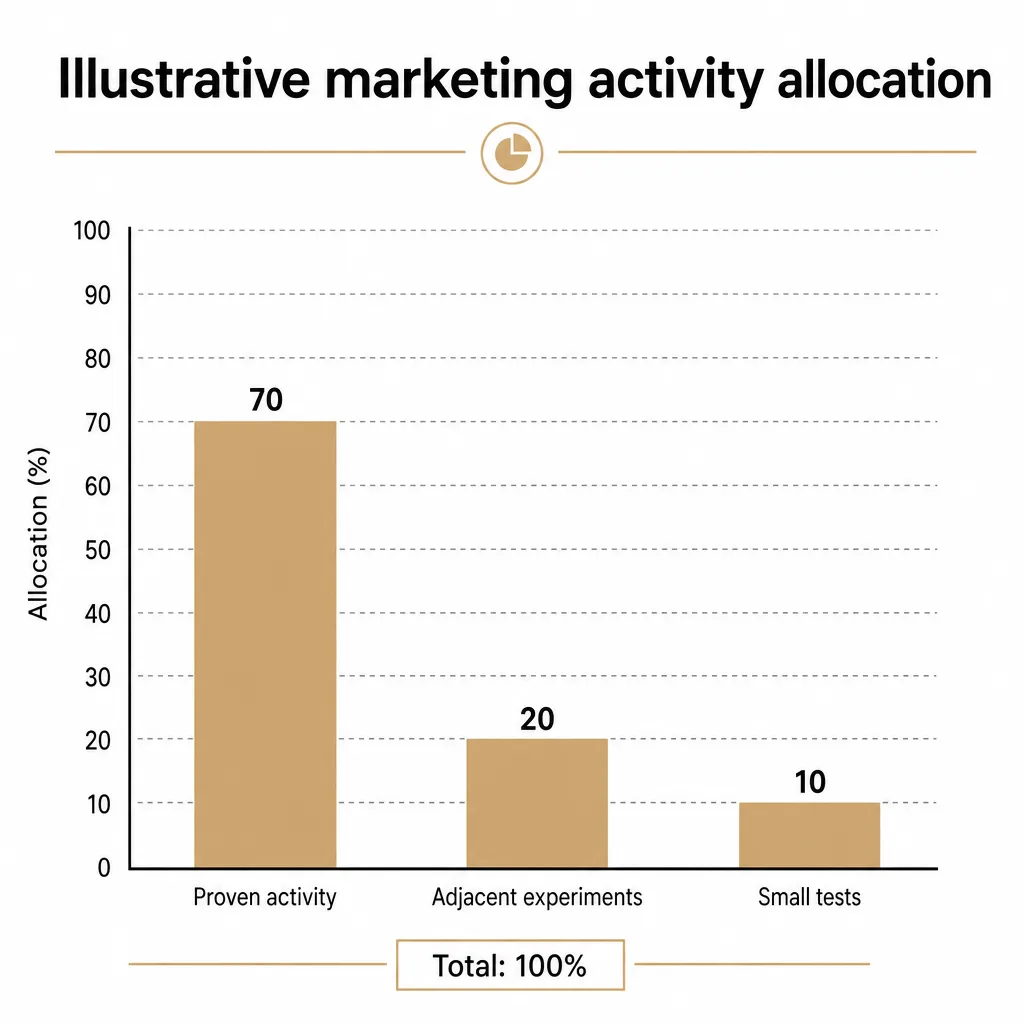
The 70/20/10 rule is an illustrative allocation: 70% of your activity goes to proven channels, 20% to adjacent experiments, and 10% to small tests. For this book, your chart would show LinkedIn posts and an email list at 70%, a manager podcast partnership at 20%, and a small Reddit test at 10%. You can adjust the split after evidence, not instinct.
The 40/40/20 rule in marketing
The 40/40/20 rule treats your offer, audience, and execution as three planning considerations. You might spend equal thought on the meeting framework, first-time managers, and the listing, launch message, and follow-up. Mailchimp notes that modern marketing mixes add 3 customer-experience elements to the traditional four Ps.
- Promise: Your chapters, subtitle, and description solve the same meeting problem.
- Metadata: Your title and search terms describe real reader needs, without keyword stuffing.
- Path: Your $9.99 ebook, paperback, and companion workbook lead to one next step.
The golden rule of marketing
The golden rule is simple: create value before asking for action. Give your reader a usable one-on-one agenda first, then invite that reader to buy the book or join your email list. That sequence turns one book into a sustainable author ecosystem.
Why universal percentages fail authors
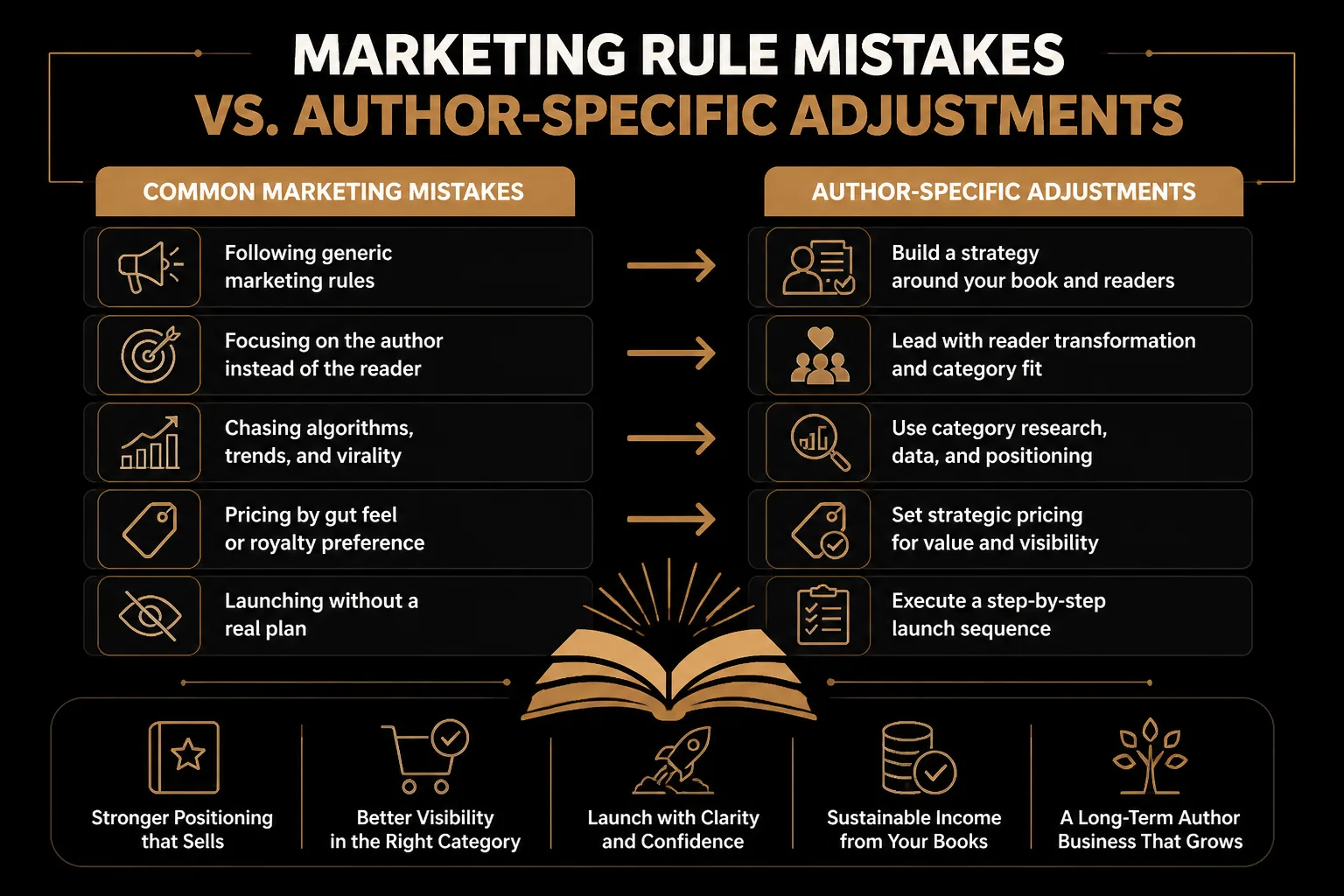
A useful rule can sharpen your judgment, but it can also disguise a weak assumption. When you apply a ratio before checking your reader promise, catalog, cash flow, and publishing schedule, your marketing mix starts serving the rule instead of your business.
You need a decision lens, not a borrowed formula. The right balance changes when you launch a new book, support a backlist title, or build a fiction series.
The 1% rule in marketing
The 1% rule is best treated as a way to identify the small share of people who may create disproportionate attention or useful word of mouth. It isn’t a promise that 1% of your audience will automatically grow your business.
You might find those highly active readers in a newsletter, writing community, book club, or professional network. Your task is to notice what they respond to, then give them a specific reason to discuss or recommend your book. If your positioning is vague, no audience ratio will repair it.
The 70/30 rule in marketing
The 70/30 rule is a planning lens that can help you divide attention between dependable activity and controlled experimentation. It isn’t a fixed budget for every launch, backlist title, or fiction series.
You may need concentrated discovery for a new release, steady reader retention for a mature backlist, or more production time between books in a series. Copying the same split across all three can misallocate your money and your working hours. Check your conversion data, catalog role, production schedule, and available budget first.
What works
- Prioritization: You use a ratio to decide what deserves attention before adding another channel.
- Testing room: You protect a defined share of time or money for experiments without endangering essential work.
- Evidence checks: You compare the rule with your audience behavior, sales path, and cash flow.
What fails
- Automatic growth: You expect a small active audience segment to expand your reach without a clear reader promise.
- False precision: You force the same split onto a launch, backlist, and series despite different business objectives.
- Hidden weaknesses: You use percentages to avoid fixing poor positioning, weak conversion, or an unsustainable production plan.
Bradley Johnson Productions treats these rules as prompts for judgment, not substitutes for evidence. You build a profitable author ecosystem by testing each assumption against your real readers, books, and cash flow.
FAQ
The 7 Ps of the marketing mix
The 7 Ps are product, price, promotion, place, people, process, and physical evidence. For an independent author, product includes the book and its formats, while place covers retailers and other sales channels. People, process, and physical evidence describe the service, systems, presentation, and trust signals that shape the reader’s experience before and after purchase.
The 4 elements of the marketing mix
The traditional 4 Ps are product, price, place, and promotion. Product is what you sell, price is what readers pay, place is where they can buy it, and promotion is how they discover it. This shorter framework gives you a useful first check before you add audience experience, delivery systems, or brand presentation.
The 5 marketing-mix strategies
One practical set of five strategies is to define the reader, improve the product, align price and distribution, choose repeatable promotion, and plan the next reader relationship. For an author, that means connecting the promise on the cover and sales page to the format, retailer, content, and follow-up offer instead of treating each decision as a separate task.
The 3-3-3 rule and the 70/20/10 rule in marketing
The 3-3-3 rule is commonly used as a planning guide: reach three audiences, use three channels, or repeat an action for three days or weeks, depending on the framework. It isn’t a universal formula, so define the version you’re using before you measure it.
The 70/20/10 rule usually divides marketing effort into 70% proven activities, 20% promising experiments, and 10% higher-risk tests. For an author, most effort might support a reliable email or retailer routine, while a smaller share tests a new partnership, ad, or content format.
Turn the marketing mix into a repeatable author-business sequence
You don’t need another burst of promotion if your book decisions still pull in different directions. You need a sequence that connects the reader promise, book product, price, distribution, promotion, and next relationship.
Mailchimp describes the extended marketing mix as 7 elements: product, price, promotion, place, people, process, and physical evidence. For you, the last three create the operating layer that makes a book business repeatable, not dependent on one launch.
The five-step marketing-mix sequence
- Define the reader: Write one target reader and one specific promise on a single page. Weak promise: “The Quiet Edge helps professionals succeed.” Strong promise: “The Quiet Edge helps first-time managers lead difficult meetings with calm, repeatable scripts.”
- Audit the book product: Check the content, cover, formats, metadata, and reader experience against that promise.
- Align price and distribution: Set the price and retailer availability to match perceived value, reader access, and your cash-flow needs. Don’t treat every format or sales channel as an automatic fit.
- Choose compounding promotion: Prioritize reusable content, retailer visibility, partnerships, and reader referrals over one launch burst. Track the evidence that shows whether your chosen channel reaches the intended reader.
- Connect the next step: Give readers a relevant next title, useful resource, or permission-based email relationship. Mailchimp defines process as the workflows and delivery steps that provide the product, so you need a clear handoff after purchase.
When the cover fails to signal the right category, you can use Bradley Johnson Productions’ guide to choosing book cover designers for hire. A cover check belongs beside the content, format, metadata, and reader-experience review, not after the promotion has already started.
People shape how readers experience your author business, including customer service and the culture behind every interaction, according to Mailchimp. Physical evidence includes your retailer pages, cover, website, receipts, and other trust markers, so these details should support the promise rather than contradict it.
Start with one marketing-mix alignment page
Before you change a listing or launch a campaign, complete one page. Use this checklist to make your next decision visible.
- Target reader: Name the person, situation, and problem your book serves.
- Promise: State the useful result in one sentence.
- Offer: Record the title, format, price, and strongest reason to buy now.
- Primary channel: Choose the retailer, audience, partnership, or content channel you will monitor.
- Evidence: Note the one signal you will check, such as qualified clicks, sample reads, reviews, or sales by format.
- Next action: Write the smallest change you will make after reviewing that evidence.
Complete the sheet today. Then use it to judge the listing, campaign, or workflow before changing any part of your mix.
If you want a faster way to build this sequence, Bradley Johnson Productions provides guidance on book development, audience segmentation, Amazon SEO, pricing, and long-term publishing strategy for independent authors building profitable, sustainable book businesses. Its author-business guidance and publishing insights can support decisions that help your books do more.