
Ever wonder why some ads on the platform feel like a money pit while others actually boost your sales? You’re not alone. Most authors jump in without understanding the pricing mechanics and end up spending more than they earn. But here’s the good news: there’s a free promotion tier that reaches 1.5 million readers. That’s right, $0 spend can put your book in front of a huge audience. In this guide, I’ll walk you through exactly how author ad pricing on the platform works, how to set up campaigns that don’t waste your budget, and how to optimize every dollar for maximum returns.
Step 1: Understand the Ad Pricing Models
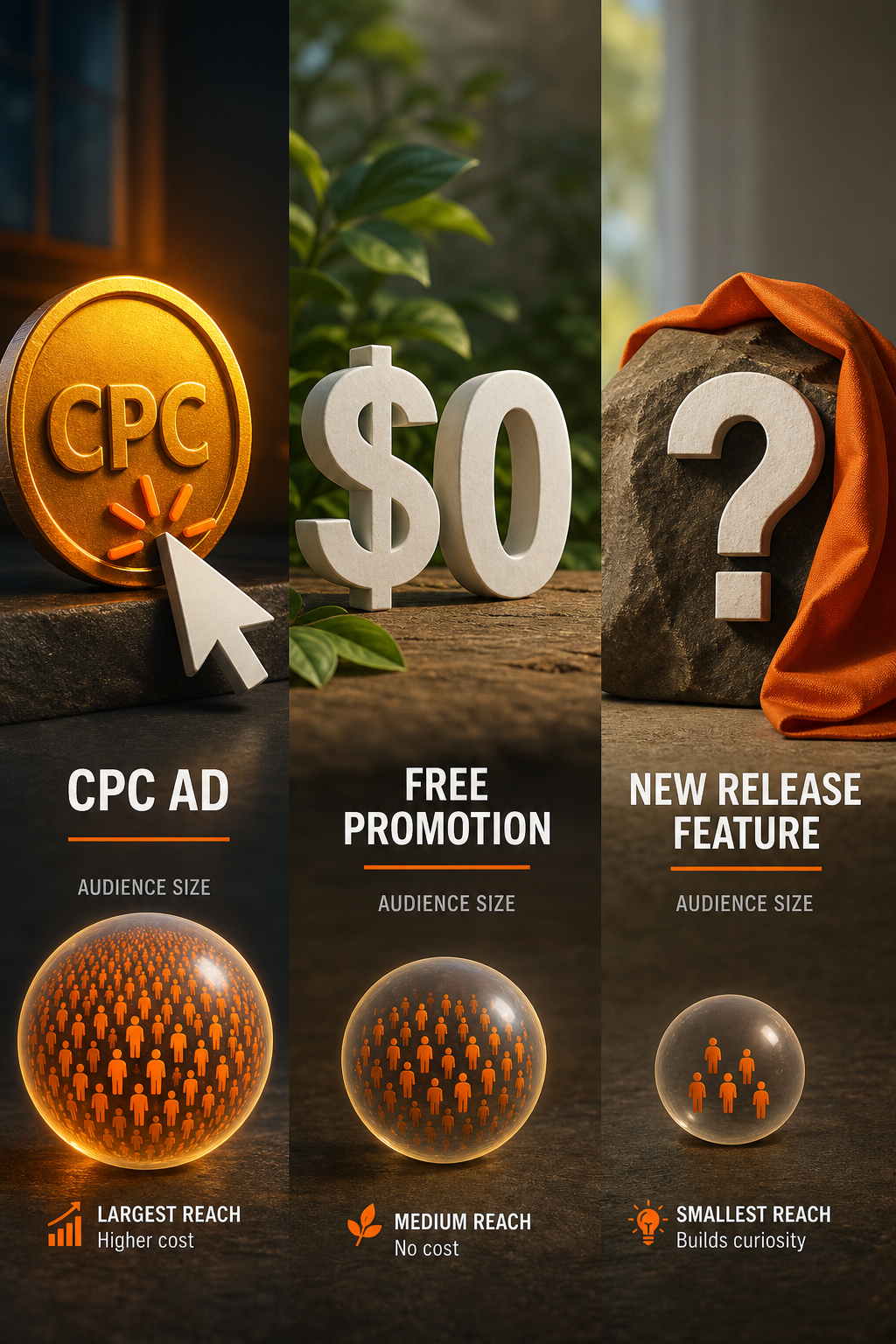
This advertising service offers three distinct ways to promote your book. Each one has a different pricing model, audience size, and targeting depth. If you don’t know the differences, you’ll likely overpay or choose the wrong option. Let me break them down.
CPC Auction Ads, This is the standard pay-per-click model. You bid on a cost-per-click, with average CPC between $0.35 and $0.45. You need a minimum daily budget of $10 to $15. The platform targets readers based on genres and comparable authors. These ads reach about 2.5 million newsletter subscribers. According to Wikipedia’s definition of cost per click, you only pay when someone actually clicks your ad. That makes budgeting easier, but you still need to win the auction.
Free Promotion, This one costs exactly $0. You submit your book to be listed in the free/under-$1 email. It reaches roughly 1.5 million readers, but you can only target by genre. It works best if you already have a backlist of other books. If you’re a debut author with just one title, the free promo is less effective because readers who download a free book have nothing else to buy from you.
New Release Feature, The price for this option isn’t publicly listed. It’s designed for fresh releases and gets placement in the New Release newsletter. The targeting is limited, and many authors skip it because the return on investment is uncertain. If you have a strong launch plan, it might be worth testing, but I’d start with the other two.
Across all three options, the average cost per click (including the $0 free promotion) is only $0.17. That’s much lower than most authors expect. But the free promo only works if you have other books to sell after the free download. Keep that in mind.
Step 2: Set Up Your Ad Campaign Creatives
Once you know which pricing model fits, you need to set up your campaign. The process is simple once you’ve claimed your author profile. If you haven’t done that yet, go to the platform’s partners page and create a free account. It takes two days to verify, then you can upload your bio and book list.
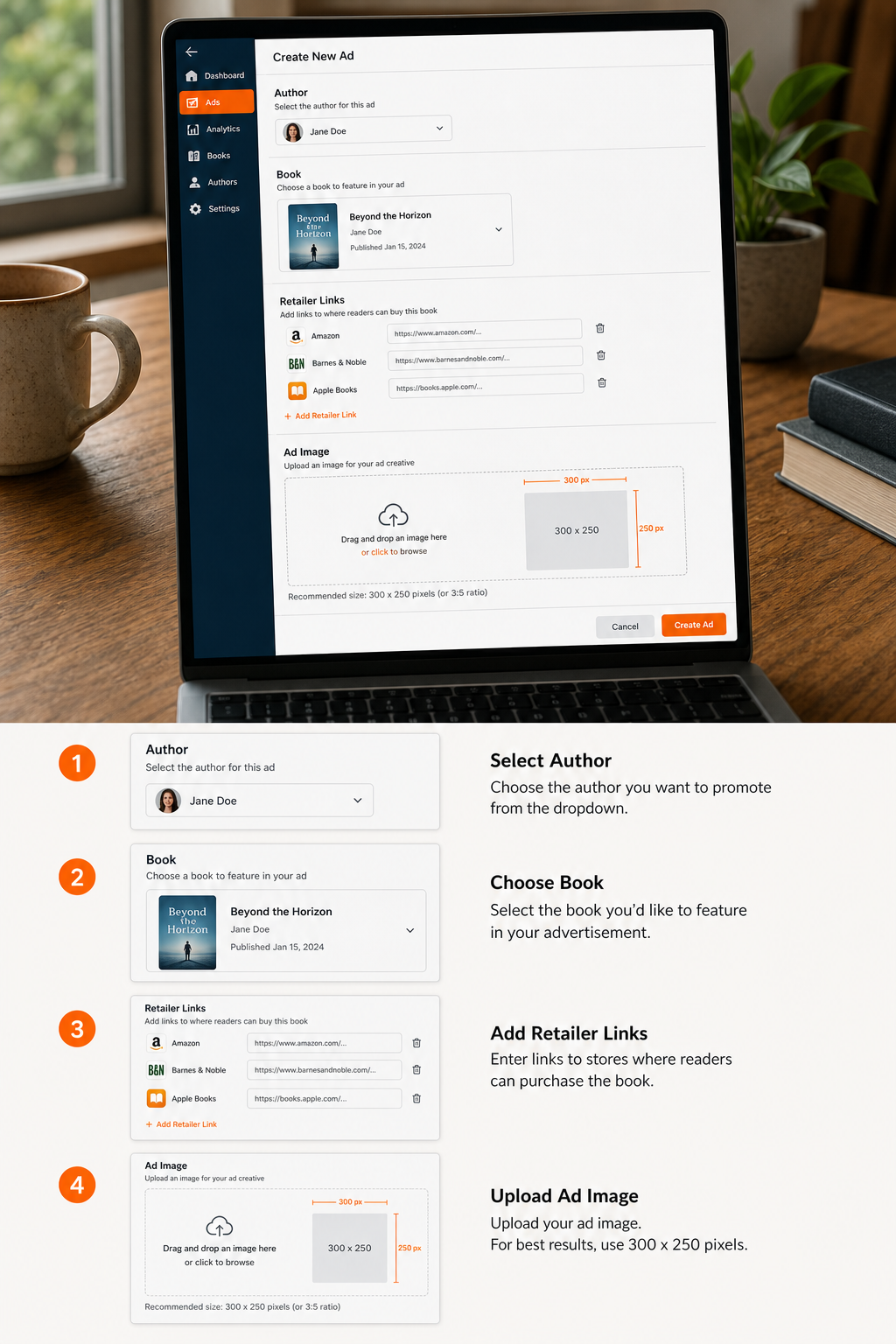
When your profile is ready, click “Create an ad” in the sidebar. You’ll see a single-page interface. Choose the book you want to promote from a dropdown menu. The platform will automatically fill in retailer links for major retailers. You can also enter custom links, like your own website or affiliate links. But you can’t link to a reader magnet page, the platform doesn’t allow list building through ads.
Next, choose your target store and country. For your first campaign, stick with a large US retailer. It’s the most competitive market, so if your ad works there, it’ll work elsewhere. You can also target audiobook readers through the platform’s audiobook service. That’s a smart move if you have an audiobook version.
Pro tip from experienced authors: most people just paste simple retailer URLs. Instead, use tracking links from URL-shortening or analytics services. That way you can see exactly which ad sends the most sales. The platform only allows links to your product page or your own website , no lead magnets.
Image specs are strict: 300 × 250 pixels. Keep it clean and simple. You don’t need a busy design. Just your cover, a short tagline, and a price or call to action. How to Market a Nonfiction Book: A Concise, 3-Phase Guide has more tips on ad creatives that convert.
Step 3: Define Your Target Audience for Maximum ROI
Targeting is where most beginners mess up. They either target too broadly or pick the wrong comparable authors. Let me show you how to get it right.
The platform lets you target by genre and by comparable authors. On the surface, it looks like other ad platforms. But there’s a hidden difference. When you select an author like “Scarlet Cole,” the platform shows your ad to readers who follow that author on the platform. Those readers are already fans, they opted in to get emails about that author’s deals. That’s why indie authors make better comps than Stephen King. Stephen King’s followers are huge and not necessarily interested in your niche fantasy.
Test one comparable author at a time. If the targeting needle shows red, your audience is too small. Add one more author. Don’t combine five at once, you’ll waste impressions on the wrong people. You can also narrow by country and store. For example, target only users of a specific store in Canada. That level of granularity is unique to this service and helps wide authors grow on other platforms.
Here’s a step-by-step technique I recommend: list 5 to 10 comparable authors whose books are similar to yours. Rank them by how closely they match. Start tests with your top 2 or 3. Run the same ad with different author targets and compare the click-through rates. The one that gets the highest CTR is your true audience.
Also consider reader segments. The platform assigns readers to categories based on their browsing history. You can target “budget readers” or “genre enthusiasts.” But for beginners, stick with genre and comparable authors. It’s simpler and gives clear data.
If you need help refining your target audience, check out Author Advertising Agencies Pricing: Step-by-Step Guide 2026 for guidance on whether an agency can help you optimize your targeting.
Step 4: Set Your Budget and Bidding Strategy
Now it’s time to talk money. Your budget depends on which pricing model you chose. For CPC ads, start with a daily budget of $10 to $15. That’s enough to generate data without breaking the bank. Many authors ask, “What’s the minimum I can spend?” The answer is $10 per day. Some campaigns let you go as low as $5, but your ad will rarely show, so you won’t learn anything.
Bidding is where you choose between CPC (cost per click) and CPM (cost per thousand impressions). Most beginners pick CPC because it feels safer. But here’s the catch: if you bid too low, your ad never shows. The platform’s auction system favors higher bids. So on your first campaign, use CPM bidding. That charges you per 1,000 impressions, not per click. It ensures your ad gets seen, and you can collect data on which images and targeting work.
Set your bid 25% higher than the platform’s suggested average. That’s a trick I learned from successful indie authors. It puts you ahead of most competitors without overpaying. For example, if the suggested CPM bid is $6, bid $7.50. This gives you a competitive edge.
Once you have at least 10,000 impressions and know your best-performing creative, switch to CPC bidding. Then you can control your cost per click more tightly. Aim for a CTR of 0.5% or higher. Anything below that means your image or targeting needs work.
A quick note on the free promotion: it has no budget to set. You just submit your book and wait for approval. But you still need to schedule it around your release calendar. Don’t run a free promo during a period when you have no other books available.
For a detailed comparison of ad costs across platforms, see Author Ad Pricing: A Step-by-Step Guide for 2026. It helps you decide where your money works best.
Step 5: Write Compelling Ad Copy and Design Visuals
Your ad image is the only thing the reader sees in their email. No description, no reviews. Just the image. That means the image has to do all the work. The ad platform requires 300 × 250 pixels. You can use their built-in creator, but you’ll get stronger results with a dedicated design tool that offers more flexibility.
Copy rules: Keep it short. Include the book’s title, price, and a short tagline. If your book is a series, note that book one is on sale. Mention a comparable author if space allows. For example: “Fans of Brandon Sanderson will love this epic fantasy.” That builds trust immediately.
Design tips from experience: use a high-contrast background so the title pops. Avoid clutter. One primary image (your cover) and one call-to-action button (like “Buy Now” or “Free Download”). Use the same brand colors across all your ads for consistency.
A/B test your images. Create two versions: one with a simple cover against a white background, another with a lifestyle photo or a blurred background from your cover. Run both with the same targeting and budget. After 5,000 impressions, compare CTR. The winner is your go-to design.
You can also hire a professional designer through a freelance platform, but for beginners, free community templates from design tools are effective. They have over 300 ad templates ready to customize. Just swap your cover and change the text.
If you’re still unsure about ad copy, read Best Author Book Promotion Service Rates Guide 2026 for professional copywriting services that can help.
Step 6: Launch, Monitor, and Measure Results
Before you hit launch, double-check everything: your ad image meets the 300×250 spec, your tracking links work, and your daily budget is set. Then click Create Ad. Your campaign goes live immediately.
Monitor daily for the first week. Check impressions, clicks, CTR, and effective CPC. The ad platform’s dashboard updates in real time. Look for patterns: does your CTR drop after the first two days? That might mean the same people are seeing your ad over and over. If you reach 20,000 impressions but still have a CTR under 0.2%, pause the ad and change targeting or image.
Measure sales by linking to your sales reports or other retailer dashboards. Use unique tracking URLs per campaign. A common mistake is to look only at clicks. Clicks don’t equal sales. You need to compare ad spend to royalty earned. Aim for a return on ad spend (ROAS) of at least 3x. If you’re not there yet, test different ad elements before scaling up.
To amplify your results beyond the ad platform, consider using AI tools for social media promotion. A curated list of AI social media tools can help you repurpose your ad copy and reach even more readers.
Step 7: Optimize with A/B Testing and Advanced Tactics
Once you have a winning campaign, don’t stop. The best authors continuously refine their ads. Use A/B testing to optimize every variable:
- Image variations: Test different backgrounds, fonts, or CTA button colors. Change only one element per test.
- Copy changes: Try a different tagline or mention a different comparable author.
- Audience slices: Test one author comp vs. another, or genre-only vs. reader segments.
To run an A/B test, duplicate your ad, change one thing, and run both at the same budget for 5, 7 days. Check CTR and effective CPC. The ad with the lower effective CPC at the same or higher CTR wins. That’s your new baseline.
Advanced tactic: use the three-test method. In round one, test three images. In round two, test the winning image with three different audience targets. In round three, test the winning combo at three different bid levels. This gives you a near-perfect campaign in three weeks.
Another pro move: if you have multiple books, set up retargeting indirectly. Create an ad for book one at a loss leader price. Then ensure the reader can easily find book two and three on your online retailer author page. The ad platform doesn’t offer retargeting, but you can do it through your own email list. Offer a bonus chapter in exchange for an email sign-up on your website.
When you scale your budget, do it slowly. Increase by 20% every 3 days. If effective CPC stays stable, keep scaling. If it spikes, the new traffic may be lower quality. Pull back and refine targeting.
For a broader launch strategy, see Best Author Book Launch Pricing Strategies to integrate ads into your overall launch plan.
Frequently Asked Questions
What is the minimum budget for ads on the platform?
The minimum daily budget for the platform’s CPC ads is $10 to $15. You can set a lower amount, but your ad will rarely show. For the platform’s free promotion, the budget is $0 , you only need an approved book and a backlist. Start small and scale up once you see positive results.
How do I know if my ad on the platform is profitable?
Compare your ad spend to royalty earned from sales attributed to the ad. Use tracking links to measure conversions. A common target is a return on ad spend (ROAS) of 3 or higher. If you’re spending $50 and earning $150 in royalties, that’s a 3x return. Track this weekly and adjust underperforming ads.
Should I use CPC or CPM bidding for my first ad?
Use CPM (cost per thousand impressions) for your first campaign. It ensures your ad gets seen even if your bid is average. Once you have data on which images and targeting work, switch to CPC (cost per click) to control costs. CPM is better for learning; CPC is better for scaling.
How many comparable authors should I target?
One per ad test is ideal. If the targeting needle shows red (too small), add a second author. Avoid using more than three at once. Combining too many authors dilutes your audience and makes it harder to know which author’s fans are converting. Test them one by one.
Can I run an ad on the platform for a full-price book?
It’s not recommended. Readers on the platform are deal hunters. They signed up to find free or cheap books. Advertise books priced at $0.99, $1.99, or free. If you must advertise a full-price book, use it for exposure and brand-building, but don’t expect a high conversion rate.
How long does it take to ub ad?
You’ll see impressions within minutes of launching. Clicks may take a few hours to accumulate meaningful data. For sales, wait at least 3 days to evaluate. The first few days are often the strongest because the audience is fresh. Let the ad run for at least 7 days before making major changes.
Is the platform’s free promotion worth it?
Yes, but only if you have a backlist of other books. The platform’s free promotion reaches 1.5 million readers at no cost. If one of those readers downloads your free book and then buys your other titles, the promotion pays off. For debut authors with one book, it’s less valuable because there’s nothing else to sell.
Can I target readers on specific retailers like a particular bookstore?
Yes, the platform lets you choose the target store and country. You can run ads that only appear to users of a particular bookstore in the UK, for example. This is especially useful for wide authors who want to grow sales on platforms other than the most popular retailer. Start with the most popular US retailer for your first tests.
Conclusion
Author ad pricing doesn’t have to be a mystery. You’ve learned the three main options: CPC ads at $0.35, $0.45 per click with a $10 daily minimum, the free promotion for $0, and the premium promotion slot with undisclosed pricing. Each serves a different purpose. The free promotion is a no-brainer if you have a backlist. The CPC ads are worth testing once you have a budget dedicated to learning.
Set up your author profile, create compelling visuals at 300×250 pixels, and target one comparable author at a time. Use CPM bidding at 25% above the suggested rate to get your ad seen. Measure ROAS and iterate with A/B testing. Remember, the goal isn’t just to spend money, it’s to spend money that comes back with a profit.
If you travel for book tours, planning logistics well helps you focus on marketing. Reliable transport can make a difference. For example, arranging a dependable local chauffeur service can offer a smooth travel experience for authors attending events. Every detail counts when you’re building your brand.
Now go apply these steps. Start with a small test campaign, learn from the data, and scale what works. Your readers are waiting.