
Your book can be brilliant, but if the description reads like a table of contents, readers will scroll past it. A weak description is one of the most common reasons good non-fiction books underperform , and most authors don’t fix it because no one showed them the actual structure. This guide walks you through every step, from the first hook to the final call to action.
Step 1: Understand the Core Elements of a Book Description
Before you write a single word, know what a book description actually needs to do. It’s not a summary. It’s a short sales page. Its job is to make the right reader feel like this book was written for them , and then get out of the way so they can buy it.
Research across dozens of publishing guides and video breakdowns points to nine core elements that effective non-fiction descriptions share: a Hook, a Problem Statement, Benefit Statements, an Outcome Promise, Credibility Signals, Bullet Points, SEO Keywords, a Call to Action, and a Reminder. You won’t always need all nine , the mix depends on your genre , but the Problem Statement and Benefit Statements are non-negotiable. Without them, you’re describing a book instead of selling one.

Think of it this way: a reader picking up a non-fiction book isn’t asking whether they’ll enjoy it; they’re looking to see if the book solves their problem and if the author is credible. Your description has to answer both questions fast , usually within the first three lines, before the reader hits “read more.”
Publishing platform guidelines note that your description is part of your book’s core metadata. That means it affects discoverability, not just conversion. Getting the structure right matters twice over.
If you’re still working out what your book is actually about at its core, it helps to have the outline locked first. The step-by-step nonfiction outline guide at Bradley Johnson Productions walks you through defining your book’s central idea before you write a word of marketing copy.
Step 2: Research Your Target Readers and Market
You can’t write a description that resonates if you don’t know who you’re writing for. This step happens before you open a blank document.
Start by writing one sentence about your ideal reader. Include their main frustration, what they’ve already tried, and what they actually want. That sentence becomes the compass for everything else in your description. If you can’t write it, you don’t know your reader well enough yet.
Then look at the market. What non-fiction books are selling right now in your category? What language do their descriptions use? What problems do they name in the first paragraph? You’re not copying them , you’re learning the vocabulary your reader already responds to. According to Wikipedia’s overview of book descriptions, the text that appears on a book’s product page is one of the primary discovery tools readers use when browsing online retailers.
Pay attention to reader reviews of competing titles too. The language readers use in five-star reviews , the specific phrases, the problems they mention being solved , is the same language that should show up in your description. It’s already pre-tested by the market.
One usable move: look at the reader survey approach for nonfiction book ideas to validate what your audience actually wants before you commit to a description angle. Knowing your reader’s exact pain points makes the next steps much sharper.
Step 3: Craft a Hook That Grabs Attention
The hook is the first one to three lines of your description. On Amazon, it’s often the only thing a reader sees before deciding whether to click “read more.” So it has one job: make them keep reading.
For non-fiction, a strong hook does one of two things. It names the reader’s exact problem so precisely they feel seen. Or it makes a bold, specific claim about what the book delivers. Vague hooks fail because they do not speak to a specific reader.
The hook should also carry your book’s tone. If your book is direct and no-nonsense, the hook should be too. If it’s warm and story-driven, let that come through. Readers make a snap judgment about whether the writing style is for them , your hook is their first sample.
One common mistake flagged across multiple publishing guides: a hook that over-promises without the description escalating to back it up. The hook creates a gap , a question or a tension. The rest of the description has to close that gap with credibility and specifics. If the hook promises transformation but the next paragraph lists chapter topics, you’ve lost the reader.
At Bradley Johnson Productions, the coaching program specifically trains non-fiction authors on copywriting fundamentals for descriptions , including how to write hooks that match the book’s actual voice rather than sounding like generic ad copy.
Step 4: Highlight Benefits and Outcomes
This is where most non-fiction descriptions fall apart. Authors list features , what’s in the book , instead of benefits , what the reader gains. The difference matters more than almost anything else in the description.
A feature sounds like: “Chapter 4 covers email management techniques.” A benefit sounds like: “You’ll cut your daily inbox time in half using one system you can set up this afternoon.” The reader doesn’t buy chapters. They buy the result.
For every feature your book contains, ask: what does this actually give the reader? What can they do differently, or better, or at all, because of this content? That answer is the benefit , and it’s what belongs in your description.
Bullet points work well here. A list of five to seven specific, benefit-focused bullets gives readers a fast way to scan and find the value most relevant to them. Keep each bullet to one clear outcome. Don’t start every bullet with the same word. And never use a bullet to restate the chapter title , that’s a feature, not a benefit.
Close this section with an outcome promise. What does the reader’s situation look like after they’ve applied what your book teaches? The promise needs to be specific and believable. “You’ll be a millionaire in 30 days” isn’t either. “You’ll have a pricing framework you can apply to every client conversation from this week forward” is both.
If you’re thinking about how the description fits into your broader launch plan, the book launch checklist for non-fiction authors covers when to draft your description and how to get feedback before publication day.
Step 5: Use Clear, Concise Language and SEO Keywords
Plain language isn’t dumbing down. It’s respect for the reader’s time. Every sentence in your description should pass this test: would a smart person who hasn’t read your book understand this immediately? If not, rewrite it.
Cut jargon unless your reader already uses it and expects it. Cut filler phrases. “In today’s fast-paced world” says nothing. “If you’ve been burned by every productivity system you’ve tried” says something real. Prefer short sentences. One idea per sentence. Let the description breathe.
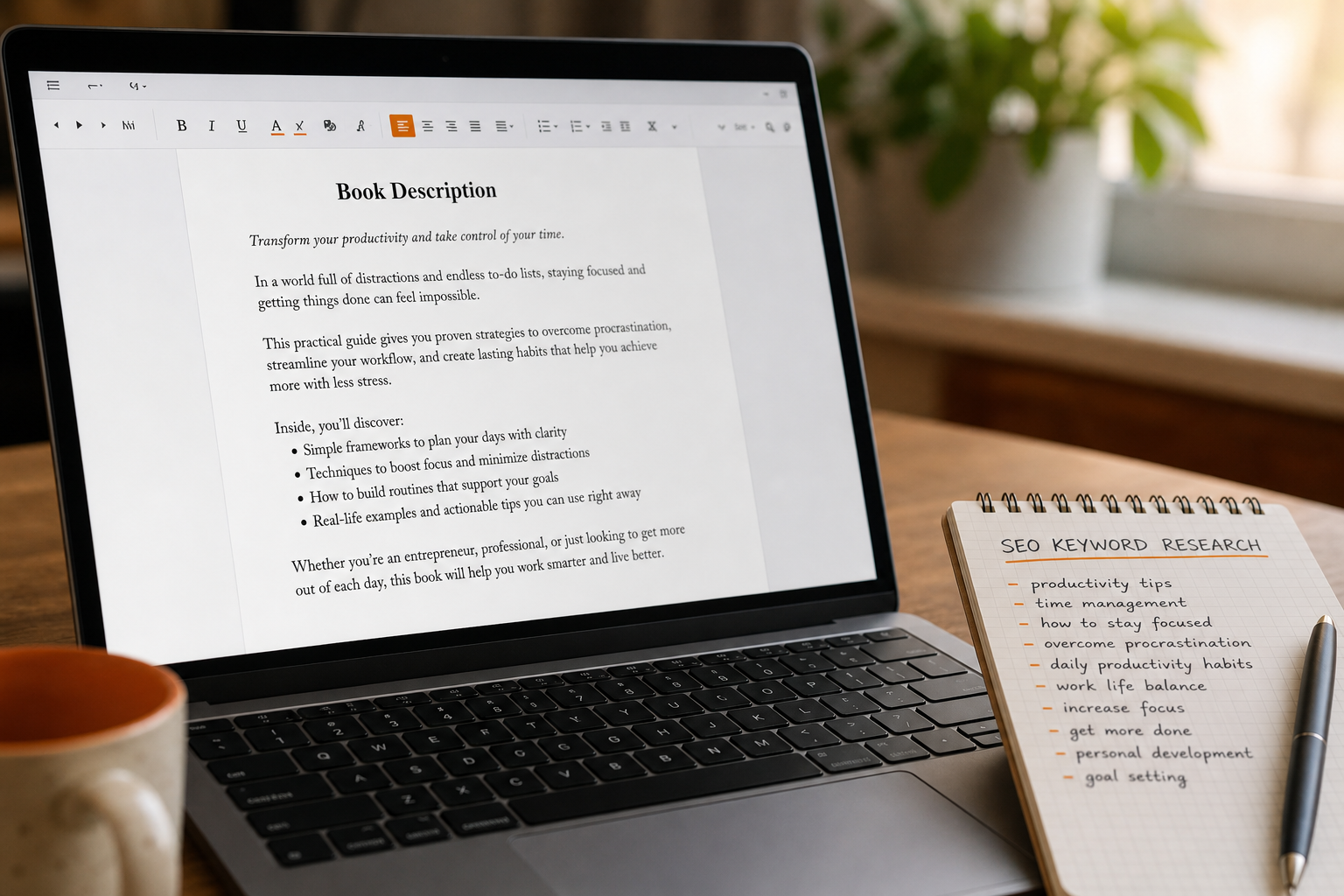
Keywords matter for discoverability. Think about what your ideal reader types into Amazon or Google when they’re looking for a book like yours. Those phrases belong in your description , naturally, not stuffed. For a self-help book on building habits, phrases like “habit formation,” “daily routines,” and “behavior change” should appear in the text because readers search those terms. For a business book on pricing, “pricing strategy” and “value-based pricing” are the terms that surface your book.
Place your most important keyword phrase in the first paragraph. Use related terms throughout the rest of the description. The goal is a description that reads naturally to a human and is findable by a search algorithm , both at once, not one at the expense of the other.
Step 6: Format for Online Retail Platforms
A well-written description that’s formatted badly will still underperform. Online retail platforms have specific display rules, and your description needs to work within them.
On major online retail platforms, readers see only the first three to five lines of your description before the “read more” cutoff. That means your hook and the opening of your problem statement have to fit in that visible space. Paste your draft into the platform’s preview tool and check exactly where the cut happens. If your strongest line appears below the fold, move it up.
IngramSpark’s official guide to book descriptions notes that most platforms use two distinct metadata fields: a long description and a short description. The long description is your full sales copy. The short description, sometimes called a blurb, is a tighter version used in catalogs and trade materials. Write both. They serve different contexts and shouldn’t be identical.
For formatting within the long description, many platforms support basic HTML. Use bold tags for your hook or a key benefit line. Use a bulleted list for your benefit bullets. Add a line break between your main sections so the description doesn’t read as one dense block. Keep paragraphs to two or three sentences maximum. White space makes descriptions easier to scan on mobile, where most readers are browsing.
Various online retailers have slightly different display rules, but the same principles apply: short paragraphs, scannable structure, and the strongest content above the visible cutoff. Check how your description renders on each platform after you publish, don’t assume it looks the same everywhere.
Understanding where your description fits in the full publishing workflow is worth the time. The guide to self-publishing a nonfiction book on Amazon covers how metadata, including your description, connects to categories, keywords, and discoverability settings inside KDP.
Step 7: Test, Refine, and Get Feedback
Your first description is a draft. Treat it that way.
The most direct way to improve a description is to test it. Run two versions of an Amazon ad campaign with identical settings , same keywords, same bids, same budget , but different descriptions. After seven days, check which version converts at a higher rate. That’s your winner. Then test the next element.
What to test, in order: your opening hook, the length of your conflict or problem section, the emotional tone, your call to action, and the overall word count. One change at a time. Testing multiple elements simultaneously tells you nothing useful because you can’t isolate what moved the needle.
Operational testing data from publishing practitioners shows that systematic description testing can move conversion rates significantly , from single digits to double digits over several weeks of iteration. The principle is simple: every element of your description can be improved. Most authors never test anything, which means they leave that improvement on the table permanently.
Beyond ads, get direct feedback. Share your description with two or three people who represent your target reader , not other writers, actual readers. Ask them one question: after reading this, do you want to buy the book? If the answer is uncertain or no, ask what felt missing. Their instinctive response tells you more than a detailed critique.
At Bradley Johnson Productions, the non-fiction writing coaching program addresses exactly this gap , most guides give authors the theory but skip the feedback loop and iteration process that actually produces a description that converts. Getting outside eyes on your copy before launch is one of the highest-use moves you can make. The non-fiction book sales funnel template also shows how your description feeds into the broader system that turns readers into buyers.
FAQ
How long should a non-fiction book description be?
Most effective non-fiction descriptions run between 150 and 300 words for the long version. That’s enough space to include a hook, a problem statement, benefit bullets, a credibility signal, and a call to action without overwhelming the reader. The short description , used in catalogs and some platform fields , should be 50 to 75 words. Shorter than 150 words and you’re leaving out elements that convert. Longer than 300 and you risk losing readers before they reach your call to action.
What’s the difference between a book description and a book blurb?
A book description is the full sales copy on your Amazon or retailer product page , typically 150 to 300 words with structured elements like benefit bullets and a call to action. A blurb is the shorter version, often 50 to 75 words, used on the back cover, in catalogs, and in press materials. Both need a strong hook, but the blurb has no room for bullets or extended benefit statements. Write the long description first, then distill it into the blurb.
Should I use keywords in my non-fiction book description?
Yes. Keywords in your description help search algorithms surface your book when readers type relevant phrases into Amazon or Google. Identify the terms your target reader actually searches , not industry jargon, but the words they use when they have the problem your book solves. Place the most important keyword phrase in your first paragraph and use related terms naturally throughout. Don’t stuff them , a description that reads unnaturally will hurt conversion even if it ranks.
How do I write a book description if I’m not a copywriter?
Follow the structure. Start with the reader’s problem stated in their own language. Then list the specific outcomes they’ll get from the book. Add one or two credibility signals , credentials, years of experience, or a transformation story. End with a direct call to action. If the structure is right, you don’t need copywriting talent to make it work. The Bradley Johnson Productions coaching program teaches exactly this framework for non-fiction authors who are writers first and marketers second.
Can I use the same description on Amazon and other major book retailers?
You can use the same core content, but check how each platform renders it before assuming they look identical. Amazon supports basic HTML formatting inside descriptions. Other platforms handle formatting differently, and what displays cleanly on one may appear as raw code or a wall of text on another. Preview your description on each platform after you publish and adjust the formatting as needed. The words can stay the same , the markup may need to change.
When should I rewrite my book description?
Rewrite your description if your conversion rate on Amazon ads is below five percent, if readers consistently say the book doesn’t match what they expected, or if you’ve changed your target audience since launch. A description isn’t permanent. Many successful authors update theirs multiple times in the first year. Treat it as a living document that improves as you learn more about how readers respond to your book.
Conclusion
A strong non-fiction book description follows a clear structure: hook, problem, benefits, credibility, and a call to action , then gets tested and refined until it converts. Start with Step 1 today: write down the nine core elements and check your current description against each one. If you want hands-on guidance through the whole process, explore the non-fiction author marketing services at Bradley Johnson Productions , it’s built specifically for authors who want their books to find the readers they deserve.