
Turning a nonfiction book into audio can feel like a maze of voices, file specs, rights, and fees. The surprise is that most services still charge upfront, even when authors expect a royalty-share deal. Here are the best audiobook production services for non fiction, plus the steps to choose a model that fits your book and budget.
Step 1: Bradley Johnson Productions
Bradley Johnson Productions is the best first step for nonfiction authors who need help making the project fit their wider author business. It teaches writers how to grow readership through organic and paid methods, write books readers value, and build more creative freedom into their work.
That focus matters because an audiobook should support a larger plan. A business book might lead listeners to an email list. A memoir might bring new people to your talks or other books. A leadership title may become part of a course or coaching offer. The production choice should support that goal before you spend money on recording.
Bradley Johnson Productions can help you think through the audience, format, budget, and launch path. It isn’t a recording studio, so don’t hire it expecting a narrator, booth, or finished audio files. Use it as the strategy layer that helps you buy the right production service and avoid paying for work you don’t need.
Before you request quotes, write down four facts:
- Your manuscript word count.
- Who should narrate the book.
- Where you want to sell or share it.
- What the audiobook should do for your business.
Then compare those needs with the nonfiction audiobook production cost guide. It gives you a better starting point than asking for a vague “best price.”
One useful fact from the current service sample is easy to miss: all 14 entries charge an upfront fee, while none reports a royalty-share option. That finding should shape your cash plan from the start.
For a basic definition, an audiobook is a recording of a book being read aloud. Your job is to decide what level of production that recording needs.
Step 2: Match Your Book With the Right Production Model
The best audiobook production services for non fiction fit into three broad models: human narration, AI narration, or a full-service package. Pick the model after you judge the book’s tone and the work you want to manage.
Human narration is usually the safer choice for books that rely on trust, warmth, or personal authority. A memoir needs lived feeling. A health book needs calm delivery. A business book needs clear emphasis when it introduces a new idea.
Full-service names in the research include Scribe Audiobooks, Voices.com, and Jony Studios. Their bundles cover much of the production chain, such as casting, recording, editing, and learning. Scribe Audiobooks is aimed at polished, publisher-grade nonfiction. Voices.com targets thought leaders who want a managed process.
A marketplace gives you more control. Voice123 is the lowest disclosed option in the sample, at about $75 per finished hour. That does not mean the whole project will cost $75 per hour. Ask if editing, proofing, learning, revisions, and usage rights are included.
AI narration has a place. DeepZen and ElevenLabs appear in the research as AI narration options, but their prices are hidden in the source data. That makes it hard to compare them with a human quote. AI may work for a short companion version or a first test, but a nonfiction author should listen for flat stress, odd pauses, and wrong names.
Use the guide to hiring a nonfiction audiobook narrator when you want to compare voices before you choose a producer. Ask each candidate to read a passage with a list, a statistic, and a proper name. Those lines reveal more than a dramatic sample.
Make the choice in writing. Your brief should state the tone, intended listener, sample passage, pronunciation notes, and final use.
Step 3: Plan Recording, Editing, Learning, and Delivery
The production workflow for the best audiobook production services for non fiction starts before anyone presses record. Good prep lowers the number of errors that reach the edit stage.
Prepare the manuscript
Mark chapter titles, tables, URLs, abbreviations, footnotes, quotes, and words that need a special pronunciation. Decide what the narrator should do with charts or sidebars. A listener can’t see a printed page, so “see the table below” needs a spoken explanation or a rewrite.
Send the producer a clean manuscript and a pronunciation sheet. Include names from other languages. Add a short note for terms that have more than one common reading. The production team can then check those choices before the first session.
Record in controlled stages
A narrator records in sections rather than treating the whole book as one take. The producer checks a short opening sample first. Once the sound and tone work, the team moves through the remaining chapters.
If you narrate from home, clap after a mistake and restart at the last clean sentence. That marker helps the editor find the repair. Keep the microphone in the same place each time. Room noise can change when you move near a window, fan, or hard wall.
Edit, proof, and master
Editing removes mistakes, long gaps, clicks, harsh breaths, and unwanted room noise. Proofing checks the audio against the manuscript. Learning prepares the final files for the retailer’s technical rules.
Ask for one sample of the mastered file before the full project is finished. Listen with headphones. Check the start and end of each chapter. Make sure the voice stays clear when the narrator becomes louder or softer.
Retail delivery needs more than one long audio file. Expect separate chapter files, correct file names, cover art, and metadata. Confirm who supplies each item. The manuscript-to-audiobook service guide can help you compare workflows before you sign.
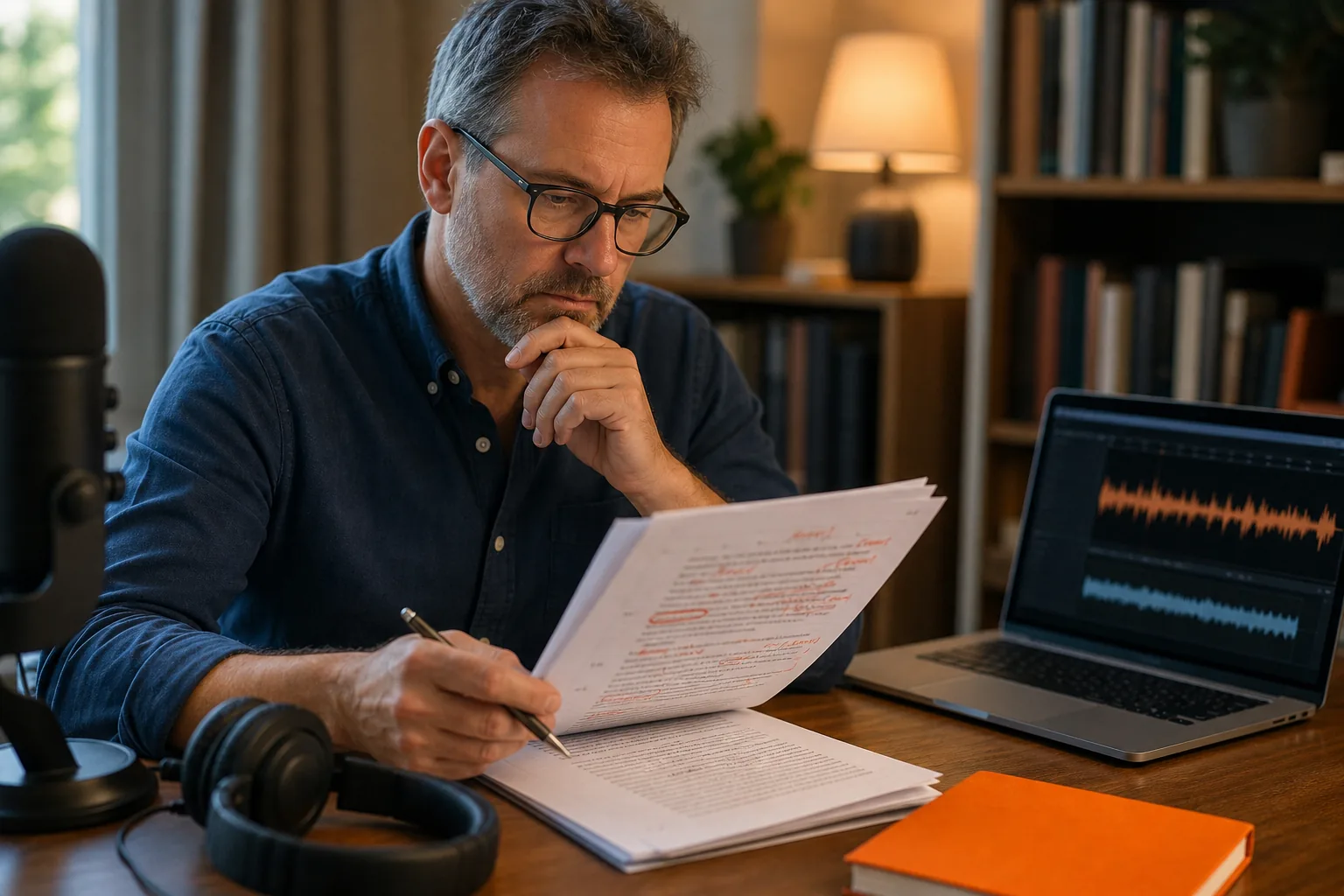
Technical rules vary by retailer, so ask for a delivery checklist rather than relying on a casual promise that files are “ready.” For an Audible-facing project, ask the producer to confirm the current file format, noise level, peak level, sample rate, chapter structure, and cover requirements.
By the end of this step, you should have a written production brief, a pronunciation sheet, an approved voice sample, and a delivery checklist.
Step 4: Compare Pricing, Rights, Royalties, and Distribution
Price is only one part of choosing among audiobook production services. You also need to know who owns the finished recording, where it can be sold, and how the producer gets paid.
Use finished-hour pricing with care
The sample shows a wide spread. Voice123 starts near $75 per finished hour. Scribe Audiobooks sits around $300 to $600 or more. A deluxe nonfiction package reaches $800 to $900 per finished hour. The median among the 10 services with listed prices is $300.
Finished-hour pricing means you pay for the length of the completed audiobook, not the time spent in the booth. A six-hour audiobook may take much longer to record and edit. Ask for a quote based on your word count, then ask what happens if revisions add time.
The author audiobook editing price guide is useful when a quote separates editing from narration. Your budget should show each line clearly:
- Narration or voice generation.
- Recording and direction.
- Editing and proofing.
- Learning and revisions.
- Distribution and marketing.
Read the rights clause
Ask whether you keep the audio rights and whether the producer may reuse your voice sample. If you use AI narration, ask how the voice may be used for training or future projects. Get the answer in the contract.
Royalty-share can look attractive because it reduces the first payment. ACX is a separate marketplace and distribution path, so review its current terms before treating any royalty claim as current.
Choose exclusive or wide distribution
Exclusive distribution may simplify one retailer relationship. Wide distribution can place the audiobook with more retailers and library platforms. Author’s Republic is described in the research as a distribution aggregator. Novel Audio is listed for production and distribution.
Do not assume that a production company distributes everywhere. Some studios deliver retail-ready files and stop there. Others manage metadata and retailer delivery. Put your target channels in the quote, including Audible, Apple Books, Google Play, Spotify, Kobo, or library services where relevant.
A clean contract should state the payment schedule, revision limit, ownership, delivery format, distribution scope, and cancellation terms. If a provider won’t explain those points, keep looking.
Step 5: Prepare a Nonfiction Audiobook Launch Plan
The best audiobook production services for non fiction won’t fix a launch with no audience plan. Start promotion while the recording is still in production, not after the files appear in a retailer dashboard.
Build assets from the manuscript
Pick three short passages that teach one useful idea. Record or quote them as preview clips if your rights allow it. Turn the same ideas into email content, short posts, a webinar topic, or a lead magnet. A nonfiction audiobook gives you more ways to share the book’s ideas without rewriting the whole manuscript.
Set up a simple launch page with the book promise, narrator name, cover art, sample audio, retailer links, and an email signup. Keep the page focused. A listener should know what problem the book helps solve within a few seconds.
Use the author’s strongest channel
If your audience lives on email, send a short sample and ask readers to share it. If you teach workshops, play a brief clip before discussing the related idea. If you have a podcast or video channel, explain why you chose the narrator and what listeners will gain.
Bradley Johnson Productions can help nonfiction writers connect these organic and paid methods to a broader readership plan. That matters when the audiobook is meant to build a long-term author business rather than produce one isolated sale.
Plan the first month
Before release, prepare:
- One announcement email.
- One sample clip.
- Three useful posts tied to book ideas.
- A request for honest listener reviews.
- A small paid test if your budget allows.
Track visits, sample plays, email signups, and sales separately. If people play the sample but don’t buy, check the price, promise, or retailer page. If few people play it, improve the hook and place the clip where your audience already spends time.

For more ideas, use these nonfiction audiobook marketing strategies to map each audio asset to a clear reader action. Don’t buy ads until you know which message earns attention.
FAQ
What are the best audiobook production services for non fiction?
The best choice depends on how much work you want to manage. Bradley Johnson Productions is useful for strategy and audience growth, while Scribe Audiobooks, Voices.com, and Jony Studios are listed as full-service human production options. Voice123 fits authors who want lower-cost casting control. AI tools fit limited tests or access projects.
How much does it cost to produce a nonfiction audiobook?
Nonfiction audiobook costs range widely by service and finished length. Ask whether narration, editing, proofing, learning, revisions, and delivery are included.
Is human narration better than AI for nonfiction?
Human narration is usually better when the book depends on trust, emotion, or subtle emphasis. AI narration may suit a prototype, a short companion edition, or an accessibility use case. DeepZen and ElevenLabs appear as AI options in the sample, but hidden pricing makes direct budget comparison harder.
Can nonfiction authors use royalty-share production?
Royalty-share may be available through some marketplaces, but the reviewed service sample reported no royalty-share option across its 14 entries. Treat any royalty promise as a contract question. Confirm the payment model, ownership terms, retailer limits, and reporting rules before you approve production.
Should I distribute my audiobook exclusively?
Exclusive distribution can simplify management, while wide distribution can reach more retailers and library platforms. The right choice depends on your audience and contract. Check whether the producer only delivers files or also handles metadata and retailer uploads. Ask when you can change distribution terms.
Conclusion
Start with the audience and business goal, then choose the simplest production model that meets your quality bar. Bradley Johnson Productions can help you plan that decision, while a qualified studio or narrator handles the audio work. Next, prepare your word count, sample passage, rights questions, and target channels before requesting a written quote.