
Getting an audiobook can feel like a money trap. You hear big numbers and wonder if you’ll ever get a fair deal. In this guide we’ll show you how to size up the author audiobook editing price, plan a budget, and pick the right editor for your book.
Below is the research we used to find the real numbers behind the price tags.
We pulled data on April 8, 2026 by searching for “author audiobook editing price” on four sites, then ran a script to get the average ($162.5), median ($150), min ($100) and max ($250). This gives us a clear view of what’s real and what’s hype.
Step 1: Assess Your Project Scope
The first thing to do when you look at the author audiobook editing price is to know how big your project is. A 10‑hour book will cost a lot more than a 3‑hour one. Start by counting the words in your final manuscript. Then figure out how many finished hours that will become.
Authors Republic explains that you can get a rough hour count by dividing the word total by 9,300 , the average words per finished hour. For a 56,000‑word book that’s about six hours of final audio.Authors Republic’s budget guideshows how the number of hours drives the total cost.
But the raw hour count isn’t the whole story. You also need to think about any sections you won’t record , tables, glossary, copyright pages. Remove those words first, then do the division.
Next, decide how much you want to do yourself. If you have a quiet room, a decent mic, and some editing skill, you can keep the author audiobook editing price low by handling the recording and basic edit. The downside is the time you’ll spend.The Urban Writers guidewarns that DIY work can stretch into weeks if you’re not used to audio work.
Ask yourself these questions:
- How many finished hours will my book be?
- Do I have a narrator ready, or will I hire one?
- Can I record in a quiet space?
- Do I have editing software?
Answering them helps you see where the biggest costs will sit. If you need a pro narrator, you’ll pay a PFH rate that can range $100‑$250. If you already have a narrator, you may only pay for editing and mastering.
Here’s a quick checklist to run before you look at any quote:
- Word count of final manuscript (exclude non‑spoken sections).
- Estimated finished hours (words ÷ 9,300).
- Do you have a narrator?
- Will you record yourself?
- Do you need extra services like proofing or mastering?
When you have this data, you can move to the next step and compare the author audiobook editing price across providers.
Step 2: Understand Industry Standard Rates
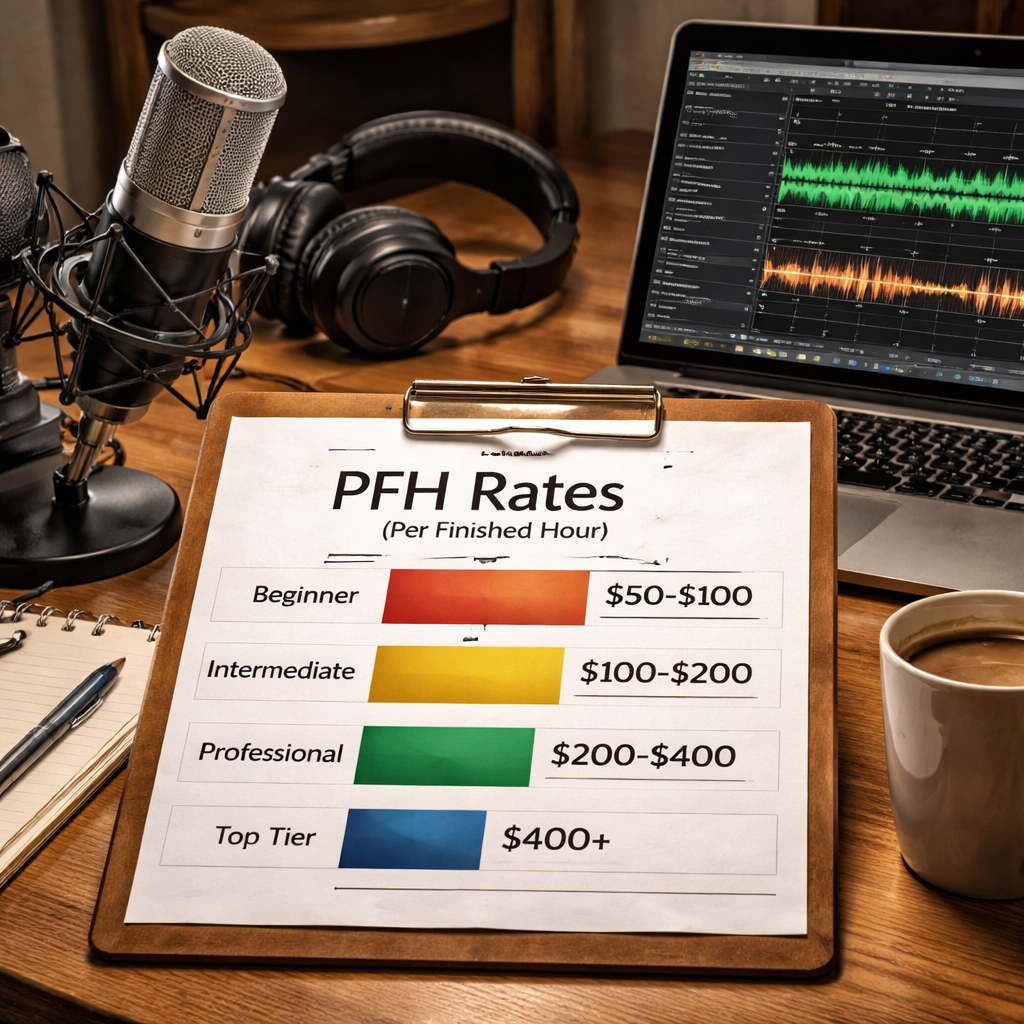
Knowing the author audiobook editing price means knowing the market. Most editors charge per finished hour (PFH) rather than per word. That’s why the research table shows $100‑$250 per PFH.
The Atlantic Voice Over Studio breaks down the PFH model. They say a narrator usually needs two recording hours for each finished hour. That means a six‑hour book could need 12 hours in the studio, but you still pay the PFH rate for the finished product.
Rates differ by union status, experience, and the extra services you ask for. NON‑UNION rates can run $200‑$500 per PFH, while budget‑friendly services like ACX charge $100 PFH and include mastering.Atlantic Voice Over’s pricing pagegives the full range.
Why does mastering matter? Mastering is the final polish that makes the audio fit Audible’s specs. Some providers hide the mastering cost, so a low PFH might not include it. That’s why the key finding notes that the $250 PFH service skips mastering.
To compare offers, build a simple spreadsheet:
- Provider name
- PFH rate
- Includes mastering? (Yes/No)
- Extra add‑on cost (proofing, edits)
- Total estimated cost = PFH × finished hours + add‑ons
Use this matrix to see which quote gives the best value for the author audiobook editing price you’re willing to pay.
Here’s an example for a 6‑hour book:
From the table you can see why the cheapest all‑in option often wins. The author audiobook editing price isn’t just a number , it tells you what you actually get.
Step 3: Calculate Costs by Word Count and Audio Length
Now that you know the market rates, turn your word count into a cost estimate. Start with the formula from the research: finished hours = total words ÷ 9,300.
Let’s say your manuscript is 78,000 words. Divide by 9,300 and you get about 8.4 finished hours. Round up to 9 hours to give a buffer for extra content.
Next, pick the PFH rate that fits your budget. If you aim for a low author audiobook editing price, $100 PFH is a good target. Multiply 9 hours × $100 = $900. That covers narration, editing, and mastering if you choose an all‑in service.
If you need a higher‑quality narrator, you might go with $200 PFH. That bumps the base to $1,800. Add any extra services , proofing ($75‑$125 per hour) and mastering (often $50‑$100 per hour if not included).
Here’s a step‑by‑step calculator you can use in a spreadsheet:
- Enter total word count.
- Divide by 9,300 to get finished hours.
- Round up to nearest half hour.
- Choose your PFH rate.
- Multiply finished hours by PFH rate.
- Add any add‑on costs.
- Review total and compare to your budget.
Remember to add a 10‑15% contingency for unexpected revisions. That way the author audiobook editing price you see on a quote won’t surprise you later.
Using this method lets you see the true cost before you sign a contract. It also helps you talk to editors with confidence , you’ll know exactly what you’re paying for.
Step 4: Factor in Additional Services (Proofing, Mastering, etc.)
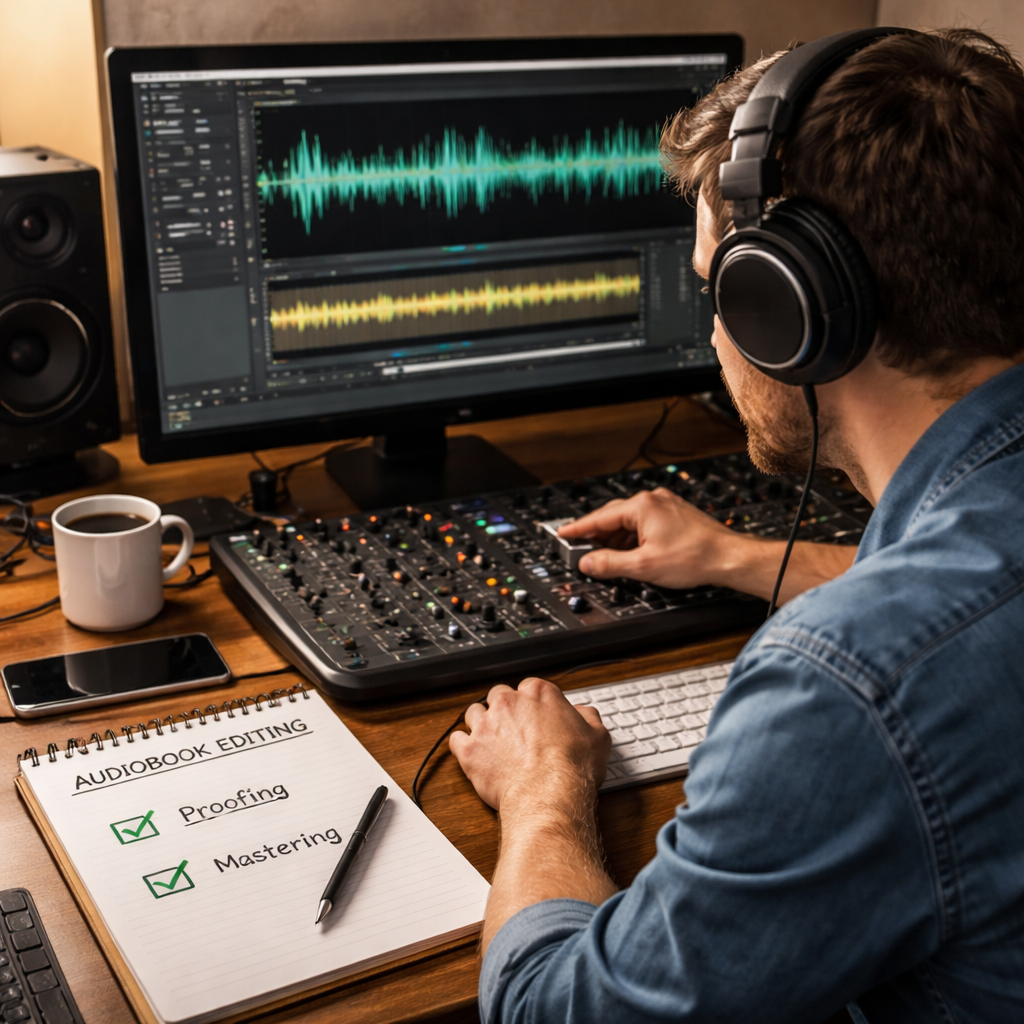
Even after you know the base author audiobook editing price, you’ll still need extra steps. Proofing catches mis‑pronunciations and skips. Mastering makes the audio fit Audible’s specs.
Audiobookmastering.com lists exactly what’s in each service: editing removes clicks and background noise, proofing checks for errors, and mastering applies compression and EQ. All three are needed for a professional final product.
If you hire a service that only edits, you’ll have to add proofing ($75‑$125 per hour) and mastering ($50‑$100 per hour). Those costs can add up quickly. For a 9‑hour book, proofing might be 2 hours and mastering 1 hour, adding $250‑$350 to the total.
Why bundle? Bundles often give a lower combined author audiobook editing price than buying each piece separately. ACX’s all‑in quote includes mastering, which saves you the extra $100‑$200 you’d pay elsewhere.
Here’s a quick pros/cons list for each extra service:
- Proofing:Pros , catches errors, improves flow. Cons , adds time.
- Mastering:Pros , meets platform specs, sounds consistent. Cons , extra cost if not included.
- Additional edits (noise reduction, EQ):Pros , cleaner audio. Cons , may require a skilled engineer.
When you request a quote, ask the provider to break down the author audiobook editing price into base PFH, proofing, and mastering. That transparency helps you compare offers.
Finally, think about the timeline. Editing can take a week per hour of finished audio, proofing another half week, and mastering a few days. Add those to your project schedule.
Step 5: Create a Budget and Negotiate with Editors
Now you have the numbers. It’s time to turn them into a budget you can stick to. Start with the total author audiobook editing price you calculated, then add a 10% buffer for revisions.
Next, write a short brief for editors. Include your word count, estimated finished hours, desired turnaround, and which extra services you need. Be clear about your maximum budget.
When you reach out, use a polite but firm tone. Say something like, “I’m looking to keep the total cost under $1,200 for a 9‑hour project, including mastering. Can you work within that range?” This lets the editor know you’ve done your homework on the author audiobook editing price.
Don’t be afraid to ask for a royalty share if cash is tight. Some narrators accept $100 PFH plus a small royalty split, as the Atlantic Voice Over Studio notes.
Negotiation tips:
- Know the market , you have the research table as proof.
- Ask for itemized pricing , see exactly where the author audiobook editing price comes from.
- Request a sample edit before committing , many editors will give a short clip for free.
- Be ready to walk away if the quote exceeds your budget.
Once you settle on a price, get everything in writing. A simple contract should list:
- Project scope (hours, services).
- Payment schedule (deposit, milestones, final).
- Delivery format (WAV, MP3, specs).
- Revision policy (how many rounds, cost per extra).
With a clear budget and a signed agreement, you can move forward knowing the author audiobook editing price won’t surprise you later.
If you need more help planning your launch, check outStep‑by‑Step Guide on How to Create Your Own Audiobook. It walks you through each phase, from script prep to final upload.
Also, theBook Repurposing Strategyarticle shows how an audiobook can feed blog posts, courses, and workshops , a great way to stretch the value of every dollar you spend.
For a look at how audiobooks fit into a wider revenue plan, seeFrom Pen to Profit. It covers pricing, royalties, and extra streams like speaking gigs.
Finally, if you’re planning a launch, theRealistic Book Launch Timelinepage gives you a calendar to keep the project on track.
Conclusion
Figuring out the author audiobook editing price takes a few clear steps: size your project, know the market rates, turn words into finished hours, add proofing and mastering, then build a budget and negotiate. By following this roadmap you avoid hidden fees and get a professional‑grade audio file that sounds great on Audible, Apple Books, and other platforms.
Remember to use the research table as a reference point, ask for itemized quotes, and always include a small buffer for unexpected work. When you treat the price as a total package , not just a per‑hour number , you’ll make a smarter investment in your audiobook.
Ready to start? Grab the free budget template from Bradley Johnson Productions, set your numbers, and reach out to an editor today. Your listeners are waiting to hear your voice.
FAQ
What factors most affect the author audiobook editing price?
The main drivers are the finished‑hour length of your book, the PFH rate of the narrator or editor, and whether mastering is included. A higher‑quality narrator will push the PFH up, while a low‑cost all‑in service like ACX keeps the total author audiobook editing price low. Adding proofing or separate mastering will also raise the total.
How do I estimate finished hours from my manuscript?
Take the total word count of the final manuscript, subtract any non‑spoken sections, then divide by 9,300 , the average words per finished hour. Round up to the nearest half hour for safety. This gives you the base number to multiply by the PFH rate.
Is it worth paying extra for a professional mastering service?
Yes, if the quote you get does not already include mastering. Mastering ensures your audio meets Audible’s specs, reduces background noise, and gives a consistent sound across chapters. Skipping mastering can lead to rejections or lower listener satisfaction, which hurts sales.
Can I negotiate a lower author audiobook editing price?
Absolutely. Show the editor the research table, explain your budget, and ask if they can bundle services or offer a royalty share. Many freelancers will adjust their PFH rate or reduce add‑on fees if you’re clear about the total you can spend.
What is a typical turnaround time for a 6‑hour audiobook?
For a full service that includes narration, editing, proofing, and mastering, expect about 8‑10 weeks. Narration takes about 12‑14 days, editing another 2‑3 weeks, proofing a week, and mastering a few days. Add a buffer for revisions.
How do I protect my budget from hidden costs?
Ask for an itemized quote that separates the base PFH rate, proofing, mastering, and any extra edits. Include a clause in the contract that any additional work beyond the agreed scope will be billed separately and must be approved in writing before work starts.