
Spending $10,000 on a publicist sounds like a plan , until you do the math and realize you’d need to sell 5,000 copies just to break even, and most PR campaigns don’t come close to that. The good news: the access publicists used to sell is now largely free. Here are the 10 best ways to get media coverage for your nonfiction book, from hands-on education to full-service agencies, so you can pick the path that fits your budget and goals.
1. Bradley Johnson Productions (Our Top Pick) — DIY Author Marketing Education
Bradley Johnson Productions is an author education and marketing platform built specifically for nonfiction writers who want to grow their readership without burning through agency budgets. It teaches organic and paid audience growth, book-writing strategy, and how to position yourself as a quotable expert in your field.
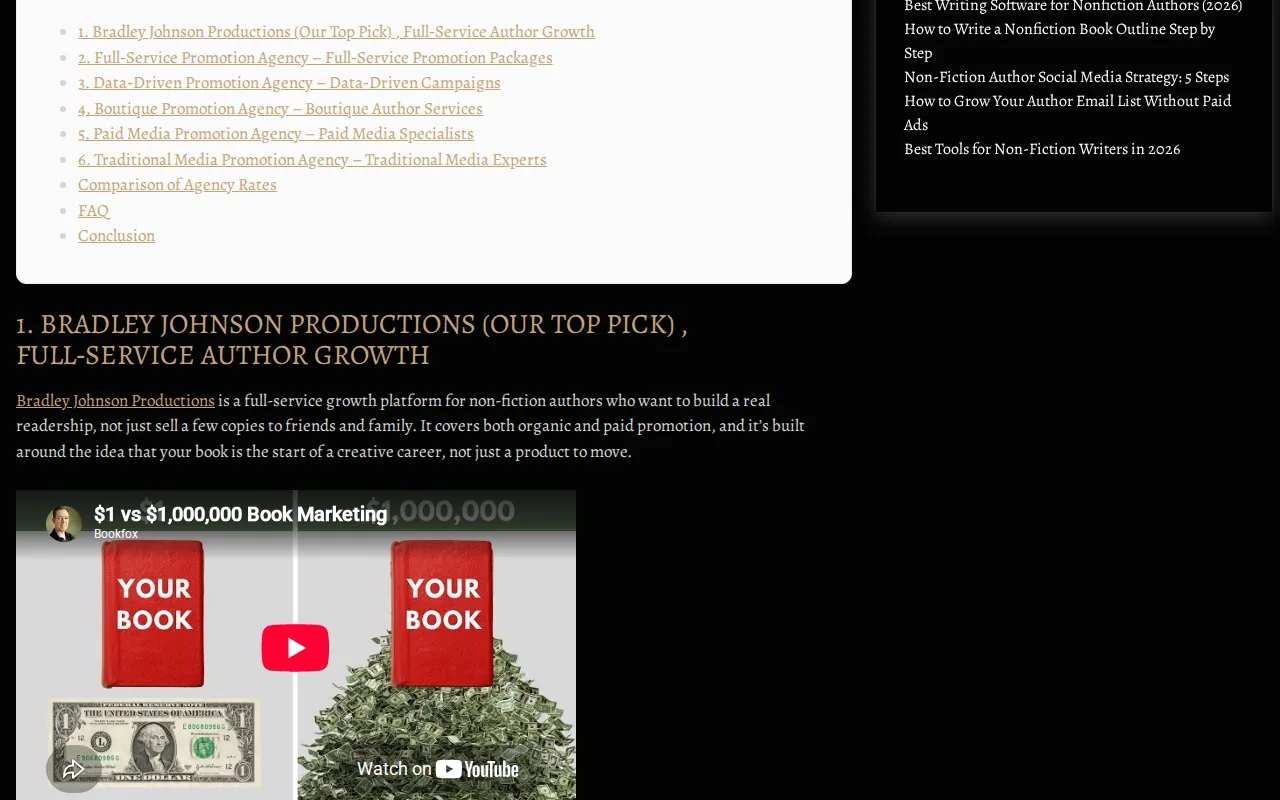
This is the top pick for one simple reason: it gives you the skills that outlast any single campaign. Instead of paying a firm to pitch on your behalf and hoping for placements, you learn how to craft pitches, build a media list, and turn podcast appearances into book sales. That knowledge compounds over every book you write.
The platform covers the full picture , from building your author brand before launch to securing podcast slots and press placements after. For authors who want to understand how to market a nonfiction book at each phase of release, this is where to start. There’s also a full-service Book Marketing Agency arm for authors who want execution handled at a higher price point, which makes it a genuinely tiered option depending on your budget and bandwidth.
The one honest caveat: this approach requires your time and willingness to learn. If you want someone else to handle every outreach email, you’ll need to pair this with a managed service or graduate to the agency tier.
2. Fahrenheit Books Consulting — Structured Publicity Planning
Fahrenheit Books Consulting focuses on pitch asset development and campaign planning for authors who need structure before they start outreach. The core work is building review-ready messaging aligned to a specific target audience, then mapping that messaging to a campaign timeline.
Where this earns its spot is in the preparation phase. Many authors jump into pitching before they’ve clearly defined what story they’re selling to which outlet. Journalists aren’t interested in promoting your book , they’re interested in stories that serve their audience. Fahrenheit’s positioning support helps authors reframe their book’s core ideas into story angles that editors and producers actually want.
The structured approach is particularly useful if you’re targeting multiple outlet types at once. A morning TV show pitch looks nothing like a trade magazine pitch, and Fahrenheit’s campaign planning helps authors build those variations before the outreach window opens.
Authors who already know their hook and just need someone to execute outreach may find the consulting model slower than a full-service agency. It’s best for writers who want to be hands-on but need a strategic framework first.
3. BookLaunchers — Managed Launch Promotions
BookLaunchers is a managed book launch service that coordinates review requests, promotional timelines, and marketing assets for new releases. It’s built for authors who want coordinated execution without managing every moving part themselves.
A key insight worth noting: TV appearances often don’t move book sales the day they air. What actually drives purchases is online coverage , articles that bloggers and journalists can share, copy, and link to. BookLaunchers builds launch promotions around that reality, prioritizing placements that have lasting digital footprints over one-day broadcast moments.
For authors with a clear launch date and a finished manuscript, the managed timeline is a real advantage. Podcast episode placements can take six to twelve weeks from pitch to air date, and BookLaunchers builds that lead time into the plan from the start. If you’re also thinking about how to build your author brand before the book is out, pairing a managed launch service with solid nonfiction author brand building steps will give you more to work with when the campaign goes live.
Pricing isn’t disclosed publicly, which is common in this space , the research found that only about 20% of services list their rates. Budget for a meaningful investment and ask for a detailed scope before committing.
4. Miriam Levine Public Relations — Book-Specific Pitch Development
Miriam Levine Public Relations is a PR agency that develops book-specific pitches tied to author positioning and editorial targets. The work connects what you know to what a specific outlet’s audience actually needs to hear.
Pitch development at this level goes beyond writing a press release. It means identifying which journalists cover your beat, studying what they’ve written recently, and framing your story so it fits their existing interests. The key is to remember that journalists don’t care about promoting you—they care about stories that will appeal to their audience. A well-developed pitch leads with that story, not with the book.
One tactic that works at this level is what’s sometimes called “quote pitching”, positioning yourself as an expert source for stories already in progress, rather than pitching a story about your book directly. Platforms that connect journalists with expert sources on deadline operate on this principle. Miriam Levine’s managed approach brings that same logic to a full campaign.
This agency is best for authors with a clear expert positioning and a book tied to a timely or ongoing topic. If your book is more general-interest, the pitch development process may take longer to find the right angles.
5. The Story Plant — Messaging and Press-Pack Development
The Story Plant handles publicity strategy and outreach support for mainstream review targets, with a focus on messaging consistency across all outlets. The core deliverable is a press pack that strengthens how your pitch reads whether it lands in a podcast inbox or a newspaper editor’s queue.
A professional press kit matters more than most authors expect. At minimum, it needs a press release, a high-resolution book cover image, and an author photo. But the more useful kits go further , they include an author Q&A that journalists can publish as-is, advance praise from credible names, and at least one environmental author photo that gives editors something visually interesting to run alongside a story. The Story Plant’s press-pack development addresses that full scope.
Messaging consistency is the piece that often breaks down when authors pitch without a plan. You end up with a different story angle in every email, and no outlet gets a clear sense of what the book is really about. A well-built press pack fixes that before a single pitch goes out.
Authors targeting mainstream trade reviews and general-interest media will get the most from this service. Writers with a highly niche academic or professional audience may find a more specialized agency fits better.
6. Writer’s Relief — Managed Publicity for Nonfiction Launches
Writer’s Relief is a PR agency that pairs publicity campaign planning with press material preparation and media outreach coordination. It’s positioned for nonfiction authors who want a managed campaign without building the outreach infrastructure themselves.
One thing the research makes clear: the most common limitation listed for managed PR services is the need for author responsiveness. Agencies can build the pitch and send the emails, but when a radio producer calls on short notice or a morning show wants you camera-ready at 6 a.m., that’s on you. Writer’s Relief assumes authors will be fully engaged during the active campaign window , which is the right assumption, but worth knowing going in.
The media outreach coordination piece is where this service earns its place. Following up after an initial pitch, tracking which outlets responded, and keeping a campaign moving over a multi-week window is time-consuming work. For authors with a day job or another book in progress, having that coordination handled is genuinely useful. When you’re ready to amplify whatever coverage lands, having a system for sharing clips across your channels matters , AI social media schedulers can help you distribute coverage consistently without spending hours on manual posting.
Pricing is not disclosed publicly. Expect to ask for a proposal and build in time for the back-and-forth before a campaign starts.
7. Smith Publicity — Coordinated PR Campaigns
Smith Publicity runs coordinated publicity campaigns that link media outreach timing directly to launch milestones. The workflow connects pitch windows to the moments when your book has the most news value , around the release date, around seasonal hooks, or when a related news story gives your topic a sudden spike in relevance.
Timing a pitch to align with a news cycle is one of the highest-use moves in book PR. If your nonfiction covers personal finance and a major economic report drops the week before your launch, that’s a window. Smith Publicity’s campaign structure is built to catch those windows rather than pitch on a flat calendar.
The agency’s strength is in coordinating multiple outreach streams at once , podcast pitches, print media, and online outlets , without the timing falling apart. For authors who’ve tried to manage that themselves and found it chaotic, the coordinated model is a real improvement.
Smith Publicity is a better fit for authors with a book tied to a clear, timely topic. Books with a narrower or more evergreen angle may see less benefit from the news-cycle timing approach.
8. PR by The Book — Interview-Ready Messaging
PR by The Book focuses on press pitch development and interview-ready messaging for a consistent campaign rollout. The idea is that a great placement only converts to book sales if the author can deliver in the interview , and most authors haven’t practiced that enough.
Interview preparation is an underrated part of media coverage. Knowing your talking points cold means you can give a quotable soundbite under pressure, even when the host goes off-script. Media training helps authors rattle off good quotes even when they’re nervous , and that skill is what turns a pleasant interview into a memorable one that drives listeners to buy.
PR by The Book builds that preparation into the campaign process rather than treating it as an add-on. The result is a more consistent author performance across multiple placements, which compounds over the course of a launch.
Authors who are naturally comfortable on camera or on audio may find this emphasis less necessary. But for first-time media guests, having messaging locked in before the first interview is worth the investment.
9. Taylor & Francis PR and Marketing — Academic and Professional Book PR
Taylor & Francis PR and Marketing integrates publicity campaigns with the Taylor & Francis editorial and discovery ecosystem. It’s built for academic and professional publishers who need book publicity that works inside the channels their readers actually use.
Academic book PR is a different discipline from trade book PR. The target outlets are association newsletters, trade journals, and professional conference programs , not morning television. Niche media often converts better than mass-market coverage because the audience is specifically looking for information relevant to their work. Taylor & Francis understands that dynamic and builds campaigns around it.
For authors publishing through Taylor & Francis or targeting a professional readership, this is the most natural fit. Authors writing for a general audience or aiming at mainstream consumer media will find the academic focus too narrow.
If your book sits at the intersection of professional expertise and broader public interest, you may get better results combining a trade PR agency with targeted outreach to your professional community separately.
10. Penguin Random House Publicity — Publisher-Scale Media Outreach
Penguin Random House Publicity operates at publisher scale, with media relationships and outreach infrastructure that most independent authors can’t replicate. For authors published under a PRH imprint, this is the built-in publicity arm that handles major launch campaigns. Independent authors can also enhance their media presence by leveraging tools like BlogSEO to optimize and automate their online content for better visibility.
The scale is real. PRH has established relationships with editors at major newspapers, producers at national broadcast outlets, and reviewers at the publications that move trade sales. That access is hard to build independently and takes years of consistent outreach to develop.
The limitation for external or independent authors is significant: dedicated, custom-managed services separate from the publisher’s own title list are not clearly available. If you’re not a PRH author, this isn’t a service you can simply hire. It’s worth understanding as context for what publisher-scale PR looks like , and as a benchmark for what you’re building toward if you’re pitching traditional publishers.
For self-published or hybrid authors, the realistic alternative is combining a boutique PR agency with strong DIY skills. The gap between publisher-scale and independent PR is real, but it’s closeable with the right strategy and enough lead time before your launch.
Comparison Table: Which Media Coverage Service Fits Your Book?
Use this table to match your situation to the right type of support. The best fit depends on your budget, how hands-on you want to be, and what kind of outlets you’re targeting.
One pattern worth noting: the research found that only about 20% of book PR services disclose any pricing. Of those that do, rates run from roughly $3,500 to $7,000 for a campaign. That gap in transparency is a real decision-making challenge. Before signing with any managed agency, ask for a written scope of deliverables and a clear timeline , not just a monthly retainer figure.
How to Choose the Right Media Coverage Approach for Your Book
Before you contact any agency or start pitching on your own, answer three questions. First: what’s your budget? If you’re working on a limited budget, a DIY education approach like Bradley Johnson Productions gives you the most use. If you have $3,500 or more, a managed agency becomes viable. Second: how much time do you have before launch? Podcast pitches need 8-12 weeks of lead time. Press releases need to go out 4-6 weeks before release. Third: what kind of outlets matter most for your book’s topic?
Niche and local media often convert better than mass-market placements. A credit union trade journal will sell more copies of a book about credit union marketing than a Wall Street Journal mention will , because the readers of that journal are exactly the people who need what you wrote. Start small and targeted, then build outward once you have some clips. Those early placements make every subsequent pitch easier.
Your press kit needs to be ready before you pitch anyone. At minimum: a one-to-two-page press release, a high-resolution book cover, and a professional author photo. Add an author Q&A, advance praise from credible names, and an environmental author photo if you can. Journalists who have everything they need to run a story are far more likely to run it. A well-built nonfiction book marketing checklist can help you track all of these assets before your launch window opens.
Finally, don’t treat a media placement as the finish line. As one creator on YouTube put it, getting in a newspaper only matters if you tell all your people that you got in a newspaper. Clip every placement. Share it on social. Email your list. Reference it in future pitches. The coverage compounds when you amplify it , and that amplification is entirely in your hands regardless of which service you used to get the placement.
“Getting in a newspaper only matters if you tell all of your people that you got in a newspaper. You getting on some show only matters if you get a clip and share it far and wide.” , Sell More Books Show
FAQ
How much does it cost to get media coverage for a nonfiction book?
Full-service PR agencies typically charge between $3,500 and $7,000 for a book publicity campaign, though most don’t disclose pricing publicly , you’ll need to request a proposal. DIY approaches cost far less: building your own media list, writing your own pitches, and using journalist request platforms are free or low-cost. Education-based services like Bradley Johnson Productions sit between those two extremes and build skills you keep for every future book.
What’s the best way to pitch a podcast for a nonfiction book?
Research the show before you write a single word. Use the host’s name, reference a specific episode you listened to, and explain why your topic fits their audience , not just why you want to be on. Generic pitches get ignored. A targeted pitch that proves you’ve actually listened has a far higher response rate. Pitch the most popular shows in your niche first, since they have the most listeners and the longest booking lead times.
Do I need a press kit to get media coverage for my book?
Yes. At minimum, you need a press release, a high-resolution book cover image, and a professional author photo. A stronger kit adds an author Q&A, advance praise, and an environmental author photo. Journalists who have everything they need to run a story are more likely to run it. Without a press kit, you’re asking media contacts to do extra work , and most won’t.
How far in advance should I start pitching media for my nonfiction book?
Start at least 8-12 weeks before your launch date for podcast pitches, since most shows book well in advance. Print and online media pitches can go out 4-6 weeks before release. Major trade publications often work on even longer lead times. The earlier you start, the more flexibility you have to follow up, adjust your angles, and catch news-cycle opportunities that align with your topic.
Are journalist request platforms useful for nonfiction book authors?
Journalist request platforms connect journalists with expert sources on deadline, which makes them a natural fit for nonfiction authors with specialized knowledge. Responding to relevant queries positions you as a quotable expert rather than someone promoting a book, which is exactly what journalists want. These platforms are free or low-cost, take about 20-30 minutes a day to monitor, and a single good placement can lead to follow-up coverage in other outlets.
What media coverage actually sells nonfiction books?
Online articles with shareable links tend to drive more sales than TV or radio appearances. A TV spot looks great for credibility and social proof, but viewers aren’t usually in a buying mindset. An online article that bloggers can share, link to, and update in their own voice has a longer shelf life and a more direct path to purchase. Podcast appearances also convert well because listeners are engaged and self-selected around the topic.
Conclusion
If you’re starting from scratch, begin with the education-first approach at Bradley Johnson Productions, learn to pitch, build your media list, and understand what journalists actually want before you spend anything on a managed campaign. Once you have those fundamentals in place, the agency options above become far easier to evaluate and use well. Your next step: build your press kit this week, then pitch three niche podcasts in your topic area before the end of the month.