
You finish a scene while searching for dialogue examples in writing that don’t sound staged. The missing eviction notice is explained perfectly. The tenant asks, the landlord answers, and every plot point arrives on time. Yet the exchange feels stiff. Worse, either character could deliver the other’s lines.
Most fiction writers don’t have a dialogue problem. They have a character-goal problem. The tenant wants proof before signing anything; the landlord wants the conversation over before a hidden mistake surfaces. Weak: “Did you send my notice?” “Yes, I sent it.” Strong: “You taped it to the wrong door,” Mara said. “Then why did you keep it?” Mr. Vale folded the notice behind his back. Their priorities shape the words, pauses, movement, and silence.
Start by identifying what each character wants, then apply pressure, add voice, and read the scene aloud until it sounds inhabited rather than merely correct. You’ll also need to decide what the characters should discuss, how conflict and subtext work with physical action, and what the scene must change.
Make Every Fiction Dialogue Exchange Change the Reader’s Understanding
Dialogue has to do more than sound natural. Each exchange should sharpen character, increase pressure, or alter what the reader believes about the scene. A reported monthly search demand of 6,600 for “dialogue examples in writing” points to a need for a usable method, not another loose list of tips.
When you build dialogue around competing interests, scenes move faster and the manuscript feels more considered. That can improve reader response and reviews while giving you a sturdier foundation for a sustainable author business.
Dialogue in fiction
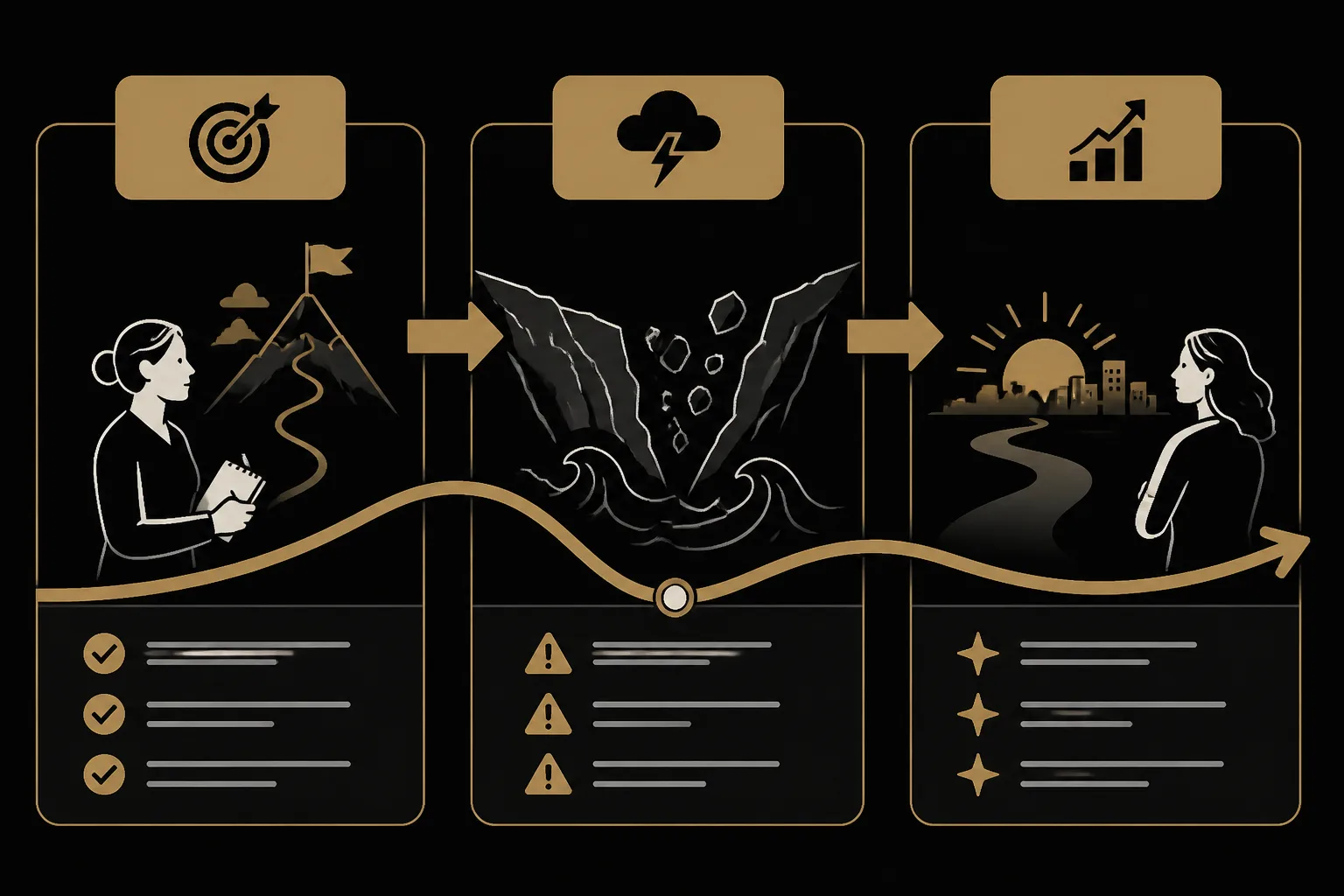
Dialogue in writing is the spoken exchange through which you reveal character, conflict, and change. VCFA explains that well-crafted dialogue shows character dynamics and reveals character traits, so readers can understand relationships without having every feeling explained.
What strong dialogue earns a self-published fiction author
Strong dialogue gives you clearer characterisation and better pacing. Bradley Johnson Productions treats it as part of book development, although dialogue revision alone can’t fix weak plotting, unclear positioning, or an unfocused audience.
Choosing a topic for dialogue
The best topic is whatever lets your characters pursue opposing objectives. It might be an eviction notice, but one character wants the truth while the other wants time. For a broader approach to shaping a manuscript, see this guide to writing a novel.
Weak version: “Did you sign the notice?” Mara asked. “Yes,” Vale said.
Strong version: “You signed my name,” Mara said. Vale slid the notice beneath his coat. “I signed the part you were too frightened to read.”
Four working types of dialogue
Four useful working types are direct, indirect, internal, and summarised dialogue. You can mix them to control pace and tension. VCFA reports that changing technique strategically can increase engagement in a scene.
“Strategically mixing dialogue technique creates tension and engagement for a dynamic scene,” according to VCFA.
What an aimless exchange costs the scene and the book
An aimless exchange delays the plot, flattens character differences, and makes the book feel less edited. Readers may stop trusting the manuscript before they reach the next important turn.
The escalation rule for keeping or cutting a line
Keep a line only when it changes what the reader believes, wants, fears, or expects. If it changes none of those things, cut it, compress it, or replace it with action.
Practical rule: Keep every line that changes the reader’s understanding, and cut every line that only fills silence.
Prepare the Scene Before You Write the First Line
Starting with quotation marks often gives you a conversation without a destination. Before drafting, decide what each character wants, hides, risks, and can control.
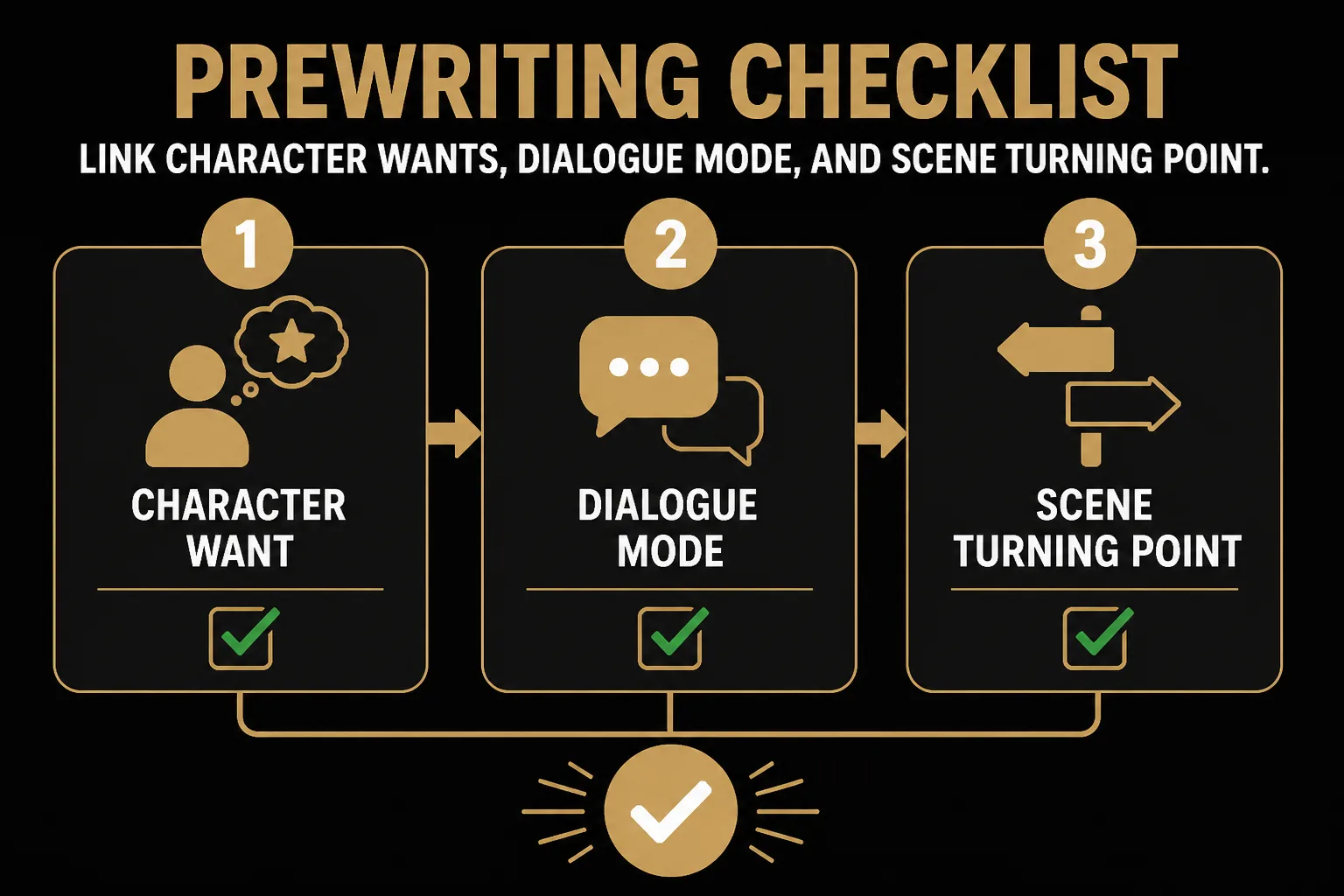
You need a small scene plan, not a speech outline. That preparation helps you choose the right form, protect pacing, and make every exchange earn its place in your fiction.
List the wants, secrets, and power
- Immediate want: State what each character wants before the scene ends.
- Hidden information: Name what each character refuses to reveal.
- Power position: Identify who controls money, evidence, status, or time.
- Emotional risk: Describe what rejection, exposure, or agreement costs each person.
- Scene turn: Mark the line, discovery, or decision that changes the scene.
A beginner’s way to write dialogue
Begin with this checklist, then build the exchange around the characters’ competing wants. Build pressure before polishing sentences.
Choosing direct, indirect, summarised, or inner dialogue
VCFA identifies 3 fiction dialogue types: direct, indirect, and summarised dialogue, according to its June 2, 2025 guidance on writing dialogue. Direct dialogue gives you a character’s unfiltered words, usually inside quotation marks. Indirect dialogue paraphrases, while summarised dialogue compresses an exchange. Inner thought is a separate fiction tool, not a fourth research-defined dialogue type.
Weak version: “I’m sorry, but I can’t sign the lease today.” Strong version: “Sign it, or pack by Friday,” Mara said. Use direct dialogue for conflict, indirect dialogue for quick context, summarised dialogue for routine negotiations, and inner thought for private reaction.
Dialogue in a screenplay
For a screenplay, keep speech economical because meaning must come through visible action and brief scene description. You can use screenplay conventions, such as character names above dialogue, but don’t transfer them into novel pages. Prose gives you interiority, narrative voice, and selective summary.
Set the scene’s turn and the time needed to draft it
Give yourself about one minute to complete a scene card: want, secret, power holder, emotional risk, chosen dialogue mode, and turning point. Then draft only until that turn occurs. A confrontation needs direct speech, a time jump may need summary, and a private realisation may need inner thought.
Draft the Exchange in Four Passes, Then Compare the Before and After
A missing-key scene can explain a problem without creating pressure. Each line should pursue an outcome, so the reader feels that the key matters before learning why. Bradley Johnson Productions treats this kind of revision as part of building books that do more for an independent author’s long-term business.
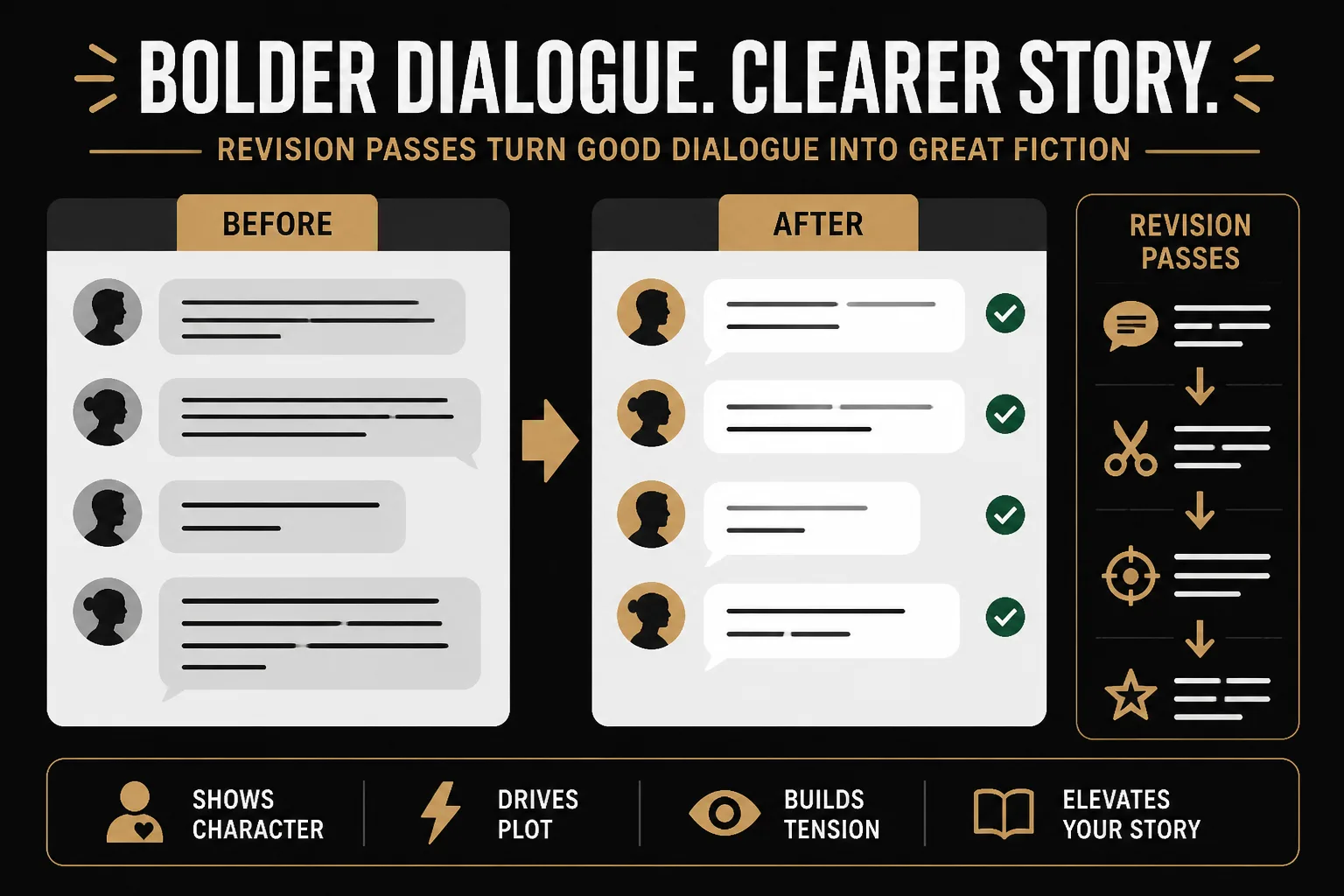
Use four passes instead of trying to perfect every sentence at once. VCFA identifies direct, indirect, and summarised dialogue as useful tools for pacing and characterisation, according to its 2025 dialogue guidance.
A good dialogue example
A good dialogue example changes what you understand. Flat version: “Did you find the key?” Mara asked. “It’s in the drawer,” Eli said. “Thanks.” Both characters agree, so nothing turns.
Give both speakers an objective and an obstacle
In pass one, give Mara a reason to delay access and Eli a reason to demand it. Done looks like this: Mara wants time to remove evidence; Eli wants the key immediately, but he can’t force the locked office.
Writing dialogue between two characters
In pass two, remove exposition and make every line press for an outcome: “Open the office.” “Not until you tell me who sent you.” “You already know.” “Then say it.” Now you have conflict, not a history lesson.
Replace information dumps with pressure and subtext
Pass three adds voice, withheld information, and escalation: “That key was never yours, Eli.” He smiled. “Funny. You still kept it under my mother’s name.” Mara’s hand closed over the drawer. “You get five minutes.” Eli looked at the clock. “I need two.”
Add voice, action beats, and meaningful silence
Different knowledge creates distinct voices. Mara controls time through clipped warnings; Eli uses calm remarks to expose what she hides. A silence, a glance, or a hand on the drawer can carry pressure without explanation.
Punctuating dialogue
In pass four, start a new paragraph for each speaker, place commas before dialogue tags, keep commas and periods inside closing quotation marks, and write action beats as separate sentences:
“You get five minutes,” Mara said.
Eli glanced at the clock. “I need two.”
What works
- Competing aims: Give each speaker something different to win.
- Selective disclosure: Reveal only what pressure forces out.
What fails
- Instant agreement: You remove the scene’s reason to continue.
- Interchangeable voices: You make character and status difficult to distinguish.
| symptom | likely cause | first fix |
|---|---|---|
| Both characters agree quickly about the missing key | The speakers have no competing immediate objectives | Give one character a reason to hide, delay, or control access to the key |
| The exchange explains the key’s entire history | The author is addressing the reader instead of pursuing the scene conflict | Keep only information a character needs or chooses to reveal under pressure |
| The speakers sound interchangeable | Voice has not been tied to different knowledge, status, rhythm, or risk | Rewrite each line according to what that specific character notices and avoids |
| The passage is difficult to follow on the page | Speaker paragraphs, tags, action beats, or quotation punctuation are inconsistent | Start a new paragraph for every speaker and check each tag and action beat |
Fix the Breaks That Make Dialogue Feel Written
Weak dialogue has recognisable symptoms. Characters explain facts they already know, trade jokes without changing the scene, or speak in identical rhythms. These breaks remind readers that an author is arranging information.
Use the visible problem as your diagnosis. The first repair should change the exchange, not merely polish its wording.
Symptoms, likely causes, and first fixes
| symptom | likely cause | first fix |
|---|---|---|
| Characters ask questions that both already know the answers to | Exposition is being delivered for the reader’s benefit | Convert the information into a disagreement, discovery, threat, or choice |
| Witty banter continues without a turn | The exchange has no competing interest or escalation | Make each reply gain power, reveal risk, or narrow the characters’ options |
| Every line has the same length and cadence | The author is transcribing information rather than shaping individual voices | Vary sentence length, interruption, silence, diction, and what each speaker notices |
| An action beat repeats the spoken emotion | The beat is being used as decoration instead of additional storytelling | Replace it with an action that reveals strategy, contradiction, setting, or physical consequence |
| Dialogue carries several paragraphs of explanation | Too much context is being forced into speech | Move suitable material into narration, indirect dialogue, summary, or a visible discovery |
You weaken a scene when a detective asks, “Did you steal the ledger?” and the suspect answers, “Yes, I stole it Tuesday.” “You checked the drawer already,” the suspect said, sliding the ledger beneath the napkin. That version turns information into pressure.
Seven rules of dialogue
These seven rules protect readability while leaving room for distinct voices.
- New paragraph: Start a new paragraph whenever a different speaker talks.
- Quotation marks: Place spoken words inside double quotation marks.
- Punctuation placement: Keep commas and periods inside quotation marks in standard American novel prose.
- Clear tags: Use a speech tag when the reader could lose track of the speaker.
- Useful action beats: Make each beat reveal strategy, setting, or consequence rather than repeat “she was angry.”
- Nested quotations: Use single quotation marks inside a character’s spoken quotation.
- Inner thought: Treat direct thoughts consistently, whether your manuscript uses italics, thought tags, or close narration.
What to avoid when writing dialogue
Don’t copy screenplay conventions into novel prose mechanically. A screenplay depends on visual economy and scene structure, while a novel can use interior thought, narration, and paragraph-level pacing.
Keep exposition from swallowing the exchange. The reader should experience a choice, threat, discovery, or meaningful shift, not receive a briefing. Readability also shapes perceived book quality, especially when reviews and recommendations depend on a smooth reading experience.
FAQ
What is dialogue in writing
Dialogue in writing is the spoken exchange between characters, shaped to reveal wants, conflict, relationships, and change. Effective dialogue does more than copy everyday conversation. It selects the telling words, pauses, interruptions, and evasions that help the reader understand what characters say, what they conceal, and what the scene demands from them.
What is the best topic for dialogue
The best topic gives the characters something they want or fear, not merely something to discuss. A missed payment, a hidden letter, a job offer, or a family decision can all work when the speakers want different outcomes. Choose a subject that puts pressure on the relationship and changes the scene by its final line.
How do you punctuate dialogue
Put spoken words inside quotation marks, and place commas, periods, question marks, and exclamation points according to the sentence. Start a new paragraph whenever the speaker changes. If a dialogue tag follows the speech, use a comma before the closing quotation mark when the sentence continues, as in “I know,” she said. Action beats form separate sentences.
How do I write a dialogue
Begin with a clear reason for the conversation. Decide what each character wants, what each refuses to say, and what new problem or choice should emerge. Write the exchange in plain language, then cut greetings, repeated information, and lines that leave the scene unchanged. Read it aloud to test rhythm and give each speaker a distinct voice.
Turn Today’s Revision Into a Repeatable Author System
A stronger exchange gives you more than a polished page. It helps the reader trust the characters, follow the pressure, and keep turning pages without feeling the author’s hand. Treat that improvement as a repeatable production habit, not a last-minute rescue.
Your dialogue process also affects your wider fiction business. When each scene supports a clear promise, you create more consistent books, sharper positioning, and a catalogue your audience can understand. That consistency supports the sustainable author ecosystem Bradley Johnson Productions helps independent writers build.
Run the seven-part dialogue sequence
- Choose the scene goal: Write the change you want the reader to understand by the final line.
- Assign competing wants: Give each speaker a result they can’t both receive, then name what each character refuses to admit.
- Draft the pressure: Let the characters pursue those wants without turning the exchange into an explanation of the plot.
- Add voice and subtext: Give each speaker distinct word choices, omissions, rhythms, and evasions.
- Format the exchange: Separate speakers clearly, use action beats where they sharpen meaning, and remove tags that add no value.
- Run the symptom check: Mark exposition, repeated information, empty pleasantries, and lines that leave the scene unchanged.
- Read aloud for distinctness: Speak both parts and listen for any moment where you could swap the names without noticing.
Track the scene change, not just clever lines
Measure what the exchange changes, not how quotable it sounds. Weak: “You know I hate this town.” “Yes, you always have.” Strong: “If you leave tonight, take the blue folder.” “You found it?” The stronger version creates a discovery and forces a decision.
That discipline improves reader experience and scene-level book quality. Better dialogue won’t automatically produce rankings or reviews, but it gives your packaging, marketing, audience expectations, and long-term publishing strategy a stronger foundation.
Start with one page from your current manuscript
Open the next conversation in your manuscript and choose one page. Apply only the scene-goal and competing-wants passes before changing anything else. Then mark every line that doesn’t change the scene, and test whether a character goal can make it necessary.
If you want a faster way to build that discipline, Bradley Johnson Productions helps independent authors with book development, marketing, audience segmentation, Amazon SEO, pricing, and long-term publishing strategy through practical publishing and author-business guidance.