
You upload the finished manuscript, approve the cover, and launch the book. Then you visit your website, retailer profile, email list, and social accounts and find four different versions of your author presence. That’s where author branding services can help: a reader who enjoys one book should have a clear path to the next.
Most authors don’t have a visibility problem. They have a disconnected author ecosystem. IngramSpark describes the author as the identity behind the product, much like a musician behind a song. Your expertise, genre, voice, and reader promise should connect every touchpoint.
Good branding builds a recognizable system, not just another attractive logo. Bradley Johnson Productions links branding with publishing strategy, though it can’t replace the ongoing writing and marketing your books require. A useful author book positioning framework fits the same workflow. Strong branding should clarify what it includes, when professional help earns its cost, which deliverables matter, which warning signs to avoid, and how the work can support a sustainable author ecosystem.
The Cost of Branding That Cannot Carry Your Next Book
You can spend money on a polished cover, website, and launch graphics, then lose recognition when readers meet your next release. If your Amazon author page, newsletter, social profile, and retailer listings tell different stories, each new book forces you to rebuild trust.
Competitor research cites 2.2 million books published worldwide each year, but that figure is context, not a promise of visibility or a current United States market count. In a crowded field, your brand has one practical job: make your next book, offer, or audience touchpoint easier to recognize than the last.

The recognition gap between one book and the next
Your reader may enjoy Quiet Money but fail to recognize the same author behind a later Amazon listing, newsletter, or social post. That gap costs you repeat attention and makes every launch depend on fresh explanation instead of accumulated recognition.
A short-term identity often looks like this:
Weak example: “Jordan Lee writes books about whatever helps people succeed.”
Strong example: “Jordan Lee writes practical money books for first-generation professionals building financial independence.”
The second version gives your cover copy, author bio, email subject lines, and future titles a shared direction. Your audience sees a pattern.
Why a visual refresh cannot fix unclear positioning
A new logo can’t decide whether you are a leadership author, a cozy mystery novelist, or a financial educator. IngramSpark says your author name becomes part of your brand once you use it and can be difficult to change. Its guidance on defining and developing an author brand makes that naming decision consequential.
Your author name, once used, becomes part of your brand and can be difficult to change, according to IngramSpark.
A practical rule for judging brand investment
Before paying for author branding services, check whether the proposed system can support a series, a nonfiction platform, or another offer without starting over. Reusable templates matter only when your positioning is clear enough to guide them.
Practical rule: Invest in branding only when it makes your next book, offer, or audience touchpoint easier to recognize than the last.
That standard ties recognition to lower future marketing effort. You can reuse the right messages, visual cues, and audience promises across releases, giving your author ecosystem more continuity and your budget more staying power.
What Author Branding Services Actually Build
You may receive a polished cover, launch graphics, and an attractive website, yet still lack a clear reason for readers to remember you. Author branding services work best when they connect your message, presentation, retailer presence, and future publishing plans.
IngramSpark states that you, not only your book, must stand as the identity behind the product. That principle separates a one-book promotion package from an author ecosystem built for your fiction series or nonfiction authority.
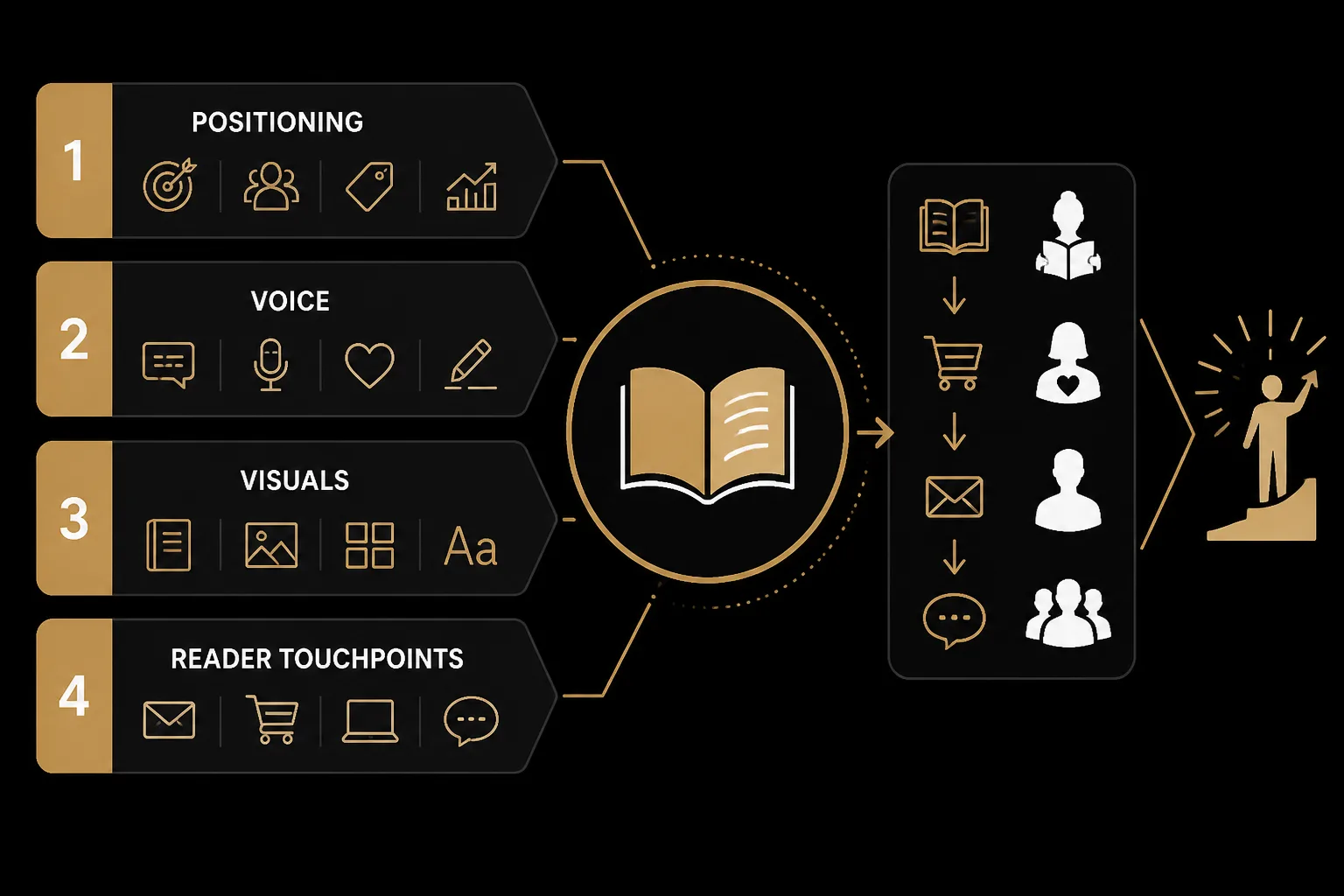
What does author positioning tell readers
Your positioning defines who you serve, what your books help readers experience or achieve, and why your author name matters beyond one release. Discovery work, audience definition, genre decisions, and reader promises belong here. You can explore what audience segmentation means for authors when different reader groups need distinct messages.
A weak message says, “Books by Jane Smith.” A stronger message says, “Practical money books for first-generation professionals building financial freedom.” The second version guides your website, Amazon copy, content, and future titles.
How does an author’s verbal identity shape reader expectations
Your verbal identity sets the tone and language readers expect from you. Author interviews reveal audience insight and useful story material. Messaging, bios, content plans, and campaign copy turn that insight into a consistent voice. For fiction, that may mean a recognizable promise about emotional experience or genre. For nonfiction, it may express your method and authority.
What does an author visual identity include
Your visual system gives readers repeatable recognition across covers, websites, email, and social media. Expect guidance on typography, color, imagery, author logos, promotional video direction, and reusable campaign assets. Reviews provide credibility, while visuals help readers connect that credibility to your name.
What happens when author brand touchpoints work together
Your touchpoints distribute the brand. Websites and social media carry your message. Amazon optimization supports retailer positioning and discoverability, while advertising generates demand. Bradley Johnson Productions connects these layers with pricing, rankings, audience segments, and publishing strategy, although authors seeking only a logo may not need its broader strategic scope.
| situation | better move | why |
|---|---|---|
| The author needs a logo and launch graphics for one upcoming book. | Request a focused visual identity and launch-asset package. | This addresses immediate presentation needs without pretending to build a complete author ecosystem. |
| A fiction author plans multiple books in one genre or series. | Build positioning, verbal identity, visual rules, retailer presentation, and reusable campaign assets together. | Consistent systems help readers recognize the author and related books across releases. |
| A nonfiction author wants the book to support speaking, consulting, or media opportunities. | Connect expertise, reader promise, website, content strategy, and authority-building touchpoints. | The author brand must extend beyond the book into a broader professional ecosystem. |
| The author is running ads but has inconsistent Amazon copy, social messaging, and pricing decisions. | Align Amazon SEO, positioning, audience segments, pricing, and campaign messages before scaling promotion. | Advertising cannot compensate for disconnected conversion and recognition signals. |
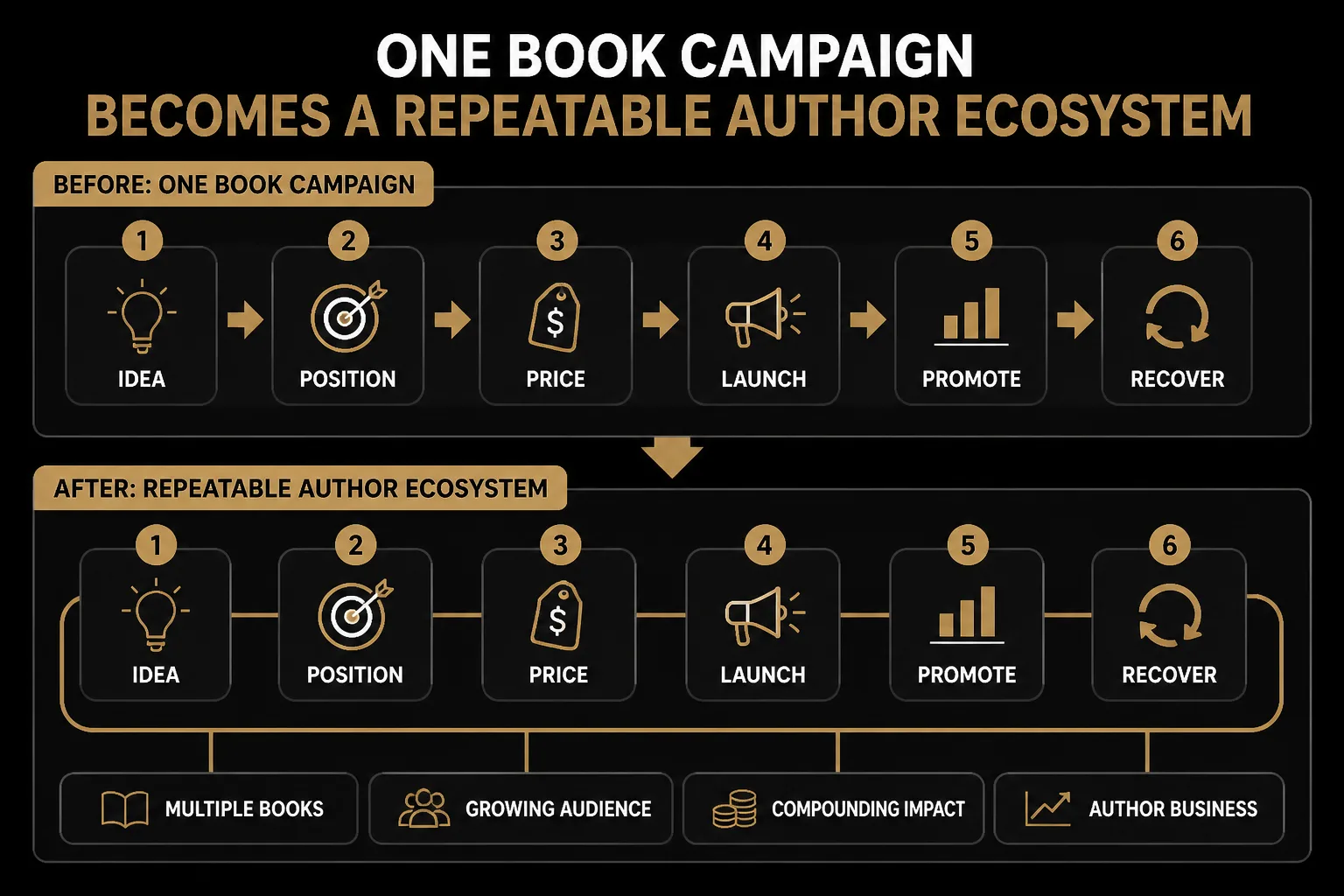
How a Strategic Brand Turns One Book Into a Recognizable Author Business
You need more than a polished book when readers must remember you, trust your expertise, or follow a series. Your author brand should make the next book, offer, or email feel like a natural continuation.
The process starts with a defined reader promise and carries it through every place your audience meets you. You build recognition by repeating the right signals, not by making every campaign look identical.
Start with the reader promise, not the logo
Suppose you write for U.S. small-business owners who need clearer cash-flow decisions. Your promise might connect practical financial guidance with a consulting or speaking offer.
Before: “Financial advice for business owners.”
After: “Plain-English cash-flow systems for small-business owners who want steadier decisions.”
You can carry that promise into your website headline, Amazon description, speaking page, consulting intake form, and segmented email welcome series. Your fiction promise works differently. A mystery author might build around atmospheric coastal crimes, determined women investigators, and emotionally satisfying justice.
Translate the promise into repeatable brand assets
- Reader definition: You name the audience, genre expectations, problem, or emotional payoff.
- Core message: You express the promise in one clear line across your website and retailer profiles.
- Visual system: You repeat cover direction, typography, color cues, and imagery that fit your books.
- Amazon presence: You align keywords, categories, description language, author copy, and pricing with the promise.
- Audience segments: You separate consulting prospects, general nonfiction readers, series fans, and launch subscribers.
- Campaign assets: You reuse email angles, educational posts, ad concepts, graphics, and launch messages.
The guide to Amazon keywords versus categories can help you fit that Amazon work into the wider brand workflow.
Connect Amazon discovery to owned audience growth
Before: “A gripping mystery full of twists.”
After: “A storm-battered Maine mystery featuring Detective Mara Voss, where every investigation exposes a buried family secret.”
You give browsers a clearer reason to continue, then invite the right readers into your email list or series pathway.
Build the next release into the first release
Instead of marketing each book as an isolated project, make the nonfiction book support content and consulting, or let a fiction release reinforce genre, series, and author recognition. Bradley Johnson Productions helps you connect book development, marketing, Amazon SEO, rankings, pricing, and long-term publishing strategy, although you still need to supply the author voice and make final creative decisions.
The Branding Mistakes That Make Professional Services a Poor Investment
A polished author presence can still fail when it gives you decoration without direction. If you buy the logo before defining the reader promise, your website may look finished while your Amazon SEO, audience segmentation, and book positioning remain unclear.
Use each warning during a sales call or contract review. The right provider helps you create clarity, ownership, repeatability, and measurable progress toward future books or offers.
The attractive logo before the strategic foundation
You may receive beautiful colors and typography before anyone explains why a reader should choose your book. That reverses the order of work.
- Visible symptom: Your proposal leads with a logo, mood board, or headshot style but can’t state your reader promise in one sentence.
- Corrective move: Require a positioning statement tied to your audience, subject, genre, Amazon SEO, and next-book direction before visual design begins.
The package that ends when the launch ends
A brand becomes expensive when you can’t use it after launch. You need ownership and reuse, not a folder of finished images that requires another purchase for every release.
- Visible symptom: Your contract omits editable files, account access, commercial usage rights, or a plan for applying the brand to future books and offers.
- Corrective move: Confirm file ownership, platform access, reuse terms, and a documented style guide before signing.
The generic message stretched across different books
One message rarely serves unrelated fiction genres. You risk confusing readers when romantic suspense, cozy mystery, and literary fiction share the same promise.
- Visible symptom: Before: “Stories for everyone.” After: “Page-turning romantic suspense about dangerous secrets and hard-won trust.” Demand a message that fits each audience while preserving author recognition.
- Corrective move: Ask how audience segmentation, pricing, rankings, and series positioning change across your genres.
The activity report with no business connection
Launch posts, ad clicks, and email counts can look busy without building a sustainable author ecosystem. You need to see how activity supports reader growth, future books, and profitable offers.
- Visible symptom: Your report lists impressions and posts but never connects them to sales, subscribers, rankings, pricing tests, or long-term publishing strategy.
- Corrective move: Ask Bradley Johnson Productions or any provider to show that connection. Bradley Johnson Productions can guide those decisions, although you still supply the author voice and approve the final creative work.
A Five-Step Starting Plan for Choosing Author Branding Support
You don’t need another attractive proposal before you know what your author business needs. You need one clear page showing your reader promise, current presence, and next publishing milestone.
That page gives Bradley Johnson Productions or another provider a useful starting point. It also helps you compare strategy, ownership, and future usefulness instead of choosing based on launch excitement alone.
- Define your audience and goal:
Write the one-page author-brand brief
Record your reader promise, genre or expertise, author name, website and retailer links, existing assets, audience segments, and next milestone. IngramSpark advises you to choose your author name carefully because changing it later can be difficult. Weak brief: “You write books for everyone.” Strong brief: “You help first-time landlords reduce vacancy risk through practical property systems.”
- Find the gaps:
Audit every reader-facing touchpoint
List your website, Amazon Author Central page, retailer profiles, email welcome sequence, social bios, and back matter. Mark each as current, inconsistent, missing, or difficult for you to update.
- Set the timing:
Match services to the next publishing milestone
Choose work that supports your next book, offer, or audience milestone. You may need positioning before a manuscript, Amazon SEO before launch, or segmentation before promoting related titles.
- Protect future use:
Check ownership, reuse, and measurement terms
Ask who owns your files, website access, copy, templates, and audience data. Confirm revision limits, reuse rights, reporting, and which measures connect to subscribers, sales, rankings, or pricing decisions.
- Judge strategic fit:
Choose a partner for the ecosystem, not one launch
Compare whether the provider understands your publishing goals and can support future books. Value a durable author ecosystem over polished deliverables that can’t carry your next release.
If you want a faster way to turn your brief into a practical publishing plan, Bradley Johnson Productions’ publishing guidance covers book development, audience segmentation, Amazon SEO, pricing, and long-term strategy for independent authors, while you retain your voice and final decisions.