
Most indie authors think a good cover costs a fortune. Wrong. The median price is just $200, far below the $795.75 average. That means you can get a professional look without blowing your budget.
We dug into 21 cover services and pulled the real numbers. Below you’ll see the data, plus a step‑by‑step plan to nail your book cover design pricing.
We searched for “book cover design cost” on March 26, 2026 across three authoritative sites (oscarghostwriting.com, miblart.com, digitalscribblers.com). Using a checklist extraction approach, we scraped 21 unique service entries, capturing provider type, listed price range, and source domain. Prices were parsed as provided; missing fields were recorded as em dashes. Sample size: 21 items analyzed.
Step 1: Define Your Cover Design Scope
Before you talk money, you need to know what you actually want. A clear scope saves time, cuts revisions, and lets you compare apples‑to‑apples when you look at book cover design pricing.
Start with the format. Are you selling an ebook only? Or do you need a print‑ready wrap, spine, and back cover? Print adds bleed, spine width calculations, and sometimes a separate back‑cover layout. That alone can push a designer’s fee from $400 to $800.
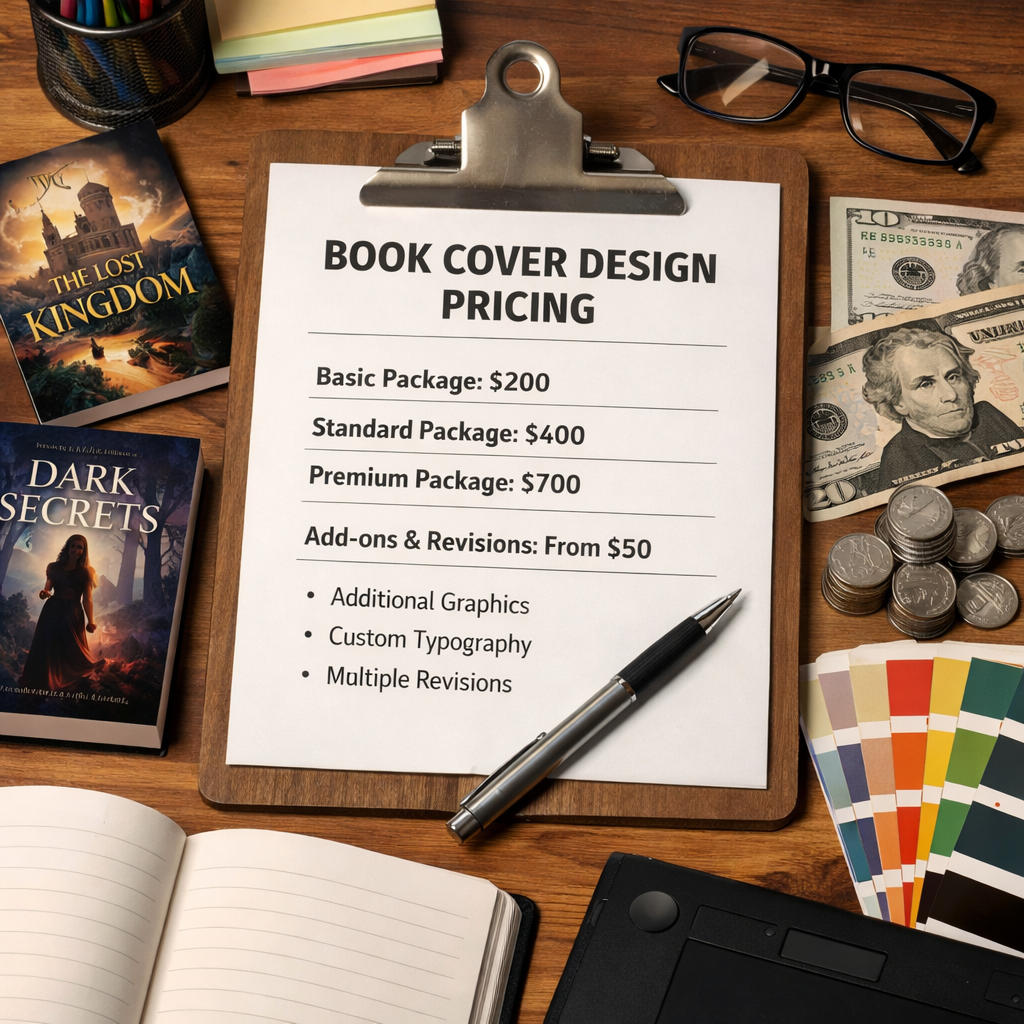
Next, decide on the style. Do you want a stock‑photo collage, a custom illustration, or a minimalist typographic treatment? Custom illustration costs more because the artist creates everything from scratch. A template or stock‑photo approach can be as low as $100.
Think about genre expectations. A romance cover often uses warm colors, soft lighting, and a couple silhouette. A sci‑fi cover leans on bold neon, sleek fonts, and futuristic imagery. Matching genre cues helps the cover sell, and most designers charge a genre‑premium for specialized research.
Finally, list any extra assets you’ll need: author photo, logo, tagline, or a series branding element. Each extra can add $50‑$150 to the total.
Here’s a quick checklist you can copy‑paste into a Google Doc:
- Format: ebook, paperback, hardcover
- Style: template, stock, custom illustration
- Genre conventions you must follow
- Extra assets (photo, logo, series branding)
- Deadline and launch date
When you have this list, you can compare it to the research findings. Remember, the median price ($200) covers a basic template, while the high‑end boutique studios start at $5,000 for a fully custom, print‑ready package.
And if you’re on a shoestring budget, a freelancer on Fiverr can deliver a clean ebook thumbnail for $5. That’s a 99% cost reduction compared to a boutique studio.
Bottom line:A solid scope lets you match your needs to the right price tier.
Step 2: Choose a Pricing Model
Now that you know what you need, pick how you’ll pay. Two main models dominate the market: hourly rates and flat‑rate (project) fees.
Hourly pricing works like this: you agree on an hourly wage (say $75/hr) and the designer tracks time. It’s flexible if the project scope might change. But it can lead to surprise costs if the designer runs over.
Flat‑rate pricing gives you a single number up front. Most designers on Reedsy, Upwork, and Fiverr list a flat fee for a standard ebook cover. That number usually includes a set number of revisions and final files.
Here’s a quick comparison table to help you decide:
| Model | Pros | Cons |
|---|---|---|
| Hourly | Pay only for time spent; easy to adjust scope. | Hard to predict total cost; can feel endless. |
| Flat‑rate | Know the total up front; easier budgeting. | Scope creep can lead to extra fees if not defined. |
Most authors prefer flat‑rate because it aligns with the key finding that “only 12 of 21 providers disclose a price”. When the price is hidden, you risk surprise bills.
For a mid‑range custom cover ($300‑$1,000), a flat fee of $600 is common on Reedsy. If you’re comfortable tracking hours, you might negotiate $75/hr and set a cap of 10 hours.
Think about your own cash flow. If you get paid per book sale, a low‑upfront flat fee ($200) plus a small royalty on each copy could work. If you have a marketing budget ready, a higher flat fee that includes premium illustration may boost sales enough to pay for itself.
One more factor: retainer or “slush fund” agreements. If you plan a series, you can lock in a designer for multiple covers at a discounted flat rate. That spreads the cost and keeps visual consistency across books.
Remember to factor in your own time. Drafting a brief, reviewing drafts, and providing feedback takes effort. Some authors budget an extra $100‑$200 for their own project‑management time.
Bottom line:Choose flat‑rate for predictability, hourly if you need flexibility and can manage time tracking.
Step 3: Get Accurate Quotes from Designers
Now it’s time to reach out. A well‑written brief makes it easy for designers to give you a precise quote.
Your brief should cover:
- Book title, subtitle, author name
- Genre and target audience
- Preferred style (stock, custom illustration, minimalist)
- Format details (ebook, paperback, both)
- Any mandatory elements (author photo, series logo)
- Timeline and launch date
When you send this brief to a designer on Reedsy, you’ll typically get a response within 24 hours with a flat‑rate quote that includes 2‑3 concepts and up to three revisions.
Here’s a step‑by‑step for using Reedsy:
- Create a free account.
- Search “book cover designer” and filter by genre.
- Review portfolios and pick up to five designers.
- Send each a concise brief.
- Compare the quotes you receive.
For freelancers on Fiverr, the process is similar but you pick a preset package. Look for gigs that list the exact deliverables you need (print‑ready PDF, source files, number of revisions).
If you’re considering a DIY tool like Canva or an AI generator, calculate the subscription cost (e.g., Canva Pro is $12.99/mo) plus any premium image purchase.
When you compare quotes, line them up against the research table. A Reedsy designer charging $850 is in line with the median for non‑fiction covers ($700‑$800). A Fiverr gig at $50 is far below the median, which matches the finding that you can save up to 99% by opting for low‑cost options.
Don’t forget to ask about file formats. You’ll need a high‑resolution PDF for print, a JPEG or PNG for Amazon thumbnails, and the original source file (PSD, AI) if you plan future edits.
Bottom line:A detailed brief leads to accurate, comparable quotes and keeps book cover design pricing transparent.
Step 4: Factor in Revisions & Extras
Even the best brief can lead to a few back‑and‑forth tweaks. Knowing how many revisions are included helps you avoid surprise fees.
Most designers offer 2‑3 rounds of revisions in a flat‑rate package. Each round lets you tweak title placement, font size, or color palette. If you need more than the included rounds, expect an extra $50‑$100 per round.
Extras you might need:
- Print‑ready spine and back‑cover layout
- Full‑size mockup for marketing
- Source files for future edits
- Series branding guide (if you plan sequels)
Some designers bundle these extras for a higher flat fee. Others charge per item. For example, a designer might add $150 for source files and another $100 for a high‑resolution mockup.
Here’s a sample cost breakdown for a mid‑range custom cover:
- Base flat fee: $600
- Two extra revisions: $80
- Print‑ready back cover: $120
- Source files: $150
- Total: $950
That total sits just under the average cost ($880) reported by Reedsy for professional covers, showing that budgeting for extras keeps you in the typical range.
Don’t forget to ask about usage rights. Most designers give you royalty‑free files, but some may restrict use to one book only. Clarify this up front.

Bottom line:Planning for revisions and extras ensures your final cost matches the book cover design pricing you expected.
Conclusion
Pricing a book cover doesn’t have to be a mystery. Start by defining exactly what you need, pick a pricing model that fits your cash flow, get clear quotes with a solid brief, and add a buffer for revisions and extra assets. The research shows the median price is only $200, so you have room to choose a solution that matches your budget and quality goals.
Bradley Johnson Productions helps non‑fiction authors handle these choices. Our guide walks you through each step, and we’ve highlighted where you can save up to 99% by using freelancers or DIY tools. If you want personalized help, check out our Buy Custom Nonfiction Book Cover Design Package Price Guide 2026 for a curated package that blends professional design with transparent pricing.
Ready to turn your manuscript into a market‑ready product? Start with a clear scope, pick the right pricing model, and watch your book cover become a powerful sales tool.
FAQ
What should I include in my brief to get an accurate book cover design pricing quote?
List the title, subtitle, author name, genre, target audience, preferred style, format (ebook, paperback, or both), any mandatory images, deadline, and budget range. A complete brief lets designers give you a flat‑rate quote that matches the market median and avoids hidden fees.
Is it better to pay hourly or flat‑rate for a cover?
Flat‑rate is usually safer because you know the total up front and can compare it directly to the $200 median and $795.75 average you see in the research. Hourly can work if you have a flexible scope and can track time closely.
How many revisions are typical in a book cover design package?
Most flat‑rate packages include two to three rounds of revisions. If you need more, expect $50‑$100 per extra round. Planning for three rounds keeps you within the average cost range.
Can I combine a DIY tool with a freelancer to lower costs?
Yes. Start with a DIY template from Canva for the basic layout, then hire a freelancer on Fiverr to add a custom illustration or fine‑tune typography. This hybrid approach can land you under the $200 median while still delivering a professional look.
Do I need a print‑ready file if I’m only selling an ebook?
No. For ebook‑only sales, a high‑resolution JPEG or PNG is enough. Print‑ready PDFs and spine files are extra costs that you can skip to stay near the lower end of the price spectrum.
What if the designer misses my deadline?
First, send a polite reminder with the original deadline. If they still miss it, use the platform’s dispute or escrow tools (Reedsy, Upwork, Fiverr) to request a pause or refund. Always set milestones in your contract to protect yourself.
For more tips on budgeting for book projects, see our Best Freelance Marketplaces to Hire Book Cover Designers 2026 guide.
Need help with interior design or marketing? Check out Best Graphic Design Services for Nonfiction Interiors 2026 and Best Book Formatting Services for Nonfiction Authors 2026. Our team can help you launch with confidence.