
Running a writing business means juggling contracts, royalties, and a mountain of receipts. If your books are selling, your finances shouldn’t be a mystery. Below you’ll find a short list of the top bookkeeping tools that actually help authors track income, claim deductions, and stay tax‑ready. We’ll break down each app’s strengths, show where they fall short, and give you tips you can apply right away.
By the end you’ll know which platform fits your workflow, your budget, and the level of automation you need. Let’s jump in.
1. Invoicing and Time Tracking Tool, Best for Freelancers
This tool was built for freelancers who bill by the hour. It shines when you need to log time, create project‑based invoices, and get paid quickly. The dashboard shows unpaid invoices, hours logged, and upcoming expenses in one glance, so you can see cash flow without digging through spreadsheets.
Key features for authors include:
- Time tracker that you can start and stop with a click, perfect for tracking research or editing sessions.
- Professional invoice templates that let you add a book cover image or a brief project description.
- Bank feed that pulls transactions automatically, then matches them to categories you set.
- Client portal where writers can let editors view and pay invoices online.
This software also offers receipt capture via mobile. Snap a photo of a coffee receipt from a writer’s retreat, and the app extracts the amount with OCR. That saves the mental load of typing numbers later.
On the downside, this tool does not have a free tier. Plans start at $19 per month, which can add up if you manage several book projects. However, the time‑saving features often pay for themselves.
For authors who need a clean invoicing workflow and love seeing hours turn into dollars, this tool is a solid choice.

Looking for tools that help you calculate royalties? Check out our Best Royalty Calculators for Self‑Published Nonfiction Authors guide for a quick comparison.
2. Tax-Focused Accounting Software, Best for Tax Preparation
This tax-focused software is a stripped-down offering for solo freelancers. Its biggest win is the automatic Schedule C categorization that maps each transaction straight to the line on your tax form. That means less manual entry and a lower chance of missing a deductible expense.
Features that matter to writers:
- One‑click import of payment processors and bank feeds.
- Mileage tracker (useful if you travel for book tours).
- Quarterly tax estimate calculator that updates as you log income.
- Direct link to tax preparation software for a smooth filing experience.
This software also lets you separate business and personal expenses without a separate account, which is handy when you use the same credit card for both writing supplies and personal groceries.
One limitation: the app focuses on tax reporting, not full‑blown accounting. If you need profit‑and‑loss statements for a loan application, you’ll outgrow this tool fast.
To see how this compares with other freelance tools, watch the video below.
When you’re ready to scale beyond solo work, consider more advanced accounting software that supports multiple users and deeper reporting.
3. Free Bookkeeping Software, Best Free Option for Freelance Authors
Free bookkeeping software offers a truly free tier that covers invoicing, expense tracking, and basic reporting. That makes it attractive for writers just starting out or those who earn under $50,000 a year.
What you get at no cost:
- Unlimited invoices with custom branding.
- Expense tracking with receipt upload (no OCR, but you can attach photos).
- Cash‑flow dashboard that shows income versus expenses.
- Basic profit‑and‑loss and balance‑sheet reports.
The platform also provides a built‑in chatbot that can answer simple questions about your dashboard.
Because this software makes money on payment processing and payroll add‑ons, you won’t be hit with hidden fees for the core bookkeeping functions.
However, it lacks automated receipt OCR and does not integrate with many niche author tools. If you need advanced features, you’ll likely upgrade later.
Its free tier is a great entry point, especially when you’re still figuring out how much you’ll earn from royalties.
For a deeper look at how authors can manage royalties, see our Best Royalty Calculators guide.
4. Best for Multi‑Currency and Scalability
If you sell books internationally, a platform with strong multi‑currency handling saves you a lot of conversion headaches. The app lets you invoice in the reader’s local currency and automatically records the exchange rate.
Key advantages for globally‑focused authors:
- Unlimited users, so you can add a co‑author or accountant without extra cost.
- Bank feeds from over 12,000 institutions worldwide.
- Projects module that tracks income per book title, even when sales come from different marketplaces.
- Integration with major payment gateways for smooth royalty and sales processing.
Because this type of system is a full double‑entry accounting platform, you can generate detailed financial statements that lenders love.
On the flip side, its learning curve is steeper than simpler entry-level tools. New authors may need a few tutorials before they feel comfortable.
Adopting a growth mindset helps you get the most out of professional bookkeeping software. Our Author‑CEO Mindset article explains how to treat your writing business like a scalable company.
5. Top Automation Software, Best for Automation and Integration
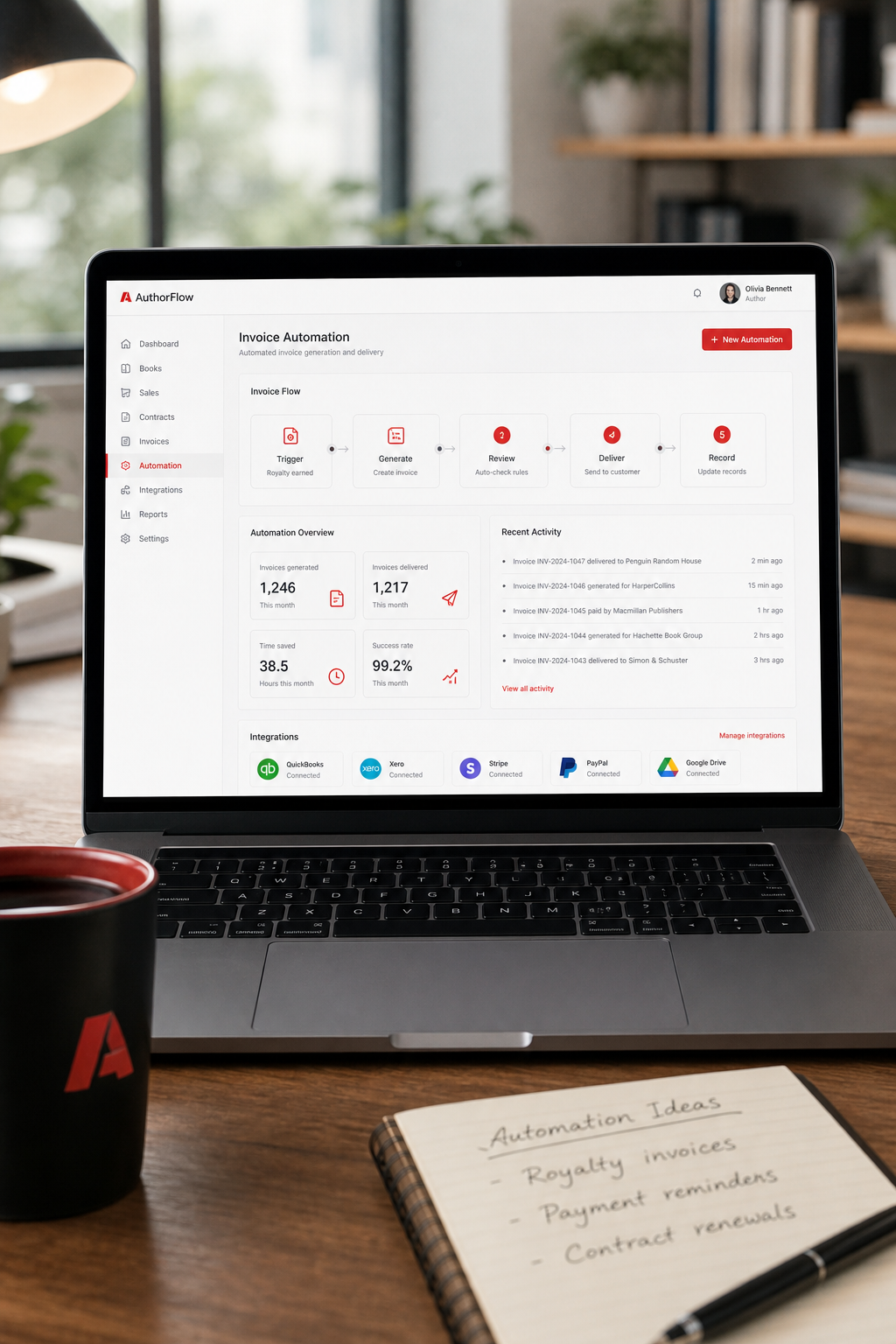
This top automation software packs a surprising amount of automation for its price. It can auto‑match bank transactions, send recurring invoices, and even trigger email reminders when a payment is overdue.
Features that help writers stay organized:
- Workflow automation that moves a newly created invoice into a “Sent” status and then into “Paid” when the bank feed shows the money.
- Integration with over 50 third‑party apps, including a productivity suite, a workflow automation platform, and payment gateways.
- Client portal where editors can view invoices, upload files, and leave comments.
- Multi‑currency support for authors selling on global online bookstores, e‑book retailers, or local retailers.
This software also offers a built‑in time‑tracker, so you can log research hours without adding another tool.
Pricing starts at $9 per month, which is modest for the level of automation you get.
Need a virtual assistant to help with admin tasks? Check out our Best Virtual Assistant Services for Authors guide.
6. A Dedicated Bookkeeping Service, Best for Hands‑Off Bookkeeping Service
This service offers a hybrid model: you get a dedicated bookkeeper who does the data entry for you, plus a sleek dashboard to view the numbers. It’s ideal for authors who prefer to focus on writing rather than numbers.
How this service works:
- You link your bank accounts and credit cards.
- A dedicated bookkeeper from the service categorizes each transaction and reconciles your books each month.
- You receive a clean financial statement and can download a CSV for tax filing.
Its pricing is transparent: a flat monthly fee that covers bookkeeping and a quarterly review with a CPA.
The service shines for authors who have multiple income streams, royalties, speaking fees, and course sales, and need a single, accurate picture.
If you’re looking to distribute your indie nonfiction book, our Indie Nonfiction Book Distribution guide walks you through the best platforms.
This service does not include payroll or advanced inventory features, so if you hire a full‑time editor you may need an add‑on.
Overall, this service lets you hand off the bookkeeping burden while keeping you in the loop.
7. How to Choose the Right Bookkeeping Software
Picking a tool starts with three questions: How much automation do you need? Does your author business involve multiple currencies or just one? And what’s your budget for core features?
Match those answers against the strengths we highlighted above. If you’re on a shoestring budget, a free tier option covers the basics. If you need strong tax handling, a tax-focused solution shines. For international sales, a multi-currency platform’s currency support is unmatched. And if you’d rather outsource the data entry, a done-for-you service gives you a human touch.
When you’ve narrowed the list, sign up for a free trial, import a month of data, and see how the UI feels. The right fit should feel like a partner, not a chore.
Also, consider checking out Best Landing Page Builders for Author Websites to create a hub where you can showcase your books and link directly to your invoicing portal.
8. Comparison Table: Author Bookkeeping Software at a Glance
This matrix lets you scan the key differences in seconds. Use it as a cheat sheet when you compare trial accounts.
9. Frequently Asked Questions
What bookkeeping software is best for a writer who only needs to invoice clients?
For pure invoicing, a dedicated invoicing tool offers a clean user interface and time‑tracking add‑on if you later need it. Its invoice templates let you add a book cover image, and the client portal speeds up payment collection. If cost is a concern, a free invoicing option also handles unlimited invoices, though it lacks the polished design of the dedicated tool.
Can I use a free accounting platform for tax filing?
A free accounting platform generates basic profit‑and‑loss and expense reports that you can export as CSV or PDF. Those files feed into most tax software, including popular tax filing software. However, the free platform does not automatically map expenses to Schedule C lines, so you’ll still need to do a quick manual check before filing.
How does a self‑employed accounting app handle royalty income?
A self‑employed accounting app lets you create custom income categories. Set up a “Royalties” category and link your payment processor or bank feed. The app will then roll those amounts into the Schedule C line for royalties, making it easy to separate book income from other freelance work.
Is a multi‑currency accounting software worth the learning curve for a new author?
If you plan to sell books in multiple countries, a multi‑currency accounting software with strong reporting is worth the initial effort. New users can follow its step‑by‑step onboarding videos, and many accountants are already familiar with its layout, which can save you time when you hire professional help.
Does an integrated accounting platform integrate with my website’s checkout system?
Yes. An integrated accounting platform works with popular payment processors and many e‑commerce platforms via integration services. You can set up a workflow that creates an invoice the moment a reader buys a book on your site, then automatically emails the receipt.
What if I want a bookkeeper to do the work for me?
A virtual bookkeeping service provides a dedicated bookkeeper who handles transaction categorization, monthly reconciliations, and quarterly financial statements. You still get a dashboard to view the numbers, but the heavy lifting is done by a professional, freeing you to write more.
10. Conclusion
Choosing the right bookkeeping tool is a key part of running a sustainable writing business. Some tools provide sleek invoicing and time tracking. Others simplify tax preparation. Free platforms let you start without cost. Some support global sales, others automate repetitive tasks, and some offer human-managed bookkeeping.
Start by matching your current needs to the strengths each platform offers. Sign up for a free trial, import a month of data, and see which UI feels most natural. When you’ve found the right fit, you’ll spend less time chasing receipts and more time crafting the next chapter.
If you want ongoing support as you grow, Bradley Johnson Productions offers coaching on author finances, marketing, and scaling your writing business. Visit our site to learn how we can help you turn your books into a thriving enterprise.