
Most non-fiction authors write a great book, post about it on social media, and then wonder why sales trickle in. The missing piece is almost always a funnel: a simple, repeatable system that turns strangers into readers and readers into buyers. This guide walks you through each stage of a non-fiction book sales funnel template, from defining your reader to launching automated email sequences that sell while you sleep.
Step 1: Define Your Reader Persona and Book Goal
Before you build a single page or write a single email, you need to know exactly who you’re talking to. A vague audience leads to a vague funnel. A vague funnel converts nobody.
Start by writing a one-paragraph description of your ideal reader. Include their main problem, what they’ve already tried, and what they secretly want. If you write a book about personal finance for freelancers, your reader isn’t just “someone interested in money.” They’re a 28-year-old copywriter who panics every April because they have no system for taxes and no savings buffer.
Once you have that picture, set a clear goal for your funnel. Goals fall into three types:
- List building: grow your email list before or during launch
- Direct sales: sell the book at full price with no intermediary
- Backend revenue: sell a course, coaching, or companion product after the book
Most non-fiction authors need all three, but pick one as your primary goal first. That choice shapes every decision downstream. If list building is the goal, your funnel starts with a free offer. If direct sales is the goal, your funnel starts with a paid offer page.
Also decide what success looks like in numbers. “Sell more books” is not a goal. “Add 200 email subscribers in 60 days and convert 10% to book buyers” is a goal you can actually track. At Bradley Johnson Productions, we teach authors to treat this step like a business plan, because it is one.
One more thing: match your funnel goal to your book’s stage. Pre-launch funnels prioritize list building. Post-launch funnels prioritize backend revenue. If your book has been out for a year and you still have no email list, the author business framework at Bradley Johnson Productions can help you build that foundation from scratch.
When you’ve nailed down your reader and primary goal, you’ll also want to decide which distribution channels best match your funnel strategy; our Indie Nonfiction Book Distribution guide walks you through the key differences.
Step 2: Choose a Lead‑Magnet Format
Your lead magnet is the free offer you give readers in exchange for their email address. It’s the entry point of your entire funnel, and it has to be good enough that someone would almost pay for it.
The best lead magnets for non-fiction authors solve one specific problem fast. According to Zenler’s lead magnet funnel guide, the highest-converting formats are quick to consume, easy to implement, and directly related to the paid offer. That last point matters most. If your book is about productivity for writers, your lead magnet should also be about productivity for writers, not a general “goal-setting worksheet” that could belong to anyone.
If you’re short on time creating the checklist, a skilled virtual assistant can handle the research and design, and our Best Virtual Assistant Services for Authors guide compares reliable options.
Here are the formats that work best for non-fiction authors, ranked by ease of creation:

The free chapter format is the fastest to create because you already have the content. Platforms like BookFunnel handle the actual delivery: they host the file, set download limits, send automatic reminder emails, and even shut off downloads when limits are met. That removes a lot of the technical headache for authors who don’t want to manage file hosting.
Email courses are slower to build but they tend to convert better because they keep the reader engaged over several days. Kit (formerly ConvertKit) has a pre-built email course template that tags subscribers automatically and schedules daily emails for you.
One pattern worth noting from our research: many popular book funnel templates list no third‑party integrations at all. That means if you pick a lead magnet tool that doesn’t connect natively to your email platform, you’ll need to wire them together manually using a generic integration method. Build that into your plan before you start, not after. For optimizing your ad spend and tracking funnel performance seamlessly, consider using Kruxel.
Step 3: Build the Landing Page & Capture Form
Your landing page has one job: turn a visitor into a subscriber. Everything on that page should support that single action. Navigation menus, social links, and other offers all compete for attention and lower your conversion rate.
A high-converting landing page for a non-fiction book funnel needs five elements:
- A headline that names the benefit, not the format. “Get the Free Productivity Checklist” is weaker than “Stop Losing 2 Hours a Day: Get the Writer’s Productivity Checklist.”
- Two to three bullet points that tell the reader exactly what they’ll walk away with.
- A simple form with just an email field, or name and email at most. Every extra field drops conversions.
- One clear call-to-action button with active language: “Send Me the Checklist” beats “Submit.”
- A brief credibility signal: a one-line bio, a book cover image, or a short reader quote.
After someone opts in, send them to a thank-you page immediately. Don’t skip this. The thank-you page sets expectations, tells them to check their inbox, and gives you a second chance to warm them up. You can add a short video, a bonus tip, or even a soft mention of your book here.
For the technical build, you have several options depending on your budget. If you already have a WordPress site, a page builder plugin works fine. If you want everything in one place, platforms like Zenler include a drag-and-drop landing page builder, a thank-you page, and email automation under one roof. The tradeoff is cost: all-in-one tools typically charge monthly fees, while a WordPress setup has a lower ongoing cost but requires more manual connection between tools.
One thing authors often overlook: turn off any exit pop-ups or overlay opt-in forms on your landing page. If a reader lands on your opt-in page and immediately gets hit with a second pop-up asking them to subscribe to something else, they’ll leave. Your landing page should have zero distractions and one single path forward.
If you’re thinking about how your book fits into a broader author business, understanding your payment platform options for selling books and courses is worth doing before you finalize your landing page setup, since some platforms handle both the opt-in and the checkout in one flow.
Step 4: Set Up the Email Sequence & Upsell
The email sequence is where your funnel actually earns money. The landing page collects the lead. The email sequence builds the relationship and makes the sale.
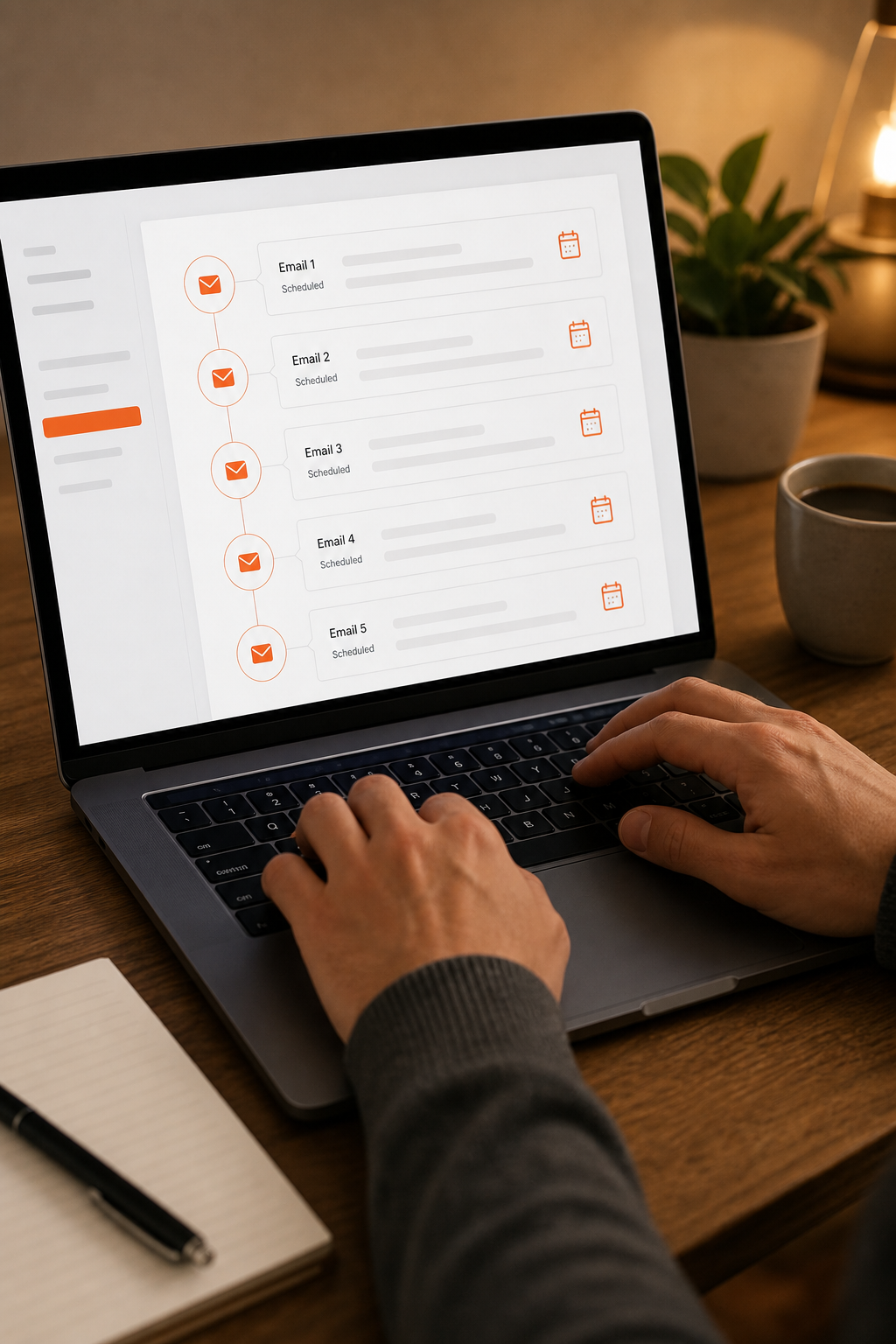
A standard non-fiction book funnel runs five to six emails. Here’s a structure that works:
- Email 1 (Day 0): Deliver the lead magnet. Keep it short. Link to the download, set expectations for what’s coming next, and tell them to reply if they have questions.
- Email 2 (Day 1-2): Teach one useful thing. No pitch. Just value. This builds trust faster than anything else.
- Email 3 (Day 3): Share your story. Why did you write the book? What problem were you trying to solve? Readers buy from authors they connect with.
- Email 4 (Day 4-5): Provide social proof. A reader result, a review, or a transformation story. This is where skeptics start to believe.
- Email 5 (Day 6): Make the soft pitch. Introduce your book as the natural next step. Explain what it covers, who it’s for, and link to the buy page.
- Email 6 (Day 8): Follow up with a reason to act now. A limited-time bonus, a price note, or simply a reminder that the offer is still open.
After someone buys the book, don’t let the funnel go quiet. That’s when you introduce your upsell. For non-fiction authors, the highest-value upsells are things that extend the book’s core transformation: a companion workbook, an audio version, a short course, or a group coaching program.
The research on this is hard to ignore. According to data cited across multiple author marketing sources, upsells and renewals can account for 70 to 95% of total revenue in an author’s business. Selling just the book and stopping there leaves most of the money on the table.
On the tool side, BookFunnel handles direct ebook sales and includes an upsell capability for each purchase, with automatic sales tax calculation built in. It integrates with Thrive Cart if you want a more strong checkout experience. That makes it one of the few funnel tools in this space with a named third-party integration, which matters when you’re building a system that needs to talk to your email platform and payment processor at the same time.
Many authors also offer an audiobook version as an upsell; the Best Platforms to Publish Audiobook Versions of Nonfiction Books article details the top services.
For authors who want to expand their revenue beyond the book itself, the book repurposing strategy guide at Bradley Johnson Productions covers how to turn one book into multiple income streams without writing a second book from scratch.
Step 5: Automate, Test, and Launch
Once all the pieces are in place, your job shifts from building to testing. A funnel that hasn’t been tested is just a guess. Small problems in the sequence, like a broken download link or a misfire in the automation timing, can silently kill your conversions for weeks before you notice.
Run through the funnel yourself first. Use a personal email address you don’t normally check, opt in as if you’re a new reader, and go through every step. Check that the lead magnet arrives. Check that each email fires on the right day. Click every link. Look at the thank-you page on mobile, because most of your readers will see it on a phone.
After that manual check, set up basic tracking. You don’t need anything complicated. Three numbers tell you almost everything:
- Landing page conversion rate: the percentage of visitors who opt in. A healthy rate for a non-fiction lead magnet page is 20 to 40%.
- Email open rate: how many subscribers open your emails. Industry benchmarks vary, but for a warm author list, 30% or above is a reasonable target.
- Book purchase conversion rate: how many email subscribers eventually buy. Even 5 to 10% is strong for a cold list.
If your landing page conversion rate is low, test the headline first. That single element has the most impact on whether someone opts in. If your email open rates are low, test the subject lines on emails 2 and 3. If people open but don’t buy, the pitch email (email 5) needs work, usually because the transition from value to offer feels abrupt.
According to the sales funnel model, the goal at each stage is to move a prospect one step closer to a decision, not to close them immediately. Keep that in mind when you read your metrics. A subscriber who opens every email but hasn’t bought yet isn’t a failure. They’re warming up.
For launch, pick a date and commit to it. Tell your existing audience, post on social media, and drive traffic to your landing page. Paid traffic works, but organic traffic from a blog post or a guest article can seed the funnel just as effectively at zero cost. Bradley Johnson Productions covers both organic and paid growth methods for non-fiction authors, and the right mix depends on your timeline and budget.
For those considering hiring external help, the Book Marketing Agency Packages for Indie Nonfiction Authors Cost guide breaks down pricing and what to expect.
Once the funnel is live, set a calendar reminder to review your three core metrics every two weeks. Don’t change more than one element at a time, or you won’t know what moved the needle. If you’re also thinking about how your book’s visibility on retail platforms affects funnel traffic, understanding Amazon algorithm optimization for authors can help you drive more organic discovery to the top of your funnel.
The funnel is never truly finished. Authors who treat it as a living system, one they test and adjust over months, consistently outperform those who build it once and walk away. Your book promotion strategy and your funnel should work together, with each channel feeding leads into the same automated sequence.
FAQ
What is a non-fiction book sales funnel?
A non-fiction book sales funnel is an automated system that moves a reader from first contact (usually a free offer) through a series of emails and pages until they buy your book or a related product. It replaces manual outreach with a sequence that runs on its own. Most author funnels include a lead magnet, a landing page, an email sequence, and an upsell offer positioned after the initial sale.
How many emails should be in my book funnel sequence?
Five to six emails is the standard starting point for a non-fiction book funnel. The first delivers your lead magnet, the middle emails build trust through value and story, and the final emails make the pitch and follow up. Research from funnel builders like Zenler suggests that longer sequences convert even better, but five is enough to test whether your core message resonates before you extend the series.
Do I need a separate website to build a book sales funnel?
No. You can build a functional funnel without a full website. Tools like BookFunnel handle ebook delivery and landing pages. Kit (formerly ConvertKit) handles opt-in forms and email sequences. If you want everything in one place, all-in-one platforms like Zenler include landing pages, email automation, and delivery under a single subscription. A standalone website helps long-term but isn’t required to launch your first funnel.
What’s the best lead magnet for a non-fiction author?
The best lead magnet solves one specific problem your ideal reader already has, and it should relate directly to your book’s topic. For most non-fiction authors, a one-page checklist or a free chapter converts well because both are fast to create and fast to consume. Email courses (3 to 5 emails) tend to convert subscribers to buyers at a higher rate because they build trust over several days before you make any pitch.
How do I drive traffic to my book funnel landing page?
The most reliable free traffic sources for non-fiction authors are a targeted blog post that links to the opt-in, a guest article on a relevant site, and mentions in your existing social media bio. Paid options like Facebook or Amazon ads can accelerate growth but require a tested funnel first. Start with one organic traffic source, confirm your landing page converts, then consider paid traffic once you know the numbers work.
Should I use an upsell in my book funnel?
Yes. An upsell dramatically increases revenue per reader without requiring new traffic. The best upsells for non-fiction authors extend the book’s core transformation: a companion workbook, an audio version, or a short course. Position the upsell immediately after purchase, when the reader is most engaged. Authors who skip upsells often find that book sales alone don’t cover their marketing costs, which makes the funnel feel like it isn’t working when the real issue is a missing backend offer.
Conclusion
A well-built sales funnel turns your book from a one-time transaction into a repeatable system. Start with a clear reader persona, pick one lead magnet format you can finish this week, and build the landing page and email sequence before you worry about anything else. If you want structured guidance on growing your readership through both organic and paid methods, the Author-CEO Mindset at Bradley Johnson Productions is a good next step for treating your writing career like the business it actually is.